

Vestas turbines to supply Sinan Ui offshore wind project
Turbine cost accounts for 35.5% of total construction expenses
Korea Development Bank approves support despite Vestas withdrawal of domestic factory plan
Government emphasizes 100% domestic sourcing rate for equipment excluding turbines
Vestas, a Danish company, will supply turbines for the Sinan Ui offshore wind project, the first investment project of the National Growth Fund aimed at fostering domestic industry.
The turbine price alone accounts for 27.6% of total project costs. Given that the project scale is 3.4 trillion won, this translates to roughly 900 billion won in simple calculation.
Vestas withdrew its plan to invest in a domestic production facility, citing insufficient business viability.
Korea Development Bank was aware of this fact during its review process but decided to provide 750 billion won in policy financing support, taking into account that equipment other than turbines would utilize domestic supply chains.
According to materials submitted by Korea Development Bank to Rep. Jo Jeong-hoon of the People Power Party, a member of the National Assembly's Political Affairs Committee, on September 22, 2026, the supply price of Vestas turbines installed at the Sinan Ui offshore wind project accounts for 35.5% of total construction costs and 27.6% of total project costs.
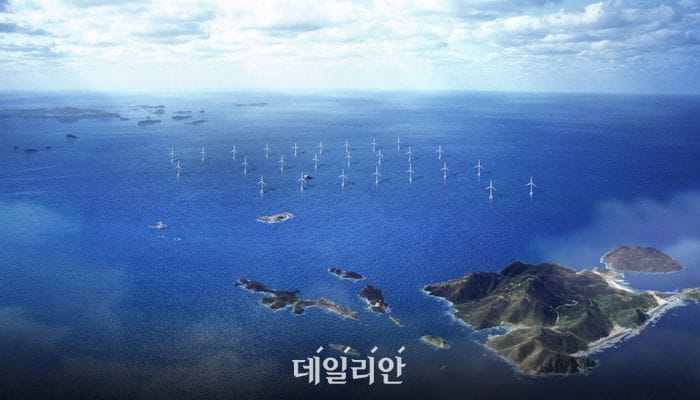
The Sinan Ui offshore wind project involves installing 26 turbines of 15 megawatt capacity near Ui Island in Sinan County, South Jeolla Province, to create a power generation complex with a total capacity of 390 megawatts.
Vestas products from Denmark will be used for the wind turbines, which are the core equipment of the power generation complex.
Korea Development Bank stated that the selection of Vestas turbines took into account price, delivery schedule, and the technical level of domestic companies.
Out of the total project cost of 3.4 trillion won, 750 billion won in total will be provided through long-term loan structure, comprising 700 billion won in senior debt and 50 billion won in subordinated debt, utilizing the Advanced Strategy Fund of the National Growth Fund.
Government emphasis on domestic industry impact
The government has emphasized domestic industry ripple effects since announcing the Sinan Ui project as the first investment project of the National Growth Fund.
When the Financial Services Commission decided to support Sinan Ui financing in January this year, it stated: "As the first large-scale offshore wind project pursued with purely domestic capital, it is expected to create synergy effects with domestic shipbuilding and cable industries." It explained at that time that the domestic sourcing rate for equipment excluding turbines was 97%, citing Ministry of Climate, Energy and Environment data. At the construction start ceremony on July 16, it emphasized 100% domestic sourcing rate for equipment excluding turbines.
Turbines, which account for 27.6% of total project costs, are considered core equipment for offshore wind power.
There are concerns that it is inappropriate to supply foreign turbines as core equipment while emphasizing 100% domestic sourcing rate for all other equipment.
Unclear domestic content in turbine manufacturing
The problem is that the extent to which domestic parts are included in turbines manufactured by Vestas remains unclear.
Korea Development Bank responded: "It is difficult to determine the domestic procurement ratio related to turbine manufacturing because the manufacturer Vestas does not disclose its suppliers."
Vestas announced in 2023 that it would invest 300 million dollars in Korea to establish production facilities for wind turbine core components and equipment and relocate its Asia-Pacific regional headquarters to Korea.
While the Asia-Pacific regional headquarters was subsequently relocated to Korea, the construction of the production facility planned in Mokpo has not yet begun. The company is postponing factory construction due to poor domestic orders and insufficient business viability.
Korea Development Bank's justification
Korea Development Bank stated: "We were aware during the review process that Vestas had withdrawn its domestic production facility investment plan," but added: "We took into account the utilization of domestic supply chains for substructures, submarine cables, and substations excluding turbines."
There was no contractual obligation requiring the contractor to enter into contracts with domestic subcontractors for work categories other than turbines.
Korea Development Bank explained: "If we were to mandate the use of domestic supply chains, it could constrain the contractor's autonomous process and cost management, risking delays in completion. There are structural limitations to establishing this as a mandatory condition in the agreement."
It further emphasized: "Although there is no related agreement, during the investment review process we established the construction contract amount based on the anticipated contract amount with domestic subcontractors, and we confirmed that actual contract negotiations have progressed substantially."
This represents an explanation that Korea Development Bank fulfilled its duty of care as fund manager to secure the maximum domestic procurement ratio.
Criticism from industry observers
A climate and energy sector official pointed out: "At a time when the government is promoting green technology localization and fostering domestic companies, it is necessary to examine what judgment led to the decision to use turbines from a company that withdrew its domestic production facility investment plan in a large-scale policy financing project."
Rep. Jo Jeong-hoon stated: "The issue is not foreign turbines themselves. If the government provided 750 billion won in policy financing while saying it would foster the domestic industrial ecosystem, the key question is what additional value was left in Korea with that money."
He added: "The government must clearly explain what additional effects were secured in terms of production, procurement, technology, and employment."
KWI developer profile — Hanwha Ocean
4 projects in Korea totalling 1,730 MW. Compiled from the KWI database. Not part of the source article.
Sinan Ui Offshore Wind — this article
|  |
ChilHae 1 Offshore Wind
| |
ChilHae 2 Offshore Wind
| |
Boryeong Nokdo Offshore Wind
| |
Related coverage
- KOMIPO launches Sinan-Ui 390MW offshore wind project toward 2040 CFE target — 2026-09-19
- LS Marine Solution secures Sinan Ui offshore wind subsea cable contract — 2026-09-18
- Hanwha Ocean Sinan-Ui offshore wind faces unresolved military coordination — 2026-09-17
- Sinan-Ui 3.4 trillion won offshore wind project evades feasibility review — 2026-09-07
Project data: KWI database — Electricity Business Licence records, EIA filings (ME2021C012, ME2026C003, ME2026C014), Electricity Regulatory Commission minutes, and pre-EBL permit filings.
Original Korean article: dailian.co.kr
English brief by Korea Wind Intelligence, koreawindintel.com



















