

The Sinan Ui offshore wind project is proceeding with construction without completing military operational coordination, according to reports. This mirrors an earlier case in which SK Innovation E&S, the developer of Jeonnam P1, began work without coordination and only resolved the issue after investing 550 billion won, raising concerns that the pattern is repeating.
The Sinan Ui offshore wind project, a 390 MW facility with a total project cost of 3.4 trillion won, is being jointly developed and constructed by Hanwha Ocean, which handles development, licensing, subsea cable and substructure work, and Hyundai E&C, which handles foundation, cable laying and offshore substation construction. KOMIPO (Korea Midland Power) and SK Eternix are equity investors, with KOMIPO operating the facility for 25 years after completion. The project uses 26 turbines rated at 15 MW each.
Since 2024, the Air Force has required radar obstruction mitigation measures for these 26 turbines, including height and position adjustments and supplementary radar installation. The Ministry of National Defense (MND) stated that an implementation agreement must be signed before implementation plan approval, but coordination has not been completed even after construction began in July of this year.
A precedent of delayed coordination
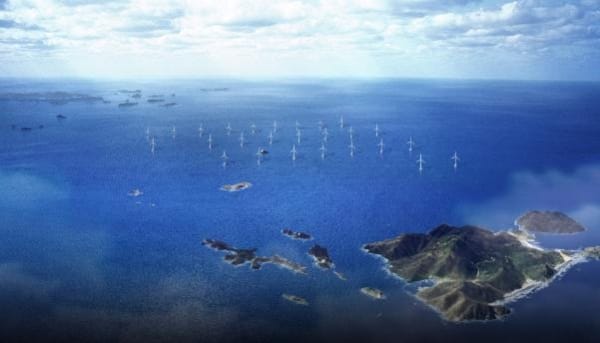
The problem has already materialized once before. In Jeonnam P1, developed by SK Innovation E&S and CIP, an Air Force review in 2021 found that 7 of 10 turbines created radar obstruction zones. Sinan County approved the implementation plan conditionally in 2022, and the developer began construction in March 2023 without Air Force agreement. MND discovered this eight months later, after 550 billion won of the total 800 billion won project cost had already been spent. The issue was resolved only after the Office for Government Coordination Mediation brokered an implementation agreement. The project was completed in December of last year.
Analysis by National Assembly Environment & Labor Cmte member Lee Heon-seung of MND and Jeonnam data shows this pattern repeats not only in individual projects but across the entire region. The government designated a 3,166 MW offshore wind integrated zone in Sinan waters, Jeonnam, worth approximately 19 trillion won, in April of last year, but military operational coordination had not been completed at that time. Reviews continued, and in December of last year the Ministry of Climate, Energy and Environment (MCEE) requested re-examination. However, the government increased the zone size to 3,697 MW in March of this year and only set a condition to complete coordination by December. SK Innovation, KEPCO and JNDC (Jeonnam Development Corporation) have been mentioned as related companies, and in the Imja area of Sinan County, Utop Construction separately received a generation licence for a 323 MW project targeting commercial operation in 2032.
Power grid capacity constraints
Power grid issues compound the problem. According to Lee Heon-seung's office, KEPCO has recovered approximately 9 GW of grid connection capacity since April 2024. Of this, the Honam region accounted for the largest regional recovery at 140 cases and 4 GW, followed by the Yeongnam region at 48 cases and 3.6 GW. The combined Honam and Yeongnam share was 84.5 percent of the total. This measure reallocates connection capacity from developers making no progress over extended periods, but it means that even with a licence, projects can be blocked if grid connection capacity is unavailable.
The government aims to increase domestic offshore wind capacity to 25 GW by 2035. However, if the pattern of military coordination and power grid securing being pushed back as project scale grows continues, concerns about delays and cost increases will mount. National Assembly member Lee Heon-seung said, "The practice of deferring Ministry of National Defense coordination until after projects begin must not be repeated. Major operational constraints such as radar obstruction must have mitigation measures established from the site selection stage."
KWI developer profile — Hanwha Ocean
4 projects in Korea totalling 1,730 MW. Compiled from the KWI database. Not part of the source article.
Sinan Ui Offshore Wind
|  |
ChilHae 1 Offshore Wind
| |
ChilHae 2 Offshore Wind
| |
Boryeong Nokdo Offshore Wind
| |
Project data: KWI database — Electricity Business Licence records, EIA filings (ME2021C012, ME2026C003, ME2026C014), Electricity Regulatory Commission minutes, and pre-EBL permit filings.
Original Korean article: Green Economy News
English brief by Korea Wind Intelligence, koreawindintel.com



















