Original Korean article: Money Today
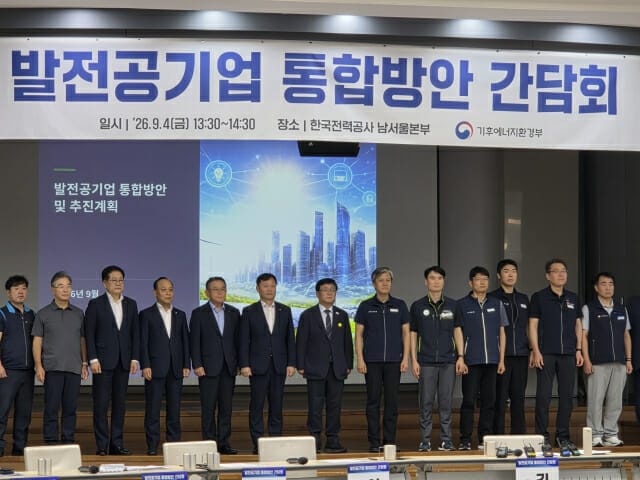
As the government reviews a plan to merge five power generation public enterprises under Korea Electric Power Corporation (KEPCO), experts have raised concerns that the consolidation could actually run counter to renewable energy expansion, regional balanced development, and power industry structural reform.
While the government's stated aim is to reduce redundant organizations by enlarging the public enterprise, increase investment capacity, and strengthen policy implementation for renewable energy expansion and coal phase-out, critics argue that creating a massive power generation public enterprise without addressing current problems in the electricity market could crowd out private investment and new industries, inflict damage on regions, and make future market reform more difficult.
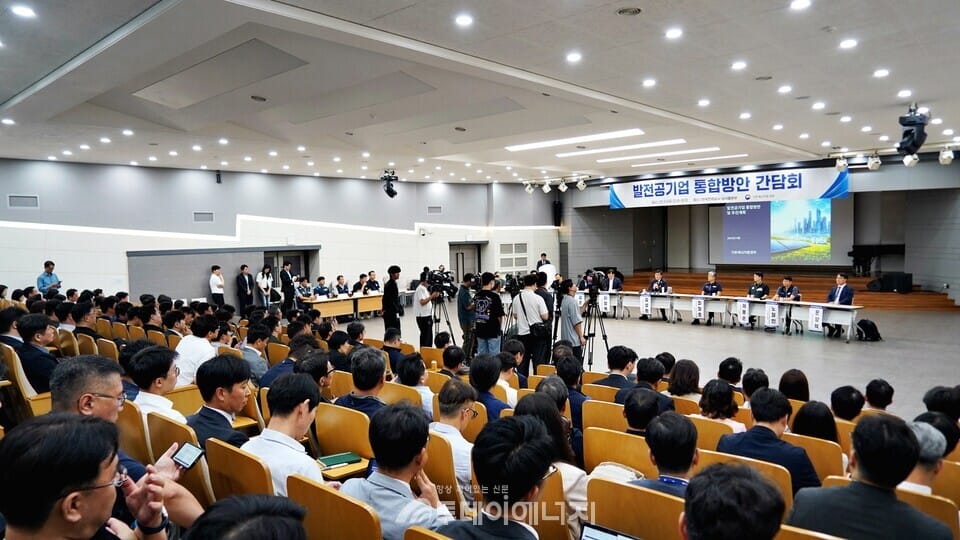
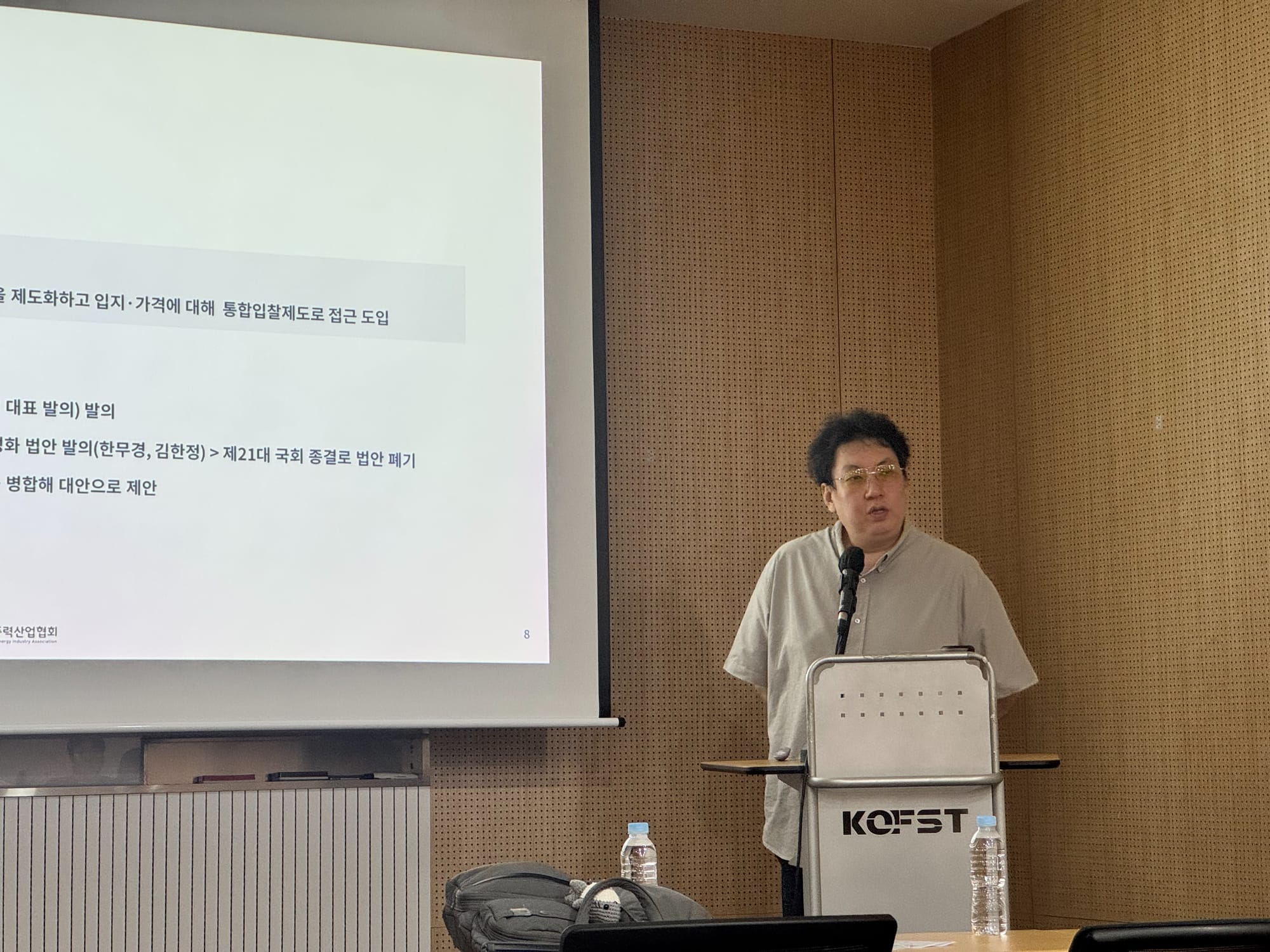
At a forum titled "How Should Power Generation Public Enterprises Be Reorganized in the Energy Transition Era," held on August 1 at the National Assembly Members' Hall by the National Assembly Climate Crisis and Carbon Neutral Economy Forum and Climate Solutions, three major categories of concern about the consolidation of power generation public enterprises emerged.
Renewable Energy Expansion and Grid Neutrality
The first concern is that the merger could work at cross-purposes with the policy goal of expanding renewable energy. One pathway through which renewable energy expansion could slow is deterioration of grid neutrality. Currently, even as KEPCO monopolizes transmission and distribution networks and serves as the parent company of power generation subsidiaries, private power developers have complained about delays in grid connection and reinforcement, and differences in compensation and settlement standards resulting from output control.
In this situation, if a massive merged public enterprise emerges from combining the five power generation companies, the conflict of interest between KEPCO and its generation subsidiaries could deepen, allowing unfair discrimination to become entrenched. In particular, if the integrated public enterprise's existing generators are prioritized when the grid becomes saturated while private renewable energy faces delayed connection or earlier output control, profitability and financing conditions would worsen, causing new projects to be delayed or cancelled and ultimately reducing both the pace of renewable energy deployment and actual generation output.
Professor Lee Yu-soo of Soongsil University noted that merging the five companies could make the integrated public enterprise a dominant player controlling more than 60 percent of wholesale power supply. In the current structure where KEPCO monopolizes transmission and distribution networks and holds 100 percent of power generation company shares, the creation of a large subsidiary could give affiliated power plants advantages over private renewable energy or distributed energy in grid connection and operation.
Kim Se-won, a researcher at Climate Solutions, argued that differences in grid connection and operating conditions between renewable energy and other power sources are already appearing. In 164 substations in Honam, new renewable energy connections are restricted until grid reinforcement is completed in 2031, while large power plants such as liquefied natural gas facilities have received business approval and grid connection. This conflict of interest structure means that simply enlarging the public enterprise could amplify grid neutrality problems.
Concerns were also raised that when the public sector directly enters businesses that the private sector could also undertake, it can dampen private investment and ultimately delay energy transition. Kim Hee-sung, chairman of Bright Energy Partners, said that limited public resources should be used as a catalyst to reduce the risk and financing costs of private projects rather than being invested in sectors where private capital could already enter. He emphasized that flexibility resources such as energy storage systems (ESS) should be fairly compensated for their contribution to reducing power grid expansion costs in order to attract private investment.
Lee Min-ho, head of power consulting firm "Slowly Beautiful Thinking" and a U.S. attorney, pointed out that the merged company's high market share could weaken the market's price discovery function. In the United States, power generators with significant market power can be regulated to bid based on actual generation costs rather than setting prices arbitrarily. When many generators engage in cost-based bidding, it becomes difficult for situations of power shortage or surplus to be adequately reflected in prices. If hourly price differences shrink, ESS developers who profit by storing electricity when it is cheap and selling when it is expensive would find it harder to generate returns, potentially weakening private investment incentives.
Regional Balanced Development
The second concern is conflict with regional balanced development. Currently, the headquarters of the five power generation companies are located in different regions. If a single integrated headquarters is established, the host region would attract personnel and tax revenue, but the other four regions could lose headquarters staff, partner companies, commercial activity, and emerging industry infrastructure. For regions already experiencing job and tax revenue losses from coal power plant closures, this would compound the impact.
Moon Hye-kyung, head of the Green Energy Team at Boryeong City, where Korea Midland Power (KOMIPO) headquarters is located, expressed concern that if a city with one power generation public enterprise loses its headquarters to another region, it would be difficult to maintain energy transition momentum. According to Boryeong City's estimate, more than 8,000 people including KOMIPO headquarters staff, partner company employees, and their families could leave. The city noted that not only the commercial district formed around the headquarters but also the workforce and expertise for regional renewable energy projects could be weakened.
An alternative was proposed to use each power generation company as a regional energy transition hub. The evaluation criteria for each company would shift from generation cost and capacity factor to carbon neutrality and grid flexibility, with each company undertaking projects suited to regional characteristics such as offshore wind and hydrogen. The argument was that converting existing organizations and personnel to new regional industries would better align with balanced development and just transition than consolidating scattered public institutions into one location.
The government viewed the headquarters relocation itself as having limited impact on regional tax revenue. Kang Kyung-taek, director of the Power Industry Policy Division at the Ministry of Climate, Energy and Environment (MCEE), stated that "a simple headquarters relocation does not appear to have a large tax impact, and the impact on local tax revenue and employment would be significant when power plants actually cease operations," adding that the government would hear regional views while reviewing coal phase-out and just transition plans. However, Moon argued that review of the ripple effects of headquarters relocation on regional economies, including industry, employment, and commercial activity, not just tax revenue, has been insufficient.
Market Reform and Structural Order
The third criticism is that the order of policy implementation is backwards. Panelists agreed that the government should first draw a blueprint for the future electricity market, define the roles of public and private sectors within that framework, and then determine the number and function of power generation public enterprises.
South Korea divided KEPCO's power generation operations into six companies in 2001, after which power industry structural reform has essentially stalled. The Cost-Based Pool (CBP), which was meant to be a transitional mechanism, has continued for 25 years, and KEPCO continues to monopolize both transmission and distribution networks and power sales. As a result, price signals and competition do not function properly, and entry by renewable energy, ESS, and new power industries remains difficult.
Professor Lee Yu-soo argued that market design should be presented first, and the scope and method of consolidation should be determined accordingly. He stated that "organizational restructuring could become a foundation for market concentration rather than a foundation for market reform." Jeong Hoon, a research fellow at the National Assembly Futures Institute, also noted that the government should first determine power grid expansion, market structure improvement, handling of stranded coal assets, and the role of public enterprises before proposing organizational restructuring.
Kang Kyung-taek of the MCEE's Power Industry Policy Division explained that the "single company merger plan" is a recommendation from Samil Accounting Corporation's interim report and has not yet been confirmed as the government's position. Kang stated that the government is "taking into account" concerns about market dominance, grid neutrality, and private investment dampening, and aims to "finalize and announce the government plan by the end of this year and present a future timeline."