SK ecoplant to sell 35.62% stake for 410 billion won
SK Ocean Plant's largest shareholder will change from SK ecoplant to the D'Ocean consortium. While uncertainty surrounding the company's stake sale has been resolved, how the new largest shareholder will navigate the revenue gap from offshore wind projects has emerged as an immediate challenge.
SK Ocean Plant announced on August 31 that SK ecoplant, its largest shareholder, has concluded a stock purchase agreement to sell its entire 35.62% stake to the D'Ocean consortium.
The sale covers 22.26 million ordinary shares of SK Ocean Plant held by SK ecoplant, with a transaction value of 410 billion won. The buyer is D'Ocean Asset Management, with Osung Advanced Materials participating as a co-investor in the consortium. The transaction is scheduled to close in December.
This agreement follows the selection of the D'Ocean consortium as the preferred bidder for SK Ocean Plant's stake sale on July 31. If the transaction closes as planned, SK Ocean Plant will cease to be a subsidiary of SK ecoplant and will have D'Ocean Asset Management as its new largest shareholder.
SK Ocean Plant operates in shipbuilding and marine engineering, with offshore wind substructures as its core business. SK ecoplant acquired the predecessor company Samgang M&T through a stock purchase agreement in November 2021 and incorporated it as a subsidiary.
Stake sale uncertainty resolved, but revenue gap expected through 2027
The market views the conclusion of this agreement as substantially resolving the uncertainty surrounding SK Ocean Plant's largest shareholder stake sale that had persisted for months. The identity of the new largest shareholder and its future investment direction had remained variables affecting stock price and business prospects. Securities firms have also identified resolution of the sale issue as a prerequisite for a stock price rebound at SK Ocean Plant. DS Investment Securities stated in a report last month that resolving the sale issue and construction start on the Anma offshore wind project would be necessary for a future stock price recovery.
The business itself shows solid profitability. SK Ocean Plant's second quarter revenue this year was 170.5 billion won, down 29.1% from the same period last year, but operating profit was 19.3 billion won, up 24.4%. As the offshore wind revenue share rose from 44% in the same period last year to 62%, the operating profit margin also increased from 6.5% to 11.3%. Operating profit exceeded market consensus of 15.9 billion won by 21.7%.
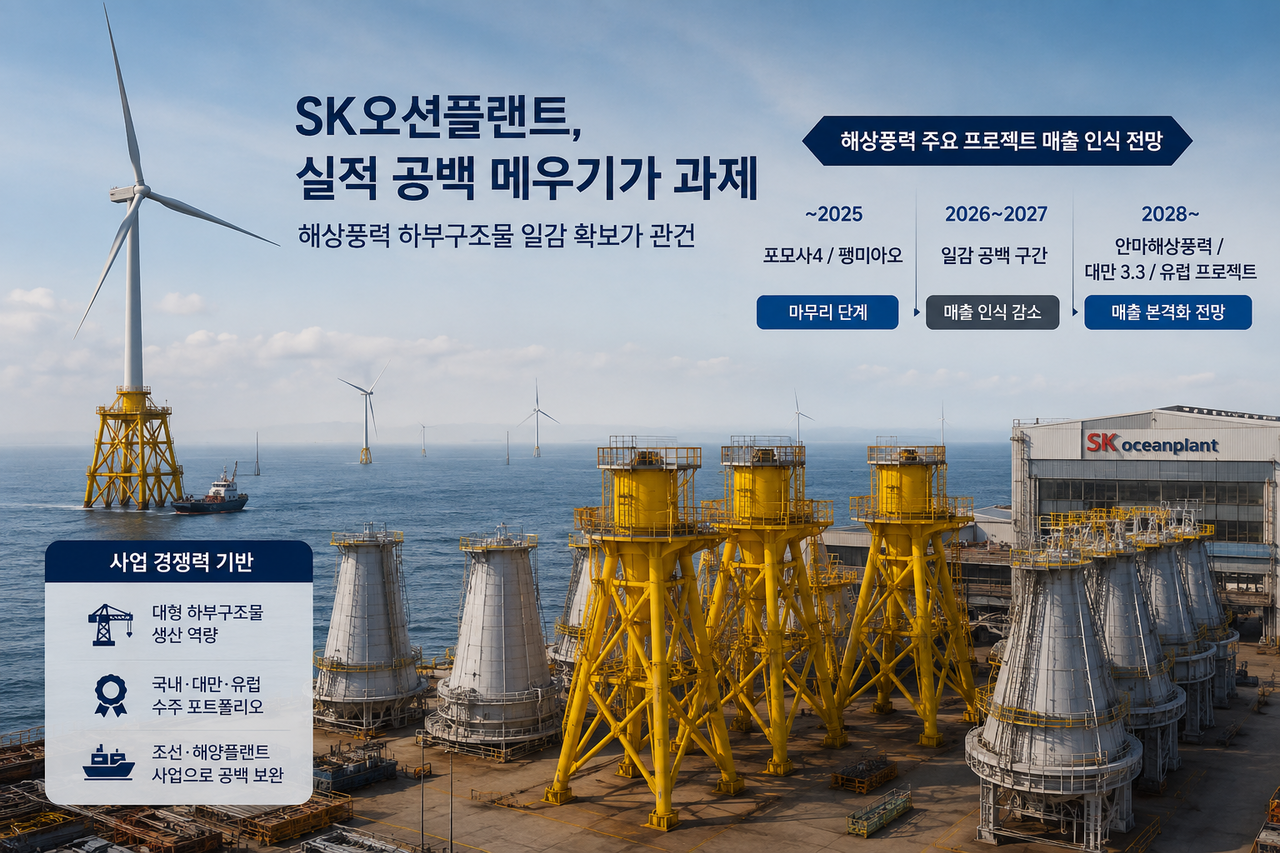
The immediate issue is the timing of revenue recognition from projects. While the Taiwan Formosa 4 and Pengmiao projects that currently support offshore wind revenue are entering their final stages, the Anma offshore wind project, which was expected as a major follow-up volume, has experienced schedule delays, creating a gap between projects.
The Anma offshore wind project has experienced schedule delays, pushing back the substructure supply volume assigned to SK Ocean Plant from the original plan. Securities firms estimate this volume at approximately 380 billion won. In its second quarter investor relations materials, SK Ocean Plant anticipated that offshore wind revenue for this year would fall short of existing guidance due to delays in Anma offshore wind construction originally scheduled for the second half. However, the Taiwan Formosa 4 and Pengmiao projects are proceeding normally.
Securities firms view this timing gap between projects as a key variable affecting SK Ocean Plant's near-term earnings. Kyobo Securities forecasts that 2027 will be a trough period for earnings as delays in Anma offshore wind revenue recognition coincide with the end of existing offshore wind projects. It lowered this year's revenue estimate from 732.3 billion won to 650 billion won, a 11.2% reduction, and next year from 1.0948 trillion won to 700.8 billion won, a 36% reduction. It also downwardly revised next year's operating profit forecast by 61.6%, from 122.9 billion won to 47.2 billion won.
European offshore wind and shipbuilding as breakthrough strategies
However, the market does not view this as a weakening of SK Ocean Plant's offshore wind bidding competitiveness. Rather, the expansion of the existing domestic and Taiwan-focused order market to Europe is cited as a medium to long-term growth factor.
SK Ocean Plant entered the European market for the first time in July by winning an order for jackets, the substructure for an offshore substation on a German North Sea offshore wind project. Taiwan also has follow-up offshore wind orders planned, including Round 3.3. Eugene Investment Securities expects earnings growth to accelerate from 2028 when supply volumes from domestic, Taiwan, and European projects overlap, forecasting revenue of 1.563 trillion won and operating profit of 122.1 billion won for that year.
SK Ocean Plant is also pursuing a strategy to fill gaps between offshore wind projects with shipbuilding and marine plant business. In particular, on August 31 it concluded a 592.9 billion won supply contract with a Greek shipowner for six 115K DWT crude oil tankers. This represents 61.41% of last year's consolidated revenue, with a contract period through June 2030. The contract also includes options for two additional crude oil tankers.
In July, it also won an order for two 6,800 DWT stainless steel chemical tankers for approximately 71.8 billion won. It plans to participate in U.S. Navy maintenance, repair and overhaul operations by acquiring a U.S. Navy Ship Repair Agreement. As a timing gap exists before revenue recognition from new offshore wind projects, the company is supplementing the work gap through commercial vessel orders.
For SK ecoplant, this sale represents a continuation of business rebalancing pursued at the group level. SK ecoplant has recently shifted its focus to advanced facility construction related to semiconductors and artificial intelligence, and to AI infrastructure businesses including semiconductor materials and industrial gases. SK ecoplant plans to use the 410 billion won it will secure from this sale to improve its financial structure through debt repayment.
An SK ecoplant official said, "We will continue to strengthen the distinctive competitiveness of our AI infrastructure-focused business model centered on semiconductors and AI, and enhance financial soundness."
KWI developer profile — SK ecoplant
5 projects in Korea totalling 2,232 MW. Compiled from the KWI database. Not part of the source article.
Jindo Maenggoldo (fixed) Offshore Wind
|  |
Geomundo floating Offshore Wind
| |
Yeonggwang Eco 1 Offshore Wind
| |
Yeonggwang Eco 2 Offshore Wind
| |
Ulsan Dongnam Hae-ahn Offshore Wind
| |
Project data: KWI database — Electricity Business Licence records, EIA filings (ME2025C014, ME2025C017), Electricity Regulatory Commission minutes, and pre-EBL permit filings.
Original Korean article: Electric Times