

Editor's note: The government is accelerating the rollout of renewable energy to supply 100 gigawatts or more by 2030. Meanwhile, the Renewable Portfolio Standard (RPS), which has underpinned renewable energy deployment for 15 years, will cease to apply to new projects after this year and will transition to a long-term fixed-price contract market from next year. The government aims to stabilize prices and lower generation costs, but whether the new pricing system will adequately support investment and local income remains uncertain. Honam and Gwangju, where large-scale offshore wind and community-based solar projects are concentrated, will be directly affected by the system transition. Namdo Ilbo will examine the gap between the government's renewable energy expansion targets and market realities after RPS in three installments.
As the government accelerates its push to supply 100 gigawatts or more of renewable energy by 2030, a 39.3 trillion won offshore wind project under way in Honam and Gwangju will face a new profitability test from next year. With renewable energy certificates (RECs) disappearing for new projects, how much the new preferential pricing reflects the additional costs of deep-water and distant-offshore development will determine financing and project viability.
According to MCEE (Ministry of Climate, Energy and Environment) and others on October 19, 2026, the amended Renewable Energy Development, Use and Promotion Act will take effect on January 1 next year. New renewable energy projects will shift to a model in which the government presents supply volumes and price ceilings by generation source, developers participate in competitive auctions, and selected developers trade power with KEPCO (Korea Electric Power Corporation) at long-term fixed prices.
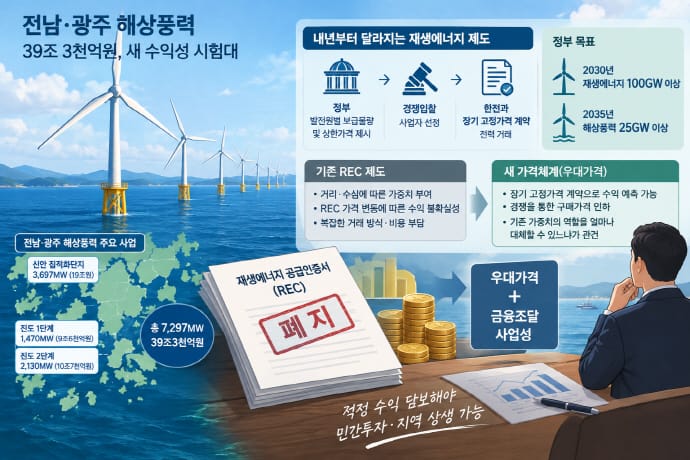
The government's policy direction is aligned with renewable energy expansion. The targets are 100 gigawatts or more of renewable energy by 2030 and 25 gigawatts or more of offshore wind by 2035.
The government cites the limitations of the existing RPS: uncertainty in project revenue due to REC price volatility and cost burdens from complex weighting and trading methods. The plan is to make developer income more predictable through long-term fixed-price contracts and to lower renewable energy purchase prices by introducing competition within price ceilings.
The role of REC multipliers in Honam and Gwangju
The critical question for Honam and Gwangju is how much the new pricing system can replace the role that existing REC multipliers have played.
Offshore wind costs increase as distance from shore grows, with longer subsea cables, and as water depth increases, with higher foundation and installation expenses. Operations and maintenance costs also rise. Under the existing system, REC multipliers were adjusted based on project conditions such as distance and water depth to offset these cost differences.
Honam and Gwangju are sensitive to the system transition because of project scale.
The Sinan offshore wind integrated zone (OWIZ) is planned at up to 3,697 megawatts and 19 trillion won. Jindo is pursuing Phase 1 at 1,470 megawatts and 9.6 trillion won, and Phase 2 at 2,130 megawatts and 10.7 trillion won. Combined, they reach up to 7,297 megawatts with a total project cost of 39.3 trillion won.
The entire 7.3 gigawatts will not immediately shift to the new contract market. Existing developers can in principle continue to receive RECs for up to 20 years, and the spot market will remain in place until the end of 2029. Depending on project stage and whether transitional provisions apply, some projects will fall under the existing system and others under the new contract market.
Profitability of new projects under the new system
The critical issue is the profitability of new projects going forward. The impact of the new pricing system on project viability can be gauged through the revenue structure of existing offshore wind projects.
For the Sinan Ui offshore wind project, which operates under the existing REC system, developer estimates submitted to the National Assembly by the Korea Development Bank (KDB) show that of projected operating revenue of 7.0939 trillion won from 2029 to 2048, power sales revenue is 1.8288 trillion won and REC sales revenue is 5.2651 trillion won. REC revenue accounts for 74.2 percent of the total. The applied REC multiplier is 3.173.
Since RECs have made up a substantial portion of long-term revenue in existing offshore wind projects, the preferential pricing that replaces them is directly linked to financing for new projects. Offshore wind, which requires trillions of won in project costs, will secure project financing based on expected future generation revenue. Long-term projected income becomes the key benchmark determining loan size, interest rates and investor required returns.
If preferential pricing fails to adequately replace the revenue that existing multipliers provided, the result is not merely reduced developer profit. The project financing terms themselves could change.
Local benefits and the wind income model
The share flowing back to local communities is also at stake. The Sinan and Jindo OWIZs have been pursued with local residents and fishermen participating in projects and sharing generation revenue as a major pillar. The government also plans to expand the "wind income" model of sharing offshore wind revenue with local communities.
Ultimately, raising renewable energy supply targets alone does not automatically attract private investment. Even if long-term contracts reduce price volatility risk, if the new pricing system fails to adequately reflect the additional costs of projects pursued in distant waters like Sinan and Jindo, it could hinder efforts to attract large-scale private capital.
An offshore wind industry official said: "As projects move to more distant waters, costs rise due to distance and depth, and existing systems reflected that through REC multipliers. With RECs gone, preferential pricing must perform the role of existing multipliers for projects to continue."
An official from the Honam-Gwangju Integrated Special City said: "The city is quite concerned, and developers are also worried about adequate returns. The government has explained through preferential pricing and other measures that it will compensate to some degree to the level of current REC receipts, but no detailed simulations have been made public. To ensure developer profitability, the position in broad terms is that the government must institutionally establish a system that can guarantee current price levels."
Original Korean article: Namdo Ilbo
English brief by Korea Wind Intelligence, koreawindintel.com



















