

The competitive arena in the offshore wind market is expanding from wind turbines to the power grids that carry electricity. Submarine cables that bring power generated at sea to land, and transmission networks that connect them reliably, are emerging as critical infrastructure that determines the success or failure of offshore wind projects. LS is accelerating its business initiatives and broadening its scope to integrated power grid operations that connect production, construction, maintenance and high-voltage direct current (HVDC).
According to industry sources, LS Marine Solution signed a contract worth approximately 156.9 billion won with Hanwha Ocean on September 18 for submarine cable construction on the Sinan Ui offshore wind project in South Jeolla Province. This is the largest contract since the company's founding, equivalent to approximately 2.2 times the separate revenue of 72.2 billion won recorded in 2025.
The Sinan Ui project is being pursued at a scale of 390 megawatts and is significant as the first project in the Sinan Offshore Wind Belt, which will eventually be developed at a total scale of 8.2 gigawatts. LS Marine Solution will be responsible for the entire submarine cable construction process, including transportation, laying and burial, from the second half of 2026 through 2028.
LS Cable's market vision does not stop at Sinan Ui alone. In May, LS Cable and LS Marine Solution were each selected as preferred negotiation partners for submarine cable supply and construction on the Sinan Haesong Offshore Wind project being pursued in the Sinan waters of South Jeolla Province. This project, with a total capacity of 1 gigawatt, consists of two facilities of 504 megawatts each.
Notably, in the Haesong project, LS Cable supplies the cable while LS Marine Solution handles construction. Rather than separating production and construction, this strengthens turnkey capabilities that connect design, supply and offshore construction. The use of domestic supply chains while cooperating with global developers is also noteworthy.
However, stability of revenue in the offshore wind market is not guaranteed by contract signing alone. LS Cable and LS Marine Solution experienced the cancellation of a supply and construction contract worth a total of 271.1 billion won on the Anmae offshore wind project in 2026. This resulted from the developer's project suspension and demonstrates that in offshore wind projects, the developer's financing, licensing and business viability are as important as construction start and equipment orders.
LS expands offshore wind order map with turnkey production and construction strategy
Industry observers assess that the competitive advantage LS seeks to secure in offshore wind is moving closer to the ability to connect through to the power generation stage rather than one-off projects.
However, as offshore wind expands, another challenge emerges. There is growing recognition that increasing generation capacity and delivering produced electricity to consumption areas are separate issues.
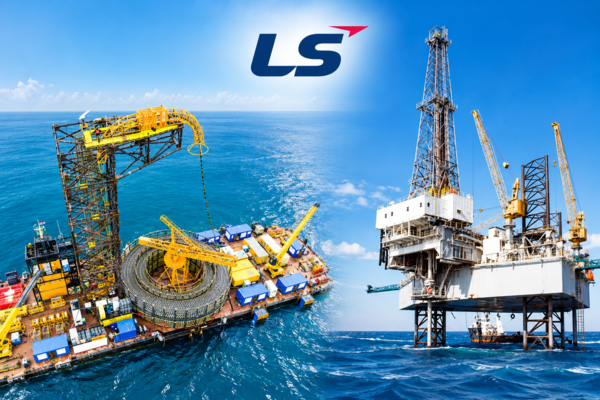
LS Cable is positioning submarine cables and high-voltage direct current (HVDC) as core pillars alongside offshore wind expansion. In particular, LS Marine Solution is constructing a next-generation submarine cable laying vessel with a target delivery date in the first half of 2028. This vessel can carry approximately 13,000 tons of cable and is aimed at long-distance HVDC and offshore wind power grid construction.
LS Marine Solution plans to use its existing laying vessel GL2030 and the new ship to respond to large-scale power grid projects such as the West Sea HVDC Energy Expressway being pursued by the government. The strategy is not merely to bring power generated from offshore wind to land, but to connect to national power grid projects that move large-scale electricity over long distances.
LS Cable's business expansion is also evident in the division of roles among its subsidiaries. LS Cable focuses on submarine cables, while LS Marine Solution strengthens submarine cable construction and marine infrastructure capabilities. LS Materials is pursuing ultracapacitors for pitch control systems in wind turbines and renewable energy grid stabilization projects, while Gaon Cable and LS Eco Energy are expanding investment and operations related to submarine cables and offshore wind.
From submarine cables to HVDC: preemptive response to power grid bottlenecks
LS Cable and LS Marine Solution showcased submarine cables that bring offshore wind power to land, superconducting cables for large-capacity power transmission, and environmentally friendly materials and waste cable recycling technology at the 2026 Climate Industry International Expo held in September. The direction is not only to switch to environmentally friendly power sources but to transform the process of delivering electricity into an environmentally friendly power grid.
LS Cable's performance and investment flows support this strategy. The company recorded consolidated revenue of 7.588 trillion won and operating profit of 279.8 billion won in 2025, with order backlog at the end of that year totaling approximately 7.63 trillion won. LS Marine Solution also recorded 2025 revenue of 244.2 billion won, a 87.4 percent increase from the previous year. The expansion of submarine cable and power grid demand is establishing itself as a growth driver for related businesses within the group.
Offshore wind can no longer be explained simply as the business of installing wind turbines at sea. The entire system of moving electricity generated by turbines through submarine cables, connecting it to large-scale transmission networks such as HVDC, and operating it reliably is being bound together as a single industrial ecosystem.
This is why LS Cable is broadening its business scope from submarine cable production to offshore construction, large laying vessels, HVDC, grid stabilization and resource circulation. The strategy targets a structure in which expansion of offshore wind becomes expansion of submarine power grids, and power grid investment in turn leads to growth in the cable and construction markets.
Industry analysts assess that the key to LS's offshore wind strategy lies in how reliably it can connect electricity made at sea to land and distribution power grids. If offshore wind is the symbol of energy transition, submarine cables and HVDC are the infrastructure that transforms that transition into electricity in practice.
KWI developer profile — Hanwha Ocean
4 projects in Korea totalling 1,730 MW. Compiled from the KWI database. Not part of the source article.
Sinan Ui Offshore Wind — this article
|  |
ChilHae 1 Offshore Wind
| |
ChilHae 2 Offshore Wind
| |
Boryeong Nokdo Offshore Wind
| |
Related coverage
- Sinan-Ui offshore wind support may burden taxpayers with REC costs — 2026-10-07
- Swiss Re leads Sinan Ui offshore wind construction insurance syndicate — 2026-10-02
- Sinan-Ui offshore wind taps Vestas turbines despite domestic growth fund mandate — 2026-09-23
Project data: KWI database — Electricity Business Licence records, EIA filings (ME2021C012, ME2026C003, ME2026C014), Electricity Regulatory Commission minutes, and pre-EBL permit filings.



















