

Domestic turbine preference in auctions, but developers bear adoption risk
Insufficient commercial operation track record for domestic offshore wind turbines is creating a financing bottleneck for developers seeking to adopt them. The government encourages domestic turbine deployment to foster the domestic supply chain, but developers face a structural paradox: to build up the operating track record that financial institutions demand, they must first construct power plants. Industry observers warn that if the current market structure leaves manufacturers and developers to shoulder the initial project risk alone, financing will stall, delaying both the accumulation of domestic turbine operating records and subsequent deployment.
Financial institutions demand additional credit enhancement despite auction wins
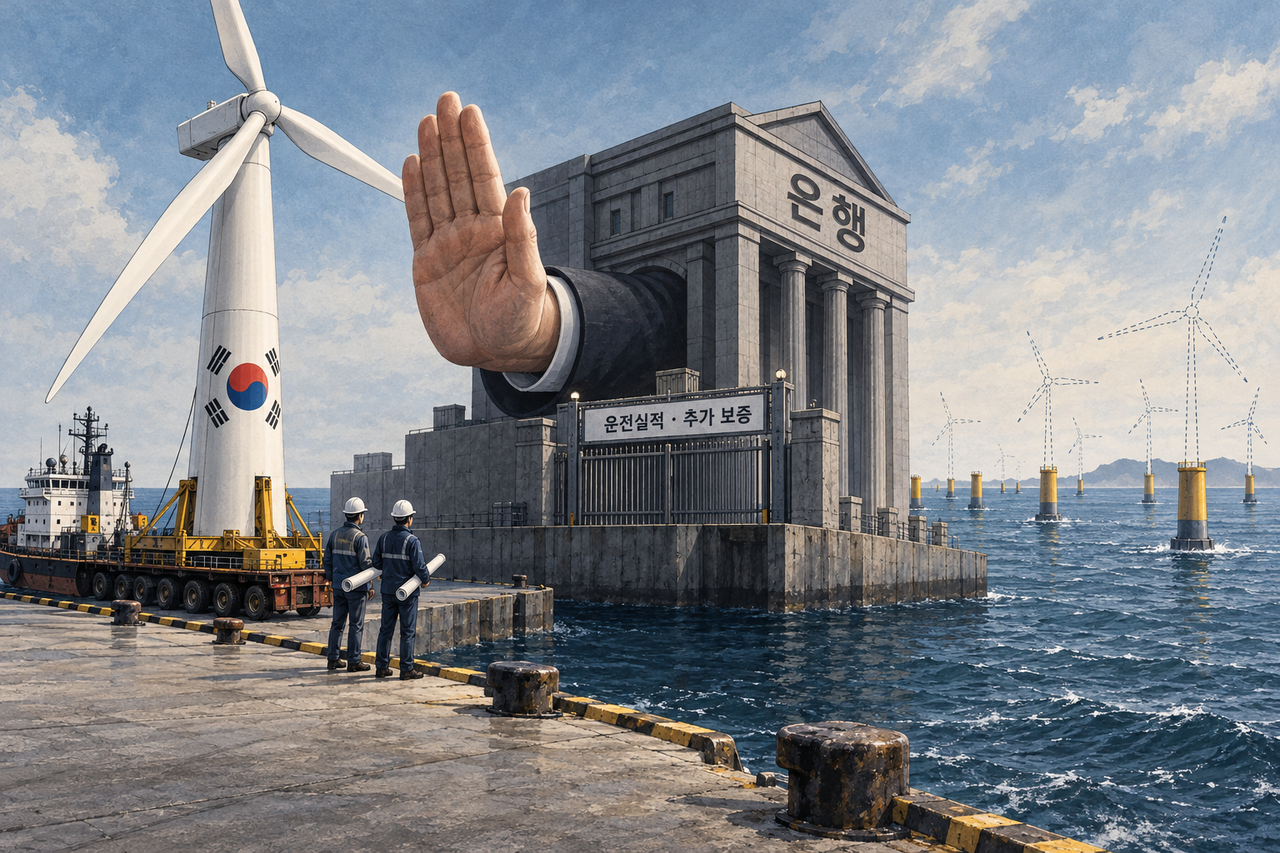
As of October 19, according to the offshore wind industry, developers adopting domestic turbines are growing concerned that even if they win a fixed-price contract competitive auction, they may face additional credit enhancement burdens such as extra guarantees during the project finance stage. This is because although they may receive recognition for domestic supply chain contribution in the auction, financial review requires separate proof of the turbine's long-term operating track record and the manufacturer's ability to honour warranty obligations.
The problem is that the guarantee burden needed to compensate for insufficient operating track record may exceed what manufacturers and developers can bear. In such cases, even after winning the auction, developers may fail to secure construction financing, delaying construction start. This has lent credibility to the argument that supporting domestic turbine deployment requires not just auction preference but also a mechanism to share the financing burden of initial projects.
Financial institutions assess lending decisions and loan amounts based on whether a power plant can stably generate electricity and repay principal and interest over the loan period. Turbine failure frequency and maintenance duration affect power generation, while parts supply and maintenance costs impact revenue. Whether a manufacturer can fulfil repair and compensation obligations when problems arise also underpins lending decisions.
One energy industry official familiar with financial matters explained: "Offshore wind project finance requires not only future cash flows but also contract structure and risk allocation mechanisms. Even with favourable cash flows, if it is not clearly stated in the contract who bears responsibility when a turbine accident occurs, financing becomes difficult."
Gap between technical certification and financial viability
Developers point out a large gap between domestically recognised technical certification and the financial viability that financial institutions assess. Even if certification validates that design and performance meet standards, it is difficult to fully prove what capacity factor will be maintained over long-term commercial operation and how much maintenance will cost.
The possibility that financial institutions will conservatively estimate power generation revenue or demand additional guarantees due to insufficient operating track record also creates uncertainty for projects. Winning a fixed-price contract competitive auction does not resolve all financing issues.
One developer official noted: "Although fixed-price auction wins reduce sales uncertainty, domestic turbines whose long-term operating performance has not been sufficiently validated still carry the risk that breakdowns or prolonged maintenance will reduce power generation and revenue. If financial institutions value expected revenue conservatively, the available loan amount shrinks, forcing developers to cover the shortfall through additional equity investment. When guarantee fees and interest burdens increase, the profitability anticipated at auction time falls."
Vicious cycle: operating track record needed to secure financing, financing needed to build track record
This creates a possibility of a vicious cycle in which the financial hurdle demanding operating track record actually blocks the opportunity to accumulate it. To secure domestic turbine commercial operation records, developers must finance and build power plants. But if financing is blocked due to insufficient track record, they have little chance to meet the conditions financial institutions demand. The paradox is that you need a loan to build a track record, and you need a track record to get a loan.
Some observers note that even public-led projects involving state-owned enterprises cannot easily assume optimistic financing prospects under these conditions. State-owned enterprise equity participation alone cannot guarantee the additional equity investment or debt guarantees that financial institutions demand.
The key question is the scope of support state-owned enterprises will bear when project costs rise or power generation revenue falls. Because additional capital injection requires separate decision-making and commitment, if financial institutions' demands and state-owned enterprise support scope diverge, the burden of securing shortfall funds may fall on private developers. Industry analysis suggests that if public-led projects cannot narrow this gap, financial commitment and construction start may be delayed.
Industry calls for public risk-sharing until domestic turbine track record builds
The industry is therefore demanding that government and the public sector share the risk of initial projects until domestic turbine operating track records accumulate. The argument is that if manufacturer performance guarantees and developer construction and operation responsibility alone cannot meet financial institutions' requirements, the public sector must support financing.
Proposed support mechanisms include partial guarantees from policy finance such as the National Growth Fund and subordinated loans. The intent is to reduce private financial institutions' loss risk and, for projects involving state-owned enterprises, to pre-establish the scope of additional equity investment or reserve fund support, thereby reducing financing uncertainty.
One domestic developer official stressed: "The success or failure of the domestic turbine policy depends not on how many domestic turbines are selected in auctions, but on whether selected projects actually succeed in financing and proceed to commercial operation. If the government has induced the use of domestic turbines, it must also bear the policy responsibility to ensure that actual financial close and construction start follow."
Original Korean article: Electric Times
English brief by Korea Wind Intelligence, koreawindintel.com



















