

Manufacturing strength masks supply chain fragility
"The market has failed to establish itself properly for over a decade, so the domestic supply chain foundation is not as solid as it appears on the surface. The government must understand this market situation sensitively and present appropriate bidding prices."
Choi Duk-hwan, external cooperation director at the Korea Wind Energy Industry Association, made this statement on October 19 at a seminar titled "Is Korean Offshore Wind Really Expensive?" co-hosted by the association and the Energy Transition Forum at the FKI building in Seoul. He said that "even if the upper limit price for the second half bidding is frozen or reduced, it should be reduced by only about 1 won."
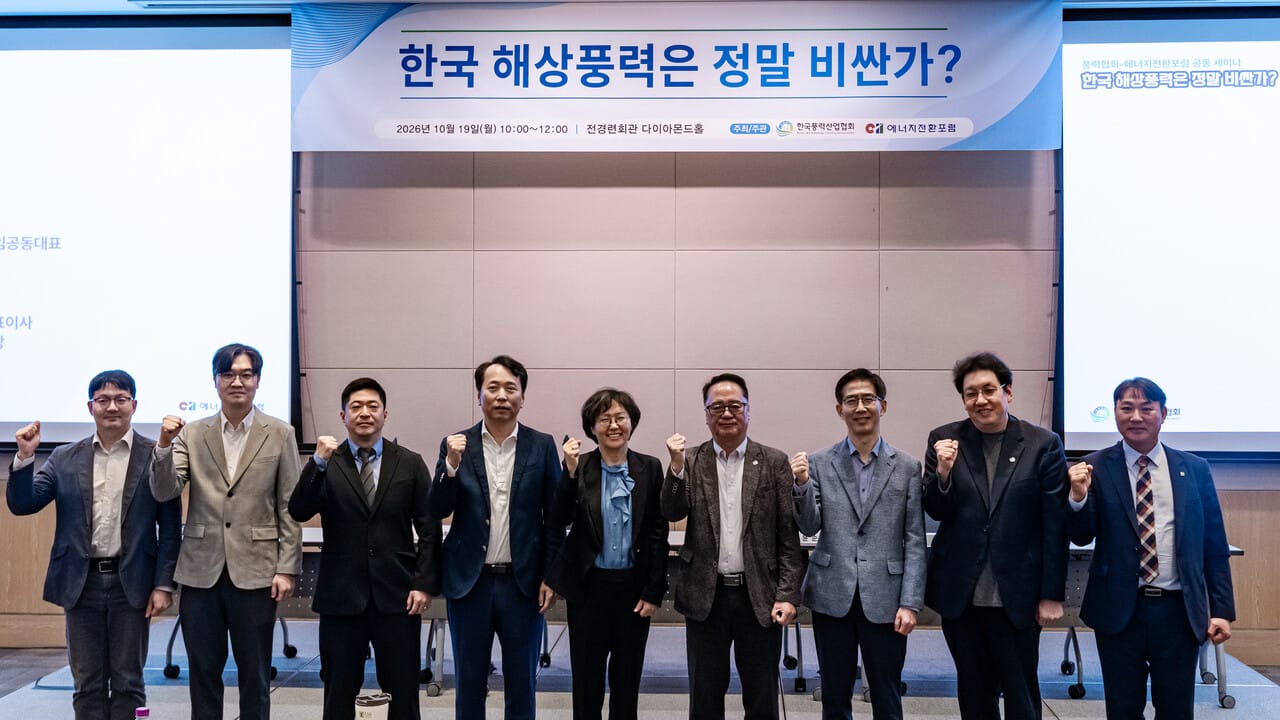
On that day, Choi presented findings on "domestic offshore wind cost characteristics" based on a research report conducted with Rystad Energy. He warned that if price reductions are pushed as they have been, the domestic supply chain could collapse when raw material and financing costs have increased before economies of scale are achieved.
He then highlighted the gap between the competitiveness of Korea's steel and manufacturing industries and the actual state of the wind power supply chain. A typical example is that domestic turbine manufacturers cannot find domestic tower suppliers when preparing bids with developers and must discover new ones. Some existing companies have withdrawn from the market because they cannot expect continuous orders. According to Choi, while some companies say they would resume production if the market opens stably, it is difficult to maintain operations while waiting indefinitely.
Choi said, "There are virtually no manufacturing companies that work exclusively in wind power domestically. Even the few remaining have survived by operating in other sectors as well. There is also a statistic that when new wind manufacturing companies enter the market, only one out of three remains after four years."
The fact that the number of domestic turbine developers fell from eight at the time of the Southwest Offshore Wind initiative in 2011 to just two companies today is cited as an example of losing industrial foundation due to prolonged project delays.
Bidding volume does not guarantee supply chain work
Increased bidding volumes do not immediately secure work for the supply chain. Domestic offshore wind projects have 20 awarded contracts totaling 5.9 gigawatts, but only three projects with 0.86 gigawatts have begun construction, representing just 14.5 percent of total awarded capacity. Even after winning a bid, projects must go through project financing and final licensing, and if costs rise during this period, whether construction will proceed becomes unclear. The point is that the fact that a project was awarded at a specific price should not be taken to mean that the project can be completed at that price.
With the supply chain in this weakened state, further price reductions would likely shift the burden first to equipment and service suppliers. Developers would demand lower supply prices rather than reduce their own margins, and if profitability still cannot be achieved, they may abandon projects or turn to cheaper foreign alternatives.
Choi said, "When the supply chain loses even short-term profits, production equipment investment stops, and ultimately the domestic supply chain has no choice but to collapse first. We must also consider whether the foreign supply chain chosen instead will remain cheap forever. If foreign products dominate the market and then raise prices, energy security, industrial development, and carbon neutrality goals could all be threatened."
Industry calls for stable market conditions before cost cuts
The industry is calling for first securing prices and market scale at which projects can actually proceed, even for cost reduction.
Japan selected developers for three offshore areas totaling 1.7 gigawatts in its first offshore wind bidding in 2021 at prices of 11.99 to 16.49 yen per kilowatt-hour, below the upper limit of 29 yen per kilowatt-hour. However, due to cost surges, all winning consortiums returned their project rights in August 2025, creating a supply gap of about four years. In response, the Japanese government presented a generation cost standard of around 30 yen per kilowatt-hour for the July re-bidding, but a gap remains with the 36 to 45 yen per kilowatt-hour that the industry requests.
By contrast, major European countries grew their markets by guaranteeing a certain level of profitability in the early stages of deployment. Germany provided support of 19.4 euro cents per kilowatt-hour for eight years starting in 2014 when cumulative capacity was at the 0.5 to 1 gigawatt level, and the United Kingdom, after securing about 3 gigawatts through existing support schemes, set a reference price of 155 pounds per megawatt-hour in its first contracts for difference. The implication is that Korea should also build industrial foundations before pursuing price reductions, having first created a market to accumulate supply chain and construction experience.
Choi said, "If prices cannot keep pace with costs, developers will not participate in bidding, and bidding failures will lead to delayed deployment and eroded policy credibility."
Economic viability requires higher prices for floating systems
Park Eo-jin, deputy representative of OWC Korea, presented interim results of an economic model analyzing hypothetical 500-megawatt fixed-bottom and floating offshore wind projects. The electricity sales prices needed to meet target returns were calculated at approximately 380 won per kilowatt-hour for fixed-bottom and approximately 600 won per kilowatt-hour for floating.
For fixed-bottom, the figure falls within the existing bidding reference price range of 370 to 400 won per kilowatt-hour, but floating significantly exceeds the reference price of approximately 500 won per kilowatt-hour. The industry believes that when grid connection costs excluded from this analysis are included, the sales prices needed to secure viability for both types would be even higher.
Park said, "Even if fixed-bottom secures viability, if costs rise or projects are delayed, the room to absorb this shrinks considerably, and floating requires more policy support. Since the Korean offshore wind market is not yet mature, there is a need to be cautious about lowering the upper limit price until a certain scale is achieved."
Professor Hong Jong-ho of Seoul National University's Graduate School of Environmental Studies pointed out that cost factors that can be reduced through policy, such as licensing uncertainty and financing burdens, must be addressed first. The implication is that if price reductions are demanded without creating conditions to lower costs, developer market participation and investment could shrink.
Hong said, "Reducing risks that the public can control can mitigate factors that raise financing and generation costs," and proposed resolving military licensing uncertainty, proactive risk-sharing by public financial institutions, expanding hub-and-spoke port infrastructure, and establishing a predictable bidding roadmap.
Original Korean article: Electric Times
English brief by Korea Wind Intelligence, koreawindintel.com



















