

Domestic offshore wind power projects have received 34 gigawatts in Electricity Business Licences, but only one port, Mokpo New Port, is available to support actual construction. With an annual processing capacity of just 0.6 gigawatts, project delays are inevitable, according to analysis.
According to a report titled "Trends and Implications of Domestic and International Offshore Wind Markets" published by the Energy Economy Research Institute on October 19, as of April, 101 domestic offshore wind power projects with Electricity Business Licences have been approved, with a total capacity of approximately 34 gigawatts.
However, only Mokpo New Port is available to support actual construction, and its annual processing capacity is estimated at just 0.6 gigawatts.
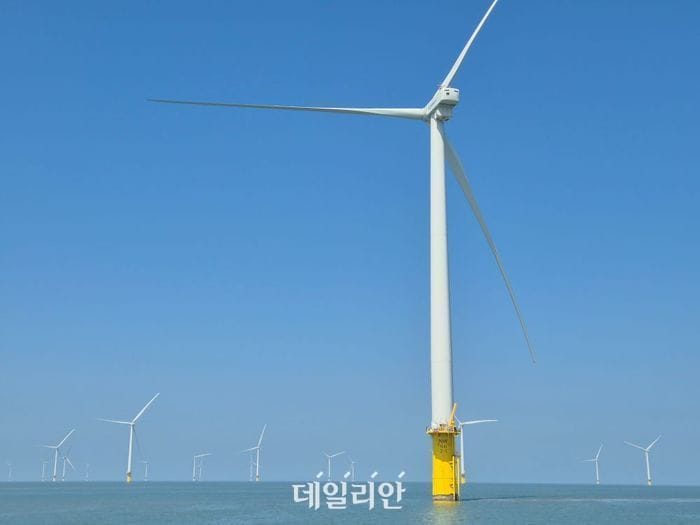
Offshore wind power requires large turbines and substructures to be stored and assembled at ports, then loaded onto installation vessels and transported to sea. If there is insufficient dock space and work areas for this, construction start becomes difficult even after receiving an Electricity Business Licence.
In the first half of 2026, nine offshore wind power projects with a combined capacity of 3,656 megawatts participated in competitive auctions, and five projects totaling 1,786 megawatts were selected. However, if construction infrastructure is not in place, delays in construction start are possible.
As of November 2025, domestic offshore wind power that had reached commercial operation was only 0.35 gigawatts. This represents a significant gap from the 14.3 gigawatt target for 2030 under the Basic Plan on Long-term Electricity Supply and Demand.
Port capacity expansion and construction timelines
In December 2025, the government determined that approximately 3 gigawatts is the actual deployable capacity by 2030, taking into account offshore wind construction conditions. The plan is to expand ports' annual processing capacity to 4 gigawatts, which is approximately 6.7 times that of Mokpo New Port, and to secure at least four 15-megawatt installation vessels.
The problem is that even if ports and installation vessels are secured, project delays are inevitable if grid connection and military operational coordination are not completed on schedule. Domestic offshore wind power typically takes six to ten years from site identification to construction start, with a government target of 6.5 years.
The report forecasts that over the next five to six years, considering military operational coordination and bottlenecks in ports, installation vessels, and transmission networks, will be a period for accumulating project experience.
Financial burden and investment requirements
Project delays translate directly into increased financial costs for companies. Construction of one gigawatt of fixed-bottom offshore wind power requires 7 trillion to 9 trillion won, and since a substantial portion of project costs is financed through borrowing, interest accumulates as construction is delayed.
To achieve the government's 2035 offshore wind power deployment target of 25 gigawatts, a minimum investment of 150 trillion won is estimated to be necessary. The report recommends increasing the predictability of project schedules and revenue stability to attract private investment.
Proactive investment in ports, installation vessels, and transmission networks, as well as resolving initial uncertainties in permitting, military operational coordination, and other early-stage issues, were identified as key tasks. The analysis indicates that the key to expanding offshore wind power lies not merely in increasing the volume of Electricity Business Licences issued, but in establishing the actual conditions for construction.
Original Korean article: Dailian
English brief by Korea Wind Intelligence, koreawindintel.com



















