

The waters off Incheon have become a major testing ground as a key hub for carbon neutrality and the transition to renewable energy. Large-scale offshore wind power projects with a total capacity exceeding 7 gigawatts are being pursued. However, conflicts and limitations emerging in the implementation process have exceeded dangerous levels, contrary to the momentum on the ground. Incheon Today examines the key issues in Incheon's offshore wind initiative and seeks alternatives for coexistence between renewable energy transition and local communities.
Reflected in National Port Master Plan, but Only Half the Required Area
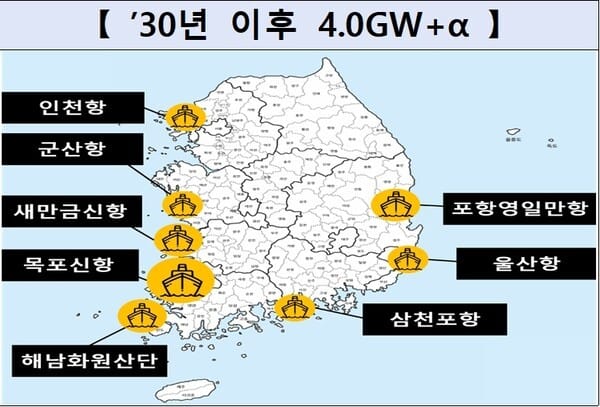
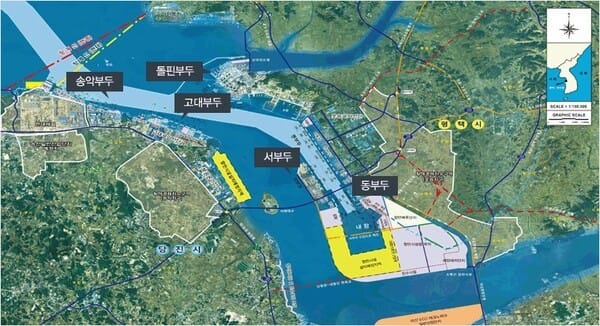
The MOF (Ministry of Oceans and Fisheries) announced the revised Fourth National Port Master Plan (2026-2030) on July 20. Along with Saemangeum, Mokpo, Gunsan, Pohang Yeongil, and Ulsan, it reflected the creation of an offshore wind support berth at Incheon Port. The plan calls for a quay of 720 meters and a hinterland area of 314,400 square meters on the east side of phases 1 and 2 of the New Port container terminal.
With this announcement, the Incheon New Port offshore wind hinterland port became a project to be built over approximately five years with private investment totaling approximately 320 billion won. Incheon City is conducting a demand survey targeting project developers and engineering, procurement and construction (EPC) firms as it pursues a business plan for the support berth.
The plan is to establish a business plan by the end of 2026, create a special purpose vehicle (SPV) with the MOF and Incheon Port Authority, attract private investment as a non-managing port development project under the Port Act, begin construction within the ninth elected administration's term, and complete the project by 2032. The goal is to develop it into an offshore wind maintenance hub by consolidating an integrated control center, safety training center, material warehouse, and component replacement and maintenance facilities.
The achievement is that a hinterland port to stack, assemble, and ship turbines to sea has been included in a government statutory plan for the first time. However, the area is only about half the required area calculated by Incheon City in a 2022 study. The city's study determined that a minimum of 510,000 square meters for the installation port plus an additional 102,000 square meters for operation and maintenance (O&M) port, totaling 610,000 square meters, was necessary.
International Comparison Shows Narrow Space; Incheon's 2032 Target Tight Amid National Port Speed Competition
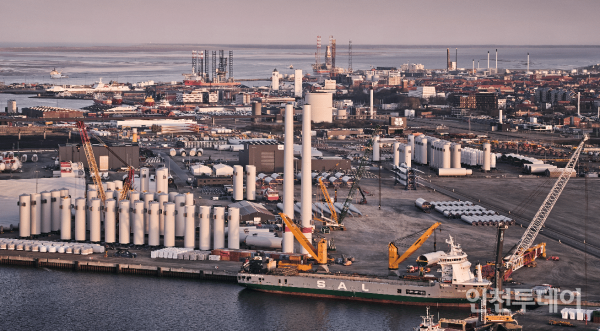
The gap is larger when compared internationally. Denmark's Esbjerg Port has 3.92 million square meters with assembly, transport, and maintenance functions supporting 4.5 gigawatts, while the United Kingdom's Humber Port has 4.84 million square meters supporting 8 gigawatts.
A University of Delaware study published in Energy Policy in 2022 found that a 1-gigawatt project using 12 to 14-megawatt turbines requires a minimum of 220,000 square meters of installation port for two years, and the area required for offshore wind installation ports ranges from 400,000 to 800,000 square meters. Applying this standard directly to Incheon New Port makes 314,400 square meters inevitably narrow.
Domestically, only Mokpo New Port and Pohang Yeongilman Port actually receive offshore wind equipment materials, handling only 1.3 gigawatts annually. The government aims for a port system handling 4.0 gigawatts or more annually after 2030. South Chungcheong is pursuing a plan to begin construction at Boryeong New Port in 2027 and operate in 2029, while Gunsan Gunjang New Port has proposed a berth conversion plan targeting 2027 operation.
South Jeolla's Yeonggwang County is independently pursuing a maintenance port cluster on 200,000 square meters near Hyanghwa Island Port. Separately, the government plans to additionally establish seven hinterland ports by 2030: Ulsan South New Port, Saemangeum New Port, Gunsan Port, Samcheonpo New Port, Haenam Hwawon Industrial Complex, Dangjin Port, and Taean Port. Incheon's 2032 completion target is already later than West Sea ports that are operating or targeting 2027-2029 operation.
Incheon City changed its approach in September 2025. The plan divides roles so that Yeongheung Island handles turbine installation and assembly while Incheon New Port handles O&M. The concept links this to the Yeongheung Future Energy Park (3.75 million square meters, 22 trillion won, targeting 2045), utilizing the former landfill site at Ecoland and the coal ash treatment facility of Yeongheung Thermal Power.
However, building a large port on Yeongheung Island also requires inclusion in the National Port Master Plan, and this revised plan could not include it due to timing. At the earliest, it can only be included in the Fifth Plan (2031-2040) in 2031.
Ørsted Offshore Wind Developer Turning to Dangjin Support Berth with No Legal Basis
Meanwhile, an ironic situation is unfolding where even the offshore wind developer for Incheon's project is turning away from Incheon Port.
On August 20, Ørsted signed a memorandum of understanding with LX International and agreed to jointly examine using the installation support port being developed by LX in Dangjin as a hub for aggregating, storing, and assembling construction materials for Incheon offshore wind. Ørsted stated it is separately examining a port site in Incheon to support O&M after completion.
The target site is the Godae District of the Asan National Industrial Complex at Dangjin Port, with an area of 194,000 square meters. The plan is to build a port supporting annual installation of 500 megawatts or more with 300 billion won in private development. To handle Ørsted's 1.47 gigawatts at an annual 500-megawatt scale, installation must be divided over approximately three years. This area is only 62 percent of Incheon New Port's support berth, making it inevitably narrow.
A larger problem is legal standing. The planned berth for the Dangjin Port offshore wind hinterland port is currently designated in the port master plan for liquid cargo and liquefied natural gas, and the plan must be changed to use it as an offshore wind support port. Dangjin City signed the agreement without submitting a change proposal to the MOF. Although Dangjin Port appears on the government's list of hinterland port candidates, it has not been reflected in the actual statutory port master plan.
Support Berth Pursued Under Current Preliminary Feasibility Study Standards Requires Benefit-Cost Ratio Below 0.5 Adjustment
Additionally, to pursue a support berth with government funding, it must clear the preliminary feasibility study threshold, but experts point out that securing economic viability under current systems is difficult.
The current port preliminary feasibility study applies general cargo port standards such as reducing ship waiting and port time and cutting unloading and inland transport costs, failing to capture effects such as reduced project delay risk and financial costs that installation ports provide. The fact that the final demand location for offshore wind equipment materials is not on land but at a construction site at sea also does not align with existing guidelines.
According to content released in January 2026 by the nonprofit organization NEXT and a research team from Korea Institute of Energy Technology (KENTECH), when reviewing the business viability of an offshore wind hinterland port by applying the existing system's average ship loading capacity on a deadweight tonnage basis, the benefit-cost ratio fell below 0.5. In sensitivity analysis adjusting the average installation vessel loading capacity to actual operational levels, it rose to an average of 1.109.
The research team proposed interpreting loading capacity in turbine set units and incorporating project delay and risk cost mitigation benefits and marine transport environmental benefits into the preliminary feasibility study system.
No Domestic Offshore Wind Installation Vessels Capable of Lifting 2,600 Tons Despite Technical Capability
The absence of large offshore wind installation vessels in Korea is also a problem. The wind turbine installation vessel (WTIV) that Hanwha Ocean delivered to Denmark's Cadeler in February 2025 measures 148 meters in length and 56 meters in width, can lift 2,600 tons, and can carry five 15-megawatt turbines at once. While Korea has the technical capability, there is not yet a single installation vessel capable of handling 15-megawatt class or larger turbines.
The turbines to be installed off Incheon are mostly 15-megawatt class. These have a rotor diameter of 236 meters, blade length of 115.5 meters, and hub height of 143 meters. The nacelle including the hub weighs 605 tons, the tower weighs 706 tons, and each blade weighs 63 tons. The substructure is also heavy. A single large monopile for 40-meter water depth weighs 1,380 tons, stands 85 meters tall, and has a diameter of 10 meters.
According to the First Renewable Energy Master Plan, the government plans to secure two large installation vessels of 15-megawatt class or larger before 2030, currently holding two 10-megawatt class installation vessels. Classification society DNV noted that when turbines grow from 11 megawatts to 15 megawatts, installation vessels must lift 20 meters higher, and towing capacity increases from 650 to 700 tons to 1,000 to 1,200 tons.
Original Korean article: Incheon Today
English brief by Korea Wind Intelligence, koreawindintel.com



















