

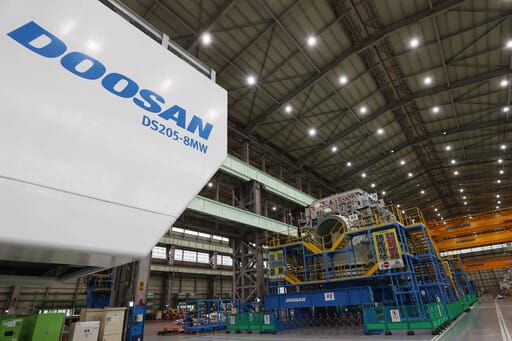
"A 10-megawatt turbine will be able to secure competitiveness in the market for some time," said Park Ji-woong, head of the Wind Power Sales 1 team at Doosan Enerbility's wind power factory in Changwon, Gyeongsangnam-do, on October 20. "Following the global trend toward larger turbines, we will transition to 15-megawatt models, but given the state of domestic supply chains and infrastructure, rapid conversion will not be easy," he said. In the middle of a factory measuring 207 meters long and 70 meters wide sat a massive nacelle. Three workers were attaching covers to the side of the nacelle. The nacelle is the machinery room of a turbine that houses generators and various mechanical devices. This nacelle was the first of 13 units of the DS205 turbine 8-megawatt model to be supplied to Yeonggwang-Yawol offshore wind farm (104 megawatts) in Yeonggwang, Jeollanam-do. According to Doosan, the nacelle is loaded onto a transport vehicle to move to the next process. Red laser light marking a safety zone shone on the ground where the transport vehicle carrying the first nacelle had stopped. Behind the first nacelle, the second and third units were lined up in sequence, and employees moved about continuing their work. The factory's annual turbine production capacity is 22 units.
Doosan, the leading wind turbine manufacturer in South Korea, is pursuing a two-track strategy: securing maximum domestic market volume with its own 10-megawatt turbines while partnering with European company Siemens Gamesa to secure market share in the 15-megawatt turbine segment, for which the company has not yet secured the necessary technology. Park said, "The domestic market has relatively lower maturity compared to markets where offshore wind is well-established, such as Europe and Taiwan. The reality is that we still lack much in supply chains and infrastructure." He added, "In terms of project scale, various projects are planned and underway, ranging from small-scale projects under 100 megawatts, mid-scale projects of 100 to 400 megawatts, and large-scale projects of 500 megawatts and above." Doosan said it is prioritizing the application of 10-megawatt turbines for mid and small-scale projects and sites with low wind speeds, while considering 15-megawatt turbines for large-scale projects and sites with high wind speeds. Doosan improved the DS205 turbine 8-megawatt model supplied to Yeonggwang-Yawol and already obtained Korea's first international type certification for a 10-megawatt turbine last year. Currently, it is developing a Korean-made 10-megawatt turbine called "K-Wind" with a domestic content ratio of over 70 percent based on the DS205 turbine 10-megawatt model. The goal is to complete demonstration and certification next year. The strength of Doosan's 10-megawatt turbine is its design specialized for low wind speeds. The rotor diameter is larger than comparable models, allowing sufficient power generation even in weak winds. To respond to the 15-megawatt turbine market, Doosan has established a Siemens Gamesa cooperation factory on the Changwon factory site. Here, Siemens Gamesa 14-megawatt nacelles and hubs are assembled and tested. The facility is prepared to handle 72 units of assembly and testing annually. Doosan said, "Technology transfer cooperation with Siemens Gamesa is proceeding with mutual good faith in negotiations." Haesong 3 (504 megawatts) and Haewoori 2 (532 megawatts), which won bids in the first half of this year's offshore wind competitive auction market, are projects that won bids with plans to use 14-megawatt turbines produced at this factory.
Securing orders remains challenging
Despite Doosan's preparations, orders remain insufficient. Doosan began its wind power business in 2005. As of December last year, the company supplied 347.5 megawatts of wind power equipment domestically. Of this, offshore wind accounts for 199.0 megawatts. The company supplied turbines to most domestic offshore wind farms, including Tamra (30 megawatts), southwestern waters phase 1 (60 megawatts), and Jeju Hanlim (100 megawatts). However, offshore wind orders have been sparse since the Hanlim offshore wind farm in 2020, with Yeonggwang-Yawol being the first supply contract signed in December last year. The turbines currently in production are expected to be actually delivered to Yeonggwang-Yawol around 2028. For other projects besides Yeonggwang-Yawol, specific delivery schedules remain undetermined. Doosan said that over the past two to three years, the domestic market has been in "a kind of confusion period" with "various new systems being created or changed," and that "price reduction pressure in offshore wind has increased considerably. The increased pressure for price cuts across all supply chains represents a major shift," the company said. It noted that some projects are being delayed due to deteriorating project viability.
To meet the demands of customers, which are developers, turbine companies must make appropriate investments. Uncertainty can only dampen such investment. Doosan said, "Private developers want turbines that are verified by track record and quality while also being mega-sized, and they also demand price competitiveness. Among these, track record and quality are considered most important." The company added, "It is also important how much manufacturers can bear the burden of infrastructure that is weak domestically." Specifically, this means manufacturers are required to bear responsibility for procuring vessels and equipment such as offshore wind installation vessels during construction and maintenance periods. Doosan is pinning its hopes on the public-led market, which operates separately from the private sector. The government introduced a "public-led track" in the offshore wind competitive auction market last year for the first time. This is a method of separately selecting offshore wind projects involving public institutions and local public enterprises from general bidding. The first year's announced volume was around 500 megawatts, and ultimately four projects (689 megawatts) were selected. In the first half of this year, around 400 megawatts were announced, but only one project, Geumo-do offshore wind farm (160 megawatts), won a bid. All of these projects are known to use domestic company turbines. Public-led track projects come with a basic preferential price of 3.66 won per kilowatt-hour, and if government research and development demonstration turbines are used, an additional 27.84 won per kilowatt-hour is added. While the private market encourages price competition, the public-led market focuses on protecting domestic supply chains. Kim Beom-seok, professor of electrical energy engineering at Jeju National University and co-chair of the Offshore Wind Power Committee, said in this regard, "The private sector raises bidding competition to lower prices, while the public sector gives opportunities to developers who bring in more domestic equipment even at higher prices, with the aim of protecting our industry." In other words, to maintain the "localization" goal of South Korea's offshore wind policy, the "low cost" objective must be compromised to some extent. Doosan said, "The public-led track is helping significantly with turbine orders," and urged that "the market should continue to be divided in certain ways to give domestic company turbines and supply chains the opportunity to build track records and prove quality."
Original Korean article: Segye Ilbo
English brief by Korea Wind Intelligence, koreawindintel.com



















