

The West Sea HVDC energy corridor project, which will carry renewable energy from Honam and the southwestern waters to the Seoul metropolitan area, is accelerating through exemption from preliminary feasibility study requirements and demonstration of domestically produced key equipment. At the same time, it faces a new variable: revised electricity demand forecasts driven by semiconductor and AI megaprojects.
During the process of establishing the 12th Basic Plan on Long-term Electricity Supply and Demand, the government has essentially completed a recalculation of electricity demand that reflects three megaprojects. The power required by 2034 for four new semiconductor fabrication plants from Samsung Electronics and SK Hynix in Honam is estimated at approximately 6.3 gigawatts. The government and KEPCO plan to supply approximately 3 gigawatts initially by 2029, then add transmission lines and substations to increase supply capacity. As a result, the first phase project linking Saemangeum to Seohwasung (2 gigawatts) will proceed as scheduled, but the remaining three routes (6 gigawatts) connecting Sinhanam to Dangjin and Dangjin to Seoincheon remain open to adjustment in route and capacity. Minister Kim Sung-hwan of the Ministry of Climate, Energy and Environment (MCEE) is reported to have stated that the Saemangeum-Seohwasung section will proceed as planned, while decisions on modifications to the remaining sections will be made after careful review of the 12th Basic Plan. Since the original plan was to build 8 gigawatts across four routes by 2038, whether the subsequent 6-gigawatt section will see route and capacity adjustments is expected to become clear in the final version of the Basic Plan.
First phase investment remains steady
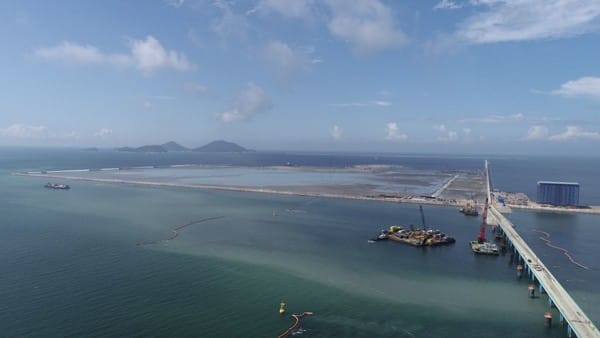
Despite this uncertainty, first phase investment shows no signs of wavering. Taihan, which decided last July to invest 497.2 billion won in constructing a submarine cable factory number two in Dangjin, Chungcheongnam-do, is maintaining its investment policy regardless of discussions on adjusting the subsequent 6 gigawatts. The factory's target completion date has also been moved up by one year, from the original 2031 to 2030.
Earlier, the Ministry of Economy and Finance and MCEE reviewed 32 preliminary feasibility study-subject projects out of 99 national backbone transmission projects designated as national infrastructure. They confirmed preliminary feasibility study exemptions for 15 projects with confirmed routes. The targeted projects total 14.2 trillion won and comprise five alternating current transmission projects, four direct current transmission projects, and six converter stations, with most routes running from Honam to the Seoul metropolitan area. The government estimates that this measure will shorten the average power grid construction period from 10 years and six months to approximately nine years, a reduction of about one year and six months. The largest project among those exempted from preliminary feasibility study is a 350-kilometer HVDC line running from Sinhanam to the Seoincheon combined power plant, with a total investment of 1.9 trillion won.
Domestic equipment demonstration accelerates
Demonstration of domestically produced equipment has begun in earnest this month. KEPCO has selected Hyosung Heavy Industries as the company to demonstrate domestically produced large-capacity voltage-source HVDC valves and controllers for use in the Saemangeum-Seohwasung section, while LS Cable & System (LS Cable), HD Hyundai Electric, and Iljin Electric are also participating in technology development for converter transformers.
The Saemangeum-Seohwasung section, a critical segment of the first phase, began design work on submarine cable routes in March with a target completion date of 2030. Site selection for eight converter station construction was completed last year. To shorten the HVDC construction period, which typically takes more than nine years, the government plans to complete basic design procedures, which previously took more than two years, by the end of this year. It will issue a tender for submarine cable work in early next year to select a contractor. The government has also redesigned the process by having KEPCO proactively conduct marine surveys, which were previously handled by cable manufacturers after contract signing, so that production can begin simultaneously with contract execution.
However, there is a gap in perspective between KEPCO and the cable industry regarding the schedule. The cable industry argues that at least four years and six months are needed for preliminary surveys alone to meet the 2030 completion target, and that preliminary surveys must be completed by August or September at the latest this year. KEPCO, by contrast, is reported to maintain that the existing plan is sufficiently achievable.
Financing and industry competition
Calculations of project costs also vary by source. For the first phase alone, analysis results presented at a National Assembly seminar estimated that the 2.8 trillion won first phase project would generate 14.6 trillion won in production-inducing effects. For the entire four-axis West Sea HVDC system, reports have put the scale at 11 to 12 trillion won. Regarding financing, several methods are being reviewed, including private capital participation through the National Growth Fund and self-financing through KEPCO bond issuance, but no specific method has been confirmed yet.
As the tender approaches, activity in the cable industry has accelerated. LS Cable announced in July that it passed the PQ (pre-qualification) test for a 525-kilovolt, 80C HVDC submarine cable, the first of its kind domestically, establishing a supply foundation applicable to the West Sea energy corridor project. In the construction sector, its subsidiary LS Marine Solution signed a 156.9 billion won submarine cable construction contract with Hanwha Ocean for the Sinan-Ui offshore wind farm, marking the company's largest order since its founding, equivalent to approximately 2.2 times the previous year's sales. Industry observers note that LS Marine Solution, which possesses the only ultra-high-voltage submarine power cable laying vessel in the country, effectively monopolizes the submarine power grid construction market. LS Cable recently invested approximately 30 billion won to acquire additional shares in the company.
Taihan is also stepping up efforts. It is showcasing 525-kilovolt HVDC submarine and underground cables at European and North American trade shows to demonstrate technological competitiveness, while securing comprehensive capabilities in design, production, transportation, and construction through its dedicated offshore wind installation vessel Palos and its specialized construction subsidiary Taihan Ocean Works.
The biggest variable remains the final demand forecast in the 12th Basic Plan. The government is reported to be considering substantial revisions to the plan itself to reflect semiconductor and AI data center demand beyond the provisional figures released in April (131.8 to 138.2 gigawatts for 2040), raising the possibility that the planning timeline could be delayed. There are also concerns that even if preliminary feasibility study exemptions accelerate procedures, failure to conduct parallel community consultations and secure public acceptance could affect the overall schedule. Concerns also remain about the need to coordinate interests regarding tight construction timelines and marine rights acquisition. The 2030 completion target is only a plan put forward by KEPCO, not a confirmed completion date, and the final picture of routes after the first phase is expected to emerge only after the 12th Basic Plan is finalized.
Original Korean article: smedaily.co.kr
English brief by Korea Wind Intelligence, koreawindintel.com



















