

As security concerns over undersea cables and energy pipelines grow, the government and defense contractors are accelerating investment in underwater surveillance and unmanned systems. According to economic media outlet CNBC on July 19, the theater of war is expanding beyond the sky to the seabed, and technology to protect undersea infrastructure has emerged as a new security challenge.
Behind this concern lies the vulnerability of undersea infrastructure that underpins the global economy. According to TeleGeography's tally, as of early 2026, more than 1.5 million kilometers of undersea telecommunications cables are in operation worldwide. In addition to telecommunications cables and oil and gas pipelines, undersea power cables that transmit offshore wind power to land are also increasing.
These concerns intensified after the Nord Stream gas pipeline explosion in the Baltic Sea in September 2022. Investigators determined that the pipeline, designed to send natural gas from Russia to Germany, was deliberately destroyed. As cases of undersea infrastructure damage near the Arctic and Taiwan followed, the vulnerability of undersea defense, which had received relatively little attention since the Cold War, came back into focus.
Unmanned systems reshape underwater surveillance
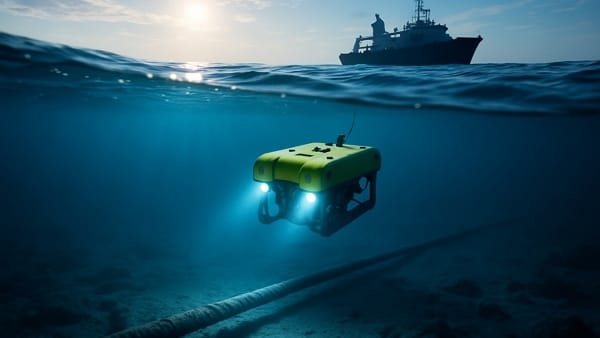
Advances in artificial intelligence, drones, and autonomous technology are also changing underwater surveillance methods. Governments and military alliances are reviewing ways to monitor critical infrastructure more densely using autonomous underwater vehicles and sensors attached to undersea cables. Katia Bego, senior researcher at Chatham House, noted that just as aerial drones changed the character of the battlefield in the Ukraine-Russia war, the marine environment is emerging as the next battlefield.
Defense contractors are also moving to capture market share. Italian shipbuilder Fincantieri announced in July that it would acquire stakes in four companies for approximately 600 million euros to strengthen capabilities in underwater and surface drones, marine surveying, and undersea communications. Chief Executive Officer Pierroberto Folgiero explained that the company is expanding from a domain centered on conventional submarines to a market encompassing small submarines, drones, and undersea communications.
German defense technology company EuroAtlas is also targeting the undersea defense market. The autonomous underwater vehicle Grey Shark is designed to move to a designated area and perform missions without requiring continuous human control. If an object suspected to be a mine is discovered during pipeline inspection, it reports the finding and the operator decides whether to conduct further verification.
Limits to unmanned systems
However, EuroAtlas drew a line at the prospect that underwater unmanned systems will replace existing naval vessels and submarines. The company believes navies will move toward operating both manned and unmanned forces together. EuroAtlas is also developing a hydrogen fuel cell-powered Grey Shark aimed at operating for up to 16 weeks or 8,000 nautical miles, but has not yet demonstrated sustained underwater operation at that level. Grey Shark has signed contracts worth over 100 million euros with European navies and is scheduled to be deployed for surveillance, detection, and deterrence missions without armament.
Clear limitations remain. It is practically difficult to protect all sections of undersea infrastructure, and many facilities are owned or operated by private companies, making responsibility unclear. Deepening cable burial depth, sensor installation, and enhanced surveillance are discussed as committee alternatives, but the cost burden is substantial. Bego assessed that while underwater unmanned systems can help, they are not a panacea for solving undersea security issues.
Original Korean article: digitaltoday.co.kr
English brief by Korea Wind Intelligence, koreawindintel.com



















