

SK Ocean Plant is rapidly expanding its business scope by securing successive large orders in the merchant vessel and offshore wind markets. In merchant vessels, the company is expanding its order base with global shipowners, while in offshore wind it is extending its business domain into high-value-added and next-generation products. The large-scale structural fabrication capabilities and quality and delivery competitiveness accumulated in offshore wind and marine plants are becoming the foundation for broadening the order horizon into new markets and product lines.
According to SK Ocean Plant on September 17, 2026, the company signed a construction contract in August this year with a Greek shipowner for six aframax crude oil tankers of 115,000 DWT (deadweight tonnage). The contract value is approximately 600 billion won, and if an additional two vessels are ordered as options, it could expand to a maximum of 800 billion won. The significance lies in securing a large volume in the company's first transaction with Greek shipowners, a core customer group in the global shipping market.
Behind the order is a structural change in the merchant vessel market. As crude oil transportation structures and trade environments are being reorganized, demand for mid-sized tankers that can flexibly respond to diverse shipping routes is increasing. With carbon reduction and strengthening environmental regulations, ship fuels and technologies are also changing rapidly.
The global tanker market is also in a fleet replacement cycle. According to a report released by Drewry Maritime Research on June 30 this year, the average age of tankers currently in operation has reached approximately 15 years. As new orders increase, construction schedules at major shipyards in South Korea, China and Japan are filling up rapidly. As competition for dock availability intensifies, shipowners' main selection criteria have shifted beyond quality and price to include production and delivery responsiveness that can deliver vessels at the desired time.
SK Ocean Plant presented a delivery schedule within 2029 in this contract. This was backed by experience in fabricating large-scale structures requiring high manufacturing difficulty in the offshore wind and marine plant sectors, tailored to global customers' quality standards and schedules. In some projects, the company has even completed fabrication ahead of the client's acceptance schedule. The quality, safety and delivery track record accumulated across different business sectors has become the foundation for demonstrating production capacity to new shipowners.
Merchant vessel strategy bearing fruit
This order is also the result of a merchant vessel business strategy pursued since the beginning of the year. SK Ocean Plant has designated aframax and LR2 as strategic vessel types and has been targeting the global market. The company's judgment is based on solid global shipowner demand for vessels built in South Korea, considering quality and future asset value.
The core of the strategy is securing production competitiveness through continuous construction. Aframax and LR2 are based on similar hull designs, allowing production experience to accumulate through repeated construction of identical or similar vessels. The plan is to increase productivity and reduce costs and construction time, thereby enhancing price, quality and delivery competitiveness. With this order as an opportunity, the company plans to inform global shipowners, ship brokers and operators of its merchant vessel construction capabilities and expand new European customers.
The character of vessels shipowners want is also changing. As carbon emission regulations strengthen mainly in Europe, interest in dual-fuel propulsion vessels such as LNG and eco-friendly and energy-saving technologies including wind-assisted propulsion systems (WAPS) and shaft generators has increased. Beyond price and delivery, fuel efficiency and environmental regulation compliance capability are becoming major criteria for vessel selection.
Expanding into eco-friendly and specialized vessels
SK Ocean Plant entered the eco-friendly merchant vessel newbuilding market in December 2025 by securing an order for two 6,800-ton methanol dual-fuel oil and chemical tankers. In July this year, the company additionally won an order for two 6,800 DWT stainless steel chemical tankers requiring high corrosion resistance and precise quality control. The company is in the process of expanding experience gained in specialized and eco-friendly vessels to the mid-sized tanker market.
Offshore wind: scaling up and moving upmarket
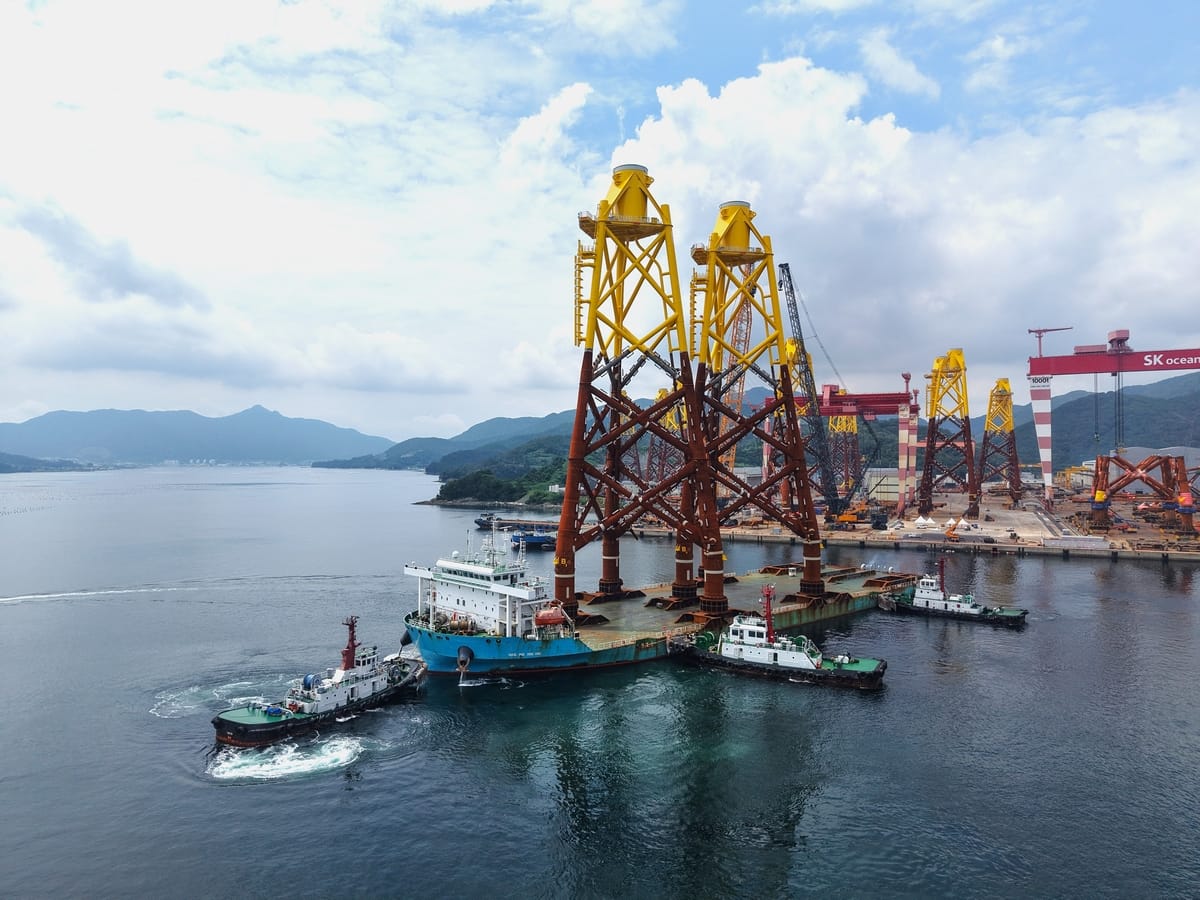
SK Ocean Plant has already built substantial fabrication track records in offshore wind. Centered on Taiwan, the company has supplied over 200 fixed-bottom substructures and accumulated mass production experience by fabricating dozens of mega-scale structures simultaneously and delivering them on schedule. Recently, the company has been expanding its business domain beyond existing fixed-bottom substructure fabrication into high-value-added and next-generation products such as offshore substations and floating structures.
The market has also expanded to Europe. Following the supply of offshore substation (OSS) jacket components for the German North Sea DolWin4 and BorWin4 projects, in July this year the company won a contract to fabricate and supply high-voltage direct current (HVDC) offshore substation substructures as complete units for the 2.2 GW BalWin5 project. This is the first time a Korean company has supplied complete HVDC offshore substation substructures to Europe.
In May this year, SK Ocean Plant was selected as the preferred negotiation partner for floating substructure supply by Korea Floating in Ulsan, expanding its domain from fixed-bottom to floating structures. The new yard currently under construction is a production base designed to handle large-scale fixed-bottom and floating substructures and next-generation products such as offshore substations. The company is also pursuing process automation to enhance production competitiveness. Recently, through welding automation using collaborative robots, the company has reduced work time in some processes from 44 minutes to 20 minutes.
SK Ocean Plant CEO Kang Young-gyu said, "The core of the competitiveness we have accumulated is the execution capability to uphold the quality and delivery schedules that customers demand in any business," and added, "Based on this, we will continue to prove our competitiveness in new markets including merchant vessels, marine infrastructure and next-generation offshore wind."
Original Korean article: Seoul Economic Daily
English brief by Korea Wind Intelligence, koreawindintel.com



















