

Delivery delays trigger painful shift to losses
Seah Steelworks Group's UK offshore wind substructure subsidiary Seah Wind, which the group had positioned as a future growth engine, has emerged as the group's "biggest risk". Riding the wave of global carbon neutrality initiatives and Europe's offshore wind boom, Seah Wind achieved major contract wins in its early days. But reckless expansion of production capacity and the resulting schedule delays have boomeranged into a cascade of contract cancellations. Seah Wind aggressively pursued factory expansion to increase capacity, causing plant operations to be delayed by nearly two years. The resulting delays in finished product delivery caused the company to lose even large-scale projects worth trillions of won.
Seah Steelworks Group and its flagship subsidiary Seah Steelworks barely survived by injecting an additional 70 billion won in capital, but attention is now focused on whether the ramp-up strategy to operate at 400,000 tonnes per year after equipment completion will succeed. Some in the wind industry worry that with affiliate capital injections exceeding 500 billion won, there is a risk of a structure forming that could erode the strong performance of the core business itself.
400,000-tonne expansion triggers disaster, loses trillion-won contracts
According to the Financial Supervisory Service's electronic disclosure system on September 30, 2026, Seah Steelworks Group recorded consolidated sales of 1.167 trillion won in the second quarter of this year, showing 14.3 percent growth year-on-year on the surface. However, profitability indicators were bleak. The company posted an operating loss of 50.7 billion won and a net loss of 74.6 billion won, swinging to losses.
The cause of the losses is clear. One-time costs related to Seah Wind of 110.7 billion won had to be written off at once. This resulted from depreciation charges from newly expanded facilities, combined with large provisions related to the scaled-down Norfolk Vanguard project due to delivery delays.
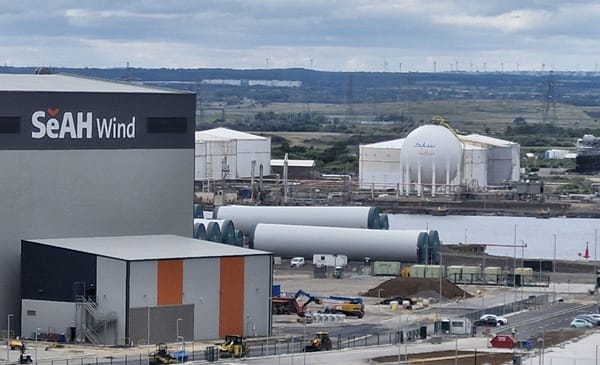
Seah Wind is a local subsidiary established in 2021 by Seah Steelworks Group to secure a foothold in the offshore wind monopile market. The group's original plan was to invest approximately 400 billion won over the initial three years to build a massive XXL-class monopile factory with an annual capacity of 240,000 tonnes on the Teesside Freeport site in northeast England, establishing a beachhead.
The business outlook was rosy. In the early stages of factory construction, aligned with the global decarbonization trend, the company won successive major contracts exceeding 2 trillion won from major European developers including Sweden's Vattenfall's Norfolk Vanguard project and Denmark's state-owned energy company Ørsted's UK Hornsea 3 project, emerging as a next-generation profit generator for the Seah Group.
But cracks soon appeared. The "ambition" to expand capacity became the source of trouble. During factory construction, Seah Wind decided to increase annual production capacity to 400,000 tonnes, 1.7 times the original plan.
This choice came at a steep financial cost. The original investment cost for the UK Teesside factory was around 400 billion won, but as of 2024 it has ballooned to 900 million pounds, approximately 1.5 trillion won, nearly four times the original amount.
Seah Wind's original target was to complete the factory by 2024 and transition to full commercial production mode from the first half of last year by ramping up yield and operating rates to ship standard-specification monopiles. However, as the company expanded the site area further and changed the design to ultra-large 400,000-tonne-per-year equipment, the construction period spiraled out of control.
According to reports from local UK media outlets including Northeast Bylines and Autonomy, the Seah Wind Teesside factory only received approval for mechanical, electrical and plumbing work completion in July of this year, pushing back the commercial production schedule entirely. As a result, unable to meet finished product delivery deadlines, the company suffered massive fixed cost expenditures and the worst blow of trillion-won contract cancellations.
When delivery deadlines were missed, global clients withdrew their projects. Ørsted, one of Seah Wind's largest customers, revoked all supplies for the UK Hornsea 3 project in February this year citing delivery schedule uncertainty, switching the volume to Spain's Haizea Wind and Chinese shipyard supplies instead.
Vattenfall also replaced Norfolk Vanguard western volumes with Spanish and German competitors and other Asian competitors. As a result, the single supply contract with Vattenfall, which had reached 1.5 trillion won, shrank to just 230 billion won.
Delayed commercial production led to accumulated losses. Seah Wind recorded an operating loss of 67.2 billion won and a net loss of 81.4 billion won last year, and in the first half of this year posted an operating loss of 30 billion won plus one-time costs, resulting in a net loss of 172 billion won.
A Seah Steelworks Group official said: "With rising oil prices recently highlighting the need for renewable energy, global offshore wind project investment is increasing. In the case of heavy and long-lead manufacturing, large-scale capital expenditure is necessarily accompanied upfront, and after the ramp-up process and production stabilization, stable profits are achieved. Seah Wind is currently in the ramp-up phase, and as operating rates gradually rise, sales are expected to expand."
The official added: "As the Seah Wind ramp-up phase takes time, for existing contracted volumes we have shared factory conditions with clients and adjusted supply volumes through mutual consultation. Since we conducted proactive consultations to minimize project impact and supply high-quality products, there are no separate penalties for volume adjustments."
Cliff in work after 2028 feared, Seah Steelworks Group calls it "growth pains"
The funding gap created by delayed factory completion fell entirely on Seah Steelworks Group. Direct and indirect capital invested by Seah Steelworks Group and key affiliates including Seah Steelworks into Seah Wind has already exceeded 500 billion won. In February this year the holding company injected 68.1 billion won in liquidity (3.156 million redeemable preferred shares), and in June Seah Steelworks injected 71.1 billion won (3.536 million redeemable preferred shares).
Industry insiders point to the "order cliff" looming after 2028 as the biggest concern. Given the large-scale capital-intensive nature of the business, steady work is essential to cover massive depreciation and fixed costs, but successive exits from major projects have created a fatal gap in securing order backlogs to drive up operating rates.
Seah Steelworks Group views the current crisis as initial "growth pains" from entering a new business. The company argues that the factory expansion at Seah Wind was an unavoidable choice, since securing initial production capacity and optimizing line layout will determine cost competitiveness for decades to come.
Meanwhile, there remains significant latent optimism about the offshore wind business and room for performance recovery. Local reports indicate that contract negotiations for multiple new projects, including the UK Dogger Bank project, are progressing in a positive direction. Additionally, the UK government's confirmation of a record 8.4GW volume in the offshore wind contracts for difference auction in January this year and budget expansion are cited as favorable factors.
A Seah Steelworks Group official said: "Seah Wind quickly responded to demand from new business under the UK government's 2030 offshore wind 50GW target policy, securing geographic advantages to absorb large-scale monopile demand. The company is currently in the ramp-up phase, and once operating rates enter normal trajectory, the loss margin will also shrink rapidly."
The official added: "Seah Wind is currently participating in bids for multiple large projects in a favorable market environment and is in negotiations, while continuing consultations with local companies to secure the offshore wind business."
Original Korean article: srtimes.kr
English brief by Korea Wind Intelligence, koreawindintel.com



















