

Posco's transition to hydrogen-reduced steelmaking is emerging as an issue that extends beyond corporate capital investment to national energy infrastructure.
If Posco were to convert all of its current annual crude steel production to hydrogen-reduced steelmaking and produce the required clean hydrogen domestically, hydrogen production alone would require electricity equivalent to approximately 35 percent of last year's domestic electricity sales.
As expectations grow for increased process electricity from expanded electric arc furnaces and reduced self-generated power from blast furnace closures, the importance of securing a carbon-free electricity supply base to support the steel industry's low-carbon transition is becoming more pronounced.
Hydrogen production alone requires 35 percent of domestic electricity sales
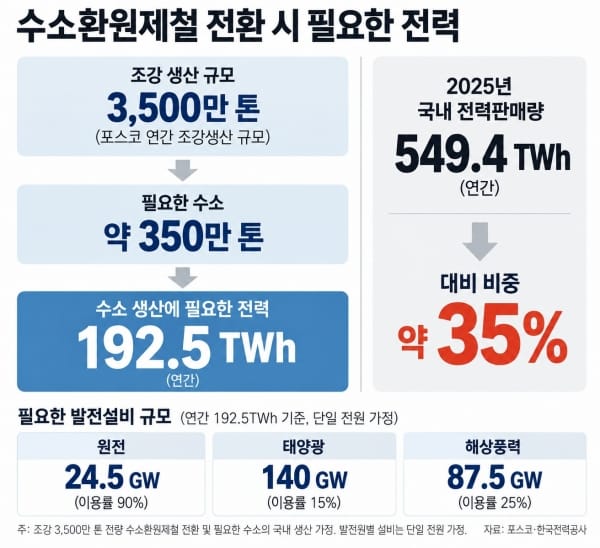
According to Posco data, producing 2 million tons annually through hydrogen-reduced steelmaking requires approximately 200,000 tons of hydrogen. The electricity needed to produce that hydrogen is approximately 11 TWh annually.
Applying this to Posco's current annual crude steel production of 35 million tons, the required hydrogen reaches a maximum of approximately 3.5 million tons. Assuming this hydrogen is produced domestically, the required electricity would reach approximately 192.5 TWh annually.
According to KEPCO (Korea Electric Power Corporation) power statistics, domestic electricity sales in 2025 were recorded at 549.4 TWh. Annual electricity of 192.5 TWh represents approximately 35.0 percent of this. Compared to domestic generation of 595.6 TWh in the same year, it amounts to approximately 32.3 percent.
The theoretical value of hydrogen required to reduce iron ore with hydrogen is approximately 54 kilograms per ton of iron. In actual steelmaking processes, more hydrogen must be input than this theoretical amount when accounting for reduction efficiency. Posco has indicated that the hydrogen required in actual processes is approximately 100 kilograms per ton of iron.
By production scale, 1 million tons of hydrogen-reduced steelmaking theoretically requires approximately 60,000 tons of hydrogen, but actual demand is approximately 120,000 tons. When production scale increases to 2 million tons, actual hydrogen demand reaches approximately 200,000 tons.
However, Posco's medium and long-term low-carbon production roadmap envisions hydrogen-reduced steelmaking accounting for approximately half of total production, with blast furnaces and electric arc furnaces handling the remaining production.
Since Posco is also examining ways to utilize both domestic and overseas clean hydrogen, the actual hydrogen required and the scale of electricity needed for domestic hydrogen production may vary depending on the future proportion of hydrogen-reduced steelmaking production, hydrogen procurement methods, and the pace of equipment conversion.
Steel processes themselves undergo electrification beyond hydrogen
What deserves greater attention is that the annual 192.5 TWh represents only the electricity required for hydrogen production. During the transition to hydrogen-reduced steelmaking, electricity consumption in the steelmaking process itself also increases.
As Posco expands general electric arc furnaces and electric arc furnaces for hydrogen-reduced steelmaking, electricity use in steelmaking processes grows. Separate from electricity for hydrogen production, large-scale electricity must be secured in the actual process of producing steel products.
Conversely, as the blast furnace share declines, the electricity that the steelworks generates internally decreases. Posco currently uses by-product gases such as blast furnace gas and coke oven gas generated during blast furnace operations for power generation to cover part of the electricity used at the steelworks.
As the transition to hydrogen-reduced steelmaking leads to closure of currently operating blast furnaces, the volume of by-product gas generation decreases, and self-generated power from utilizing these gases also declines.
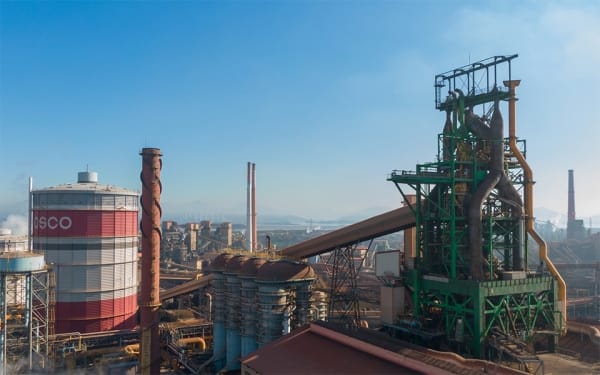
As the transition to a low-carbon production system progresses, electricity demand for hydrogen production and electric arc furnace operation increases while the steelworks' own power generation capacity simultaneously decreases.
An industry official explained: "As the transition to a low-carbon production system advances, the importance of reliably securing electricity from external sources becomes unavoidable. This is why the steel industry's low-carbon transition leads directly to electrification."
Nuclear capacity of 24.5 GW required for carbon-free electricity
Converting the electricity needed for hydrogen production into power generation capacity reveals the scale necessary to secure carbon-free electricity.
Posco presented the power generation capacity needed to produce annual 11 TWh as 1.4 GW of nuclear, 8 GW of solar, and 5 GW of offshore wind. These figures apply a capacity factor of 90 percent for nuclear, 15 percent for solar, and 25 percent for offshore wind.
Applying the same standards to the hydrogen scale required for 35 million tons of production yields approximately 24.5 GW of nuclear, approximately 140 GW of solar, and approximately 87.5 GW of offshore wind. These represent the required capacity if each power source were used independently.
Beyond increased electricity consumption and reduced self-generation, rising industrial electricity prices are another factor to consider during the hydrogen-reduced steelmaking transition. According to Posco data, industrial electricity prices rose approximately 72 percent from 105 won per kWh in 2021 to 181 won in 2025. S&P Global forecasts cited in Posco materials project 265 won in 2040 and 330 won in 2050.
When clean hydrogen is produced through water electrolysis, electricity prices are closely linked to hydrogen production costs. As hydrogen-reduced steelmaking production expands, securing clean hydrogen and establishing a foundation to supply electricity at competitive prices for hydrogen production and steelmaking processes becomes increasingly important.
Posco is examining ways to utilize carbon-free electricity including private large-scale nuclear power. Given the steel industry's continuous operation characteristics, it requires stable large-scale electricity supply, making it necessary to secure power sources with both supply stability and price competitiveness.
Small modular reactors (SMR) are also among the usage options being considered. Posco is examining nuclear power including SMR, domestic green hydrogen, overseas green hydrogen, and domestic introduction of hydrogen produced overseas.
An industry official stated: "The steel industry's low-carbon transition must be supported by large-scale carbon-free electricity and clean hydrogen supply. Since corporate equipment conversion alone has limitations, national-level energy infrastructure expansion and institutional support must be implemented together."
Original Korean article: snmnews.com
English brief by Korea Wind Intelligence, koreawindintel.com



















