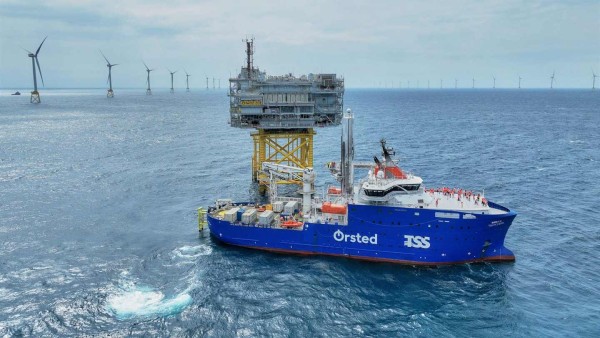
Danish offshore wind company Ørsted announced on August 25 that it is withdrawing from participation in the power supply bidding for its offshore wind project in waters off Incheon and entering a redesign phase, according to an internal notice. The Ørsted Asia-Pacific CEO indicated that this decision will affect certain positions in South Korea and across the company, suggesting the possibility of workforce reductions in Korea.
"Risk increases and project viability weakens"... redesign instead of bidding
Offshore wind specialist media outlet Recharge reported the notice on August 26. According to the report, Per Mejnert Kristensen, Ørsted's Asia-Pacific regional CEO, stated in the notice that "external factors over the past year have increased the risk of the Incheon project and weakened its viability" and "in its current configuration, it cannot meet the internal financial standards required for bidding participation."
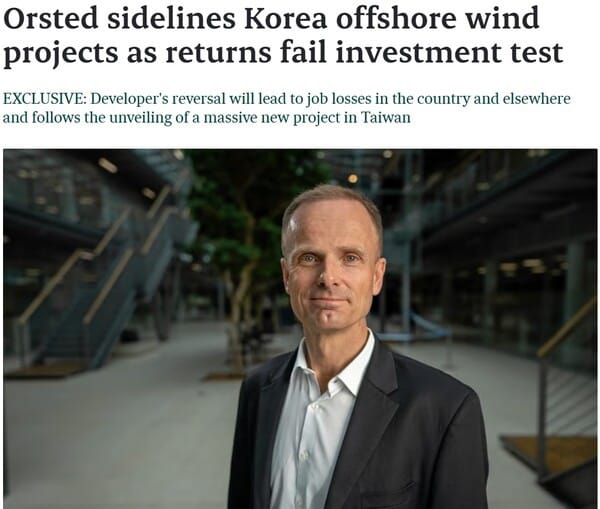
Accordingly, Ørsted decided not to participate in the second fixed-price competitive bidding for offshore wind this year (1.9 to 3.0 GW scale) that the Ministry of Climate, Energy and Environment will open as early as next month. However, he emphasized that "we are not abandoning the Korean offshore wind business" and stated that "we are entering a process to redesign the project in a direction that enhances financial competitiveness and long-term project viability."
The report also noted that Ørsted had hired a local permitting team and a Korea country manager, and was about to sign a contract for a new 40 to 50-person office in central Seoul, making this announcement a surprise setback. In fact, it is known that four to five Ørsted Korea employees were recently offered voluntary severance.
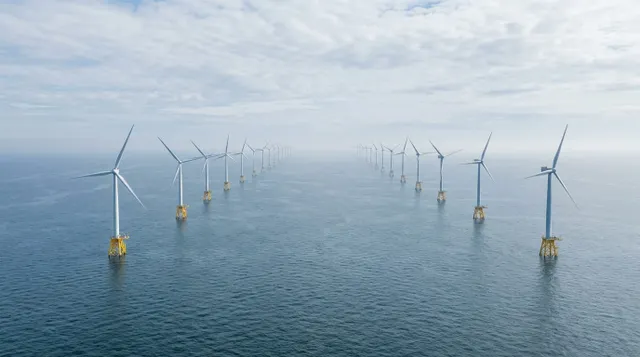
However, the report stated that Ørsted will maintain its business rights in the Incheon waters. The target project is the Incheon offshore wind units 1 and 2 (870 MW and 600 MW totaling 1.47 GW) located 35 to 70 kilometers west of Deokjeok-do in Incheon waters. The generation capacity increased slightly from the original 1.4 GW following an EBL amendment in February.
Northern Limit Line, shipping lanes, and crab fishing grounds overlap... eight years of accumulated conflict
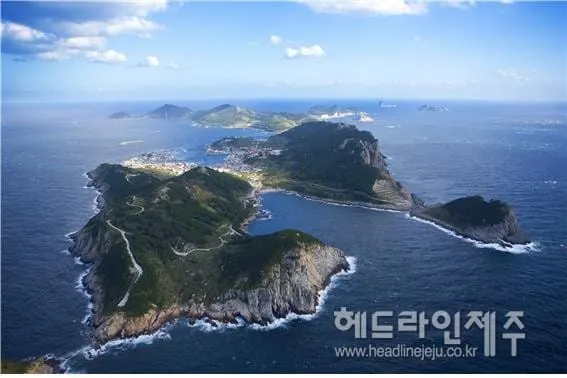
The specific "external factors" that Ørsted identified do not appear in the internal notice. However, the Incheon waters are close to the Northern Limit Line in the West Sea bordering North Korea, and the passenger ferry shipping lane between Incheon and Baengnyeong-do overlaps with the project area. Additionally, it overlaps with South Korea's largest crab fishing ground, raising concerns about impacts on fishermen's livelihoods.
As a result, the project must simultaneously pass permitting from relevant ministries including the Ministry of Oceans and Fisheries, Ministry of National Defense, and Ministry of Environment. There is ongoing discussion about the possibility of further reducing the project area to secure the shipping lane.
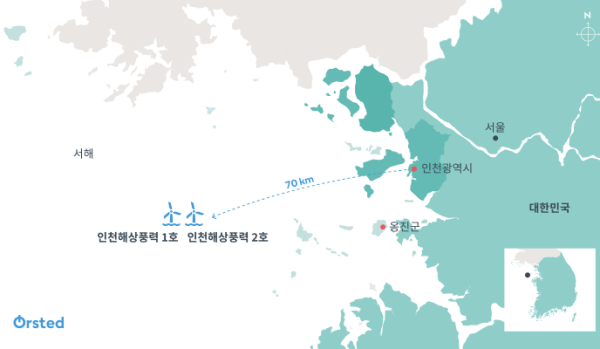
Accordingly, complaints related to offshore wind have grown to 112 cases received during the seventh and eighth local government administrations alone, with resistance from fishermen and residents intensifying. The "external factors" that Ørsted's representative mentioned as increasing project risk appear to stem from this background.
Taiwan focus expected to shift... domestic and foreign offshore wind developers withdrawing one after another
There is speculation that Ørsted may be withdrawing from the Incheon offshore wind project in Korea and concentrating on Taiwan operations in the Asia-Pacific region. Ørsted unveiled a new 2 gigawatt Taiwan project (Dadu II) on August 19, just one week before announcing the Incheon project review.
In November 2023, Ørsted also withdrew from Norway and Vietnam while stating it would continue pursuing the Korean project. The company's position this time is similarly that it is not a complete withdrawal. However, in recent years, foreign offshore wind developers have successively scaled back or abandoned Korean projects. Analysis suggests that Ørsted's decision is not unrelated to this trend.
In fact, Shell has divested its stake in the Ulsan joint venture, Vestas has indefinitely postponed construction of its Mokpo turbine factory scheduled for 2025, RWE has transferred part of its stake in Taean, Sinan, and Incheon Haneuibaram, Corio dissolved its Korean subsidiary in March 2026, and Equinor has reduced its Korea office following bidding restrictions. Foreign companies have withdrawn from Korea.
Korea's 20-year fixed price ceiling versus Taiwan's B2B contracts... revenue structure differences
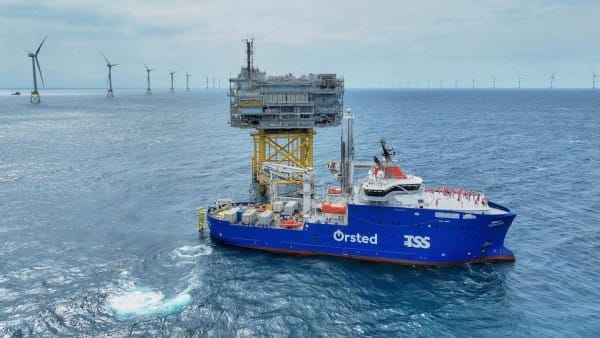
Behind the speculation about Ørsted's withdrawal from Korea lies a difference in offshore wind generation cost standards between Korea and Taiwan. Korea guarantees developers a fixed price for 20 years while imposing a ceiling on that price. The fixed-bottom price ceiling for the first half of 2026 was 171,229 won per megawatt-hour. Once a bid is accepted, the price cannot be raised even if costs increase.
Moreover, the Incheon project is burdened with additional barriers including the Northern Limit Line, shipping lanes, and fishing grounds on top of this price ceiling structure, raising the possibility that Ørsted's internal financial standards were not met. Ørsted has a precedent of abandoning bids for similar reasons in the 2024 to 2025 Hesselø offshore wind bidding in Denmark.
By contrast, Taiwan, where Ørsted already operates and is constructing 1.95 GW, does not have the government guarantee prices but also has no ceiling. In 2020, Ørsted signed the world's largest corporate power purchase agreement with TSMC in Taiwan, supplying 920 MW of power over 20 years.
This was higher than Taiwan's first offshore wind auction fixed price. Taiwan's export manufacturers in semiconductors and other sectors have strong incentives to meet RE100 requirements, meaning that in Taiwan without a government ceiling, there is room for Ørsted to receive higher unit prices.
However, Ørsted drew a line against withdrawal speculation from the Korean market. An Ørsted Korea official stated: "We are continuing to pursue business in Korea, including proceeding with permitting procedures necessary for future offshore wind bidding participation. We are continuously reviewing business direction and resource allocation methods and actively consulting with relevant agencies. Korea is an important offshore wind market with high growth potential. We will examine ways for the Incheon offshore wind project to take root effectively in preparation for future bidding opportunities."
KWI developer profile — Ørsted
2 projects in Korea totalling 1,470 MW. Compiled from the KWI database. Not part of the source article.
Incheon 1 Offshore Wind
|  |
Incheon 2 Offshore Wind
| |
Project data: KWI database — Electricity Business Licence records, EIA filings (ME2025C009, ME2025C010), Electricity Regulatory Commission minutes, and pre-EBL permit filings.
Original Korean article: Incheon Today