Denmark's state-owned Ørsted has issued an official statement saying it is not withdrawing from the Korean market after reports emerged that the company is reviewing a reduction in its Incheon offshore wind project. However, the company will not participate in the fixed-price competitive bidding scheduled for next month, and has not disclosed specific details or timing for project redesign, raising concerns that the project is stalled without clear direction.
Ørsted issues first official statement on Korea withdrawal reports, maintains only permitting procedures
British offshore wind specialist publication Recharge published a follow-up report on August 27 carrying a statement from an Ørsted spokesperson. This was the company's first official response to the previous day's reporting of CEO Christensen's internal memo.
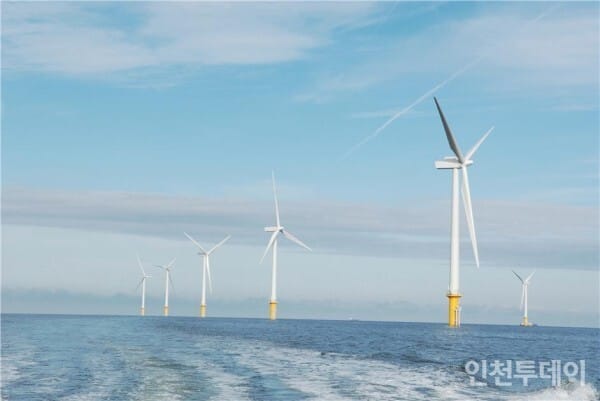
The Ørsted spokesperson said: "Development activities continue in Korea, and we are continuing to advance the Incheon project. This includes progressing the permitting procedures necessary for participation in future offshore wind auctions. We are continuously evaluating how to allocate resources so that the project becomes competitive and positioned for long-term success." The company added that it has obtained an Electricity Business License (EBL) for a maximum 1.47 gigawatt project, completed seabed surveys, submitted a final environmental impact assessment (EIA) report, and is in consultation with Korean authorities.
Deferral of 20-year contract confirmation, a critical milestone, accelerates foreign companies' exit from Korean market
However, what Ørsted has actually committed to is only maintaining permitting procedures. The company will not bid in the South Korean government's second offshore wind fixed-price competitive bidding expected next month, covering 1.9 to 3.0 gigawatts, including both Incheon offshore wind projects 1 and 2 (870 megawatts and 600 megawatts, totaling 1.47 gigawatts). The company has not disclosed how it will redesign the project or when it will rebid.
While continuing with administrative procedures such as the Electricity Business License and EIA submission, Ørsted is deferring confirmation of the 20-year fixed-price contract, which is the critical milestone for actual project construction. This has prompted observations that the project is being left in a state of indefinite suspension.
Ørsted's approach is linked to strengthened investment criteria under CEO Rasmus Errbøe's global leadership. In May of last year, Ørsted also halted development of the Hornsea 4 offshore wind project in the United Kingdom, which has a capacity of 2.4 gigawatts. At that time, Errbøe stated that the company would proceed only with assets deemed capable of passing strict financial standards. The Incheon project appears to have failed to meet internal financial criteria when the same standards were applied.
South Korea has set targets to supply 10 gigawatts of offshore wind by 2030, 25 gigawatts by 2035, and up to 41 gigawatts by 2050. Since 2022, 5.9 gigawatts have been awarded through bidding, and in June alone bidding occurred for 1.2 gigawatts of fixed-bottom and 530 megawatts of floating capacity. However, according to the report, projects that have reached final investment decision (FID) are rare.
In fact, in recent years foreign companies have withdrawn from Korea: Shell divested its stake in an Ulsan joint venture, Vestas indefinitely postponed construction of its Mokpo turbine factory scheduled for 2025, RWE transferred part of its stake in the Taean, Sinan and Incheon Haeneuibaram projects, Corio dissolved its Korean subsidiary scheduled for March 2026, and Equinor reduced its Korean office after bidding restrictions took effect.
Renewable energy law amendment passes, uncertainty increases from institutional reform
Ørsted's financial judgment appears to have been influenced by uncertainty surrounding the new renewable energy supply system taking effect next year.
On August 20, the National Assembly passed seven renewable energy-related bills including the Electric Utility Act and the Renewable Energy Development, Use and Promotion Act. Among these, the Renewable Energy Act amendment repeals the Renewable Portfolio Standard (RPS), which has been maintained for 15 years since its introduction in 2012, and completely restructures it into a "contract market system" in which the government selects project operators on a capacity basis.
The existing RPS had faced criticism for having limited effectiveness in fostering industry competitiveness due to declining renewable energy generation costs.
The amended law takes effect on January 1 next year. Issuance of existing Renewable Energy Certificates (RECs) will be phased out over three years and discontinued on December 31, 2029. From January 1, 2030, the contract market system will be fully implemented. Under this system, future winning bidders will enter into long-term fixed-price power purchase agreements (PPAs) with Korea Electric Power Corporation (KEPCO).
The Ministry of Climate, Energy and Environment has stated that this will lower financing costs for renewable energy projects and increase funding availability. The industry views it as a "backstop" mechanism in which the government essentially guarantees returns even if the market fails to function properly.
However, there are factors that could cause the new system to work in the opposite direction. In December of last year, the government announced a target to lower offshore wind generation costs from approximately 330 won per kilowatt-hour to 150 won or less by 2035. Project operators like Ørsted that defer bidding may face even lower ceiling prices when they rebid.
KWI developer profile — Ørsted
2 projects in Korea totalling 1,470 MW. Compiled from the KWI database. Not part of the source article.
Incheon 1 Offshore Wind
|  |
Incheon 2 Offshore Wind
| |
Project data: KWI database — Electricity Business Licence records, EIA filings (ME2025C009, ME2025C010), Electricity Regulatory Commission minutes, and pre-EBL permit filings.
Original Korean article: Incheon Today