

On September 30 in waters off Anma Island and Songni Island in Nagwol-myeon, Yeonggwang County, South Jeolla Province, the Nagwol offshore wind farm was nearing completion. In waters 8 to 13 meters deep with strong currents, blades 82.5 meters long hung from steel towers 92.1 meters tall and 3.86 to 6 meters in diameter, rotating slowly to generate power in average winds of 7 meters per second. The offshore wind turbine installation vessel Han-san 1 stood by near one of the facility's turbines after completing installation work over two days through the early morning of September 30.
The Nagwol offshore wind farm is equipped with 64 wind turbines made up of 5.7-megawatt turbines manufactured by German company Vensys and three-stage towers 92 meters tall made by CS Wind. Total generation capacity reaches 364.8 megawatts, capable of producing 900 gigawatt-hours of electricity annually. Power generated at this site is sent to land through an onshore substation on Songni Island, then connected to the nationwide power grid through the Seohong switching station.
The facility recorded a 97.5 percent completion rate on August 28. It will reach completion once three more turbines are fully installed and undersea cable installation is finished. Onshore facilities began construction in March 2024, while offshore facilities began in April of the previous year, with the first unit commencing commercial operation in December. Nagwol, the project developer, aims to complete the facility and begin full commercial operation of all turbines this year. Currently, 45 turbines are undergoing trial operation.
Challenges of offshore construction
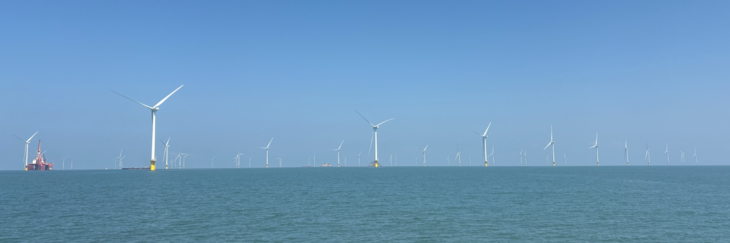
Developing the Nagwol offshore wind farm has not been straightforward because large structures must be installed at sea that are thin, long, and rotate in circular motion. The developer maintains three offshore wind turbine service vessels with bow designs shaped like waves according to standard specifications to allow workers to access the turbines. Changes in marine conditions such as weather and wave height have affected the entire project timeline.
Particular challenges include renting specialized offshore wind project vessels like the WTIV and encountering situations where work cannot proceed at all due to worsening weather. Because of the turbines' size, if the angle is off by even one degree when attaching a turbine to the tower, installation is impossible. The Yellow Sea's strong tidal currents make it especially difficult to position the WTIV at the correct angle on the seabed. As a result, the original completion target of the end of last year was pushed back to the first half of this year, then to the end of this year.
Kim Uk-jin, executive director of Nagwol, said: "When constructing an offshore wind farm, the work-capable period is only from March to mid-November, and typically only about 11 days per month are available for work, making project management highly challenging. Fortunately this year there were no typhoons in summer, giving us more work days than usual, but as mid-September arrived, tidal currents strengthened and we temporarily halted undersea cable laying and burial work."
Operations and market outlook
The integrated control center monitoring whether these turbines operate without problems is located in Hongnung-eup, Yeonggwang County, approximately one hour and 20 minutes by boat from the wind farm. This site was secured by purchasing land when the developer acquired mid-sized shipbuilder MJ Heavy Industries. Two transmission towers were erected on the site to send the transmission network to the nationwide power grid.
The control center has a display showing power system connections and whether generating equipment is operating at a glance. It monitors whether the transmission network connecting the Nagwol wind farm to the nationwide grid operates properly, the operational status of 11 circuits connecting the intermediate substation on Songni Island to the wind turbines, and turbine status and output. Sung Min-soo, director of Nagwol, explained: "We operate it as a command center to rapidly identify emergency situations such as equipment failures and take measures such as remote recovery or on-site dispatch. We determine whether a failure has occurred by detecting environmental changes such as temperature."
Nagwol was selected in a fixed-price contract bid for wind power conducted by KEA (Korea Energy Agency) at the end of 2023. In February 2024, it signed a renewable energy certificate contract with KOSPO (Korea Southern Power). It secured profitability by supplying power to the Genco at a fixed price over 20 years.
Major power generators are facing changes in the renewable energy market as the renewable portfolio standard based on renewable energy certificates is set to be abolished in early next year following amendments to relevant laws. The approach will introduce a competitive renewable energy contract market and manage goal achievement by mandating renewable energy generation capacity allocations to each developer.
As market competition intensifies, securing profitability and obtaining competitive equipment remain challenges for the continued viability of offshore wind farm development and operation. Within South Korea, large-scale offshore wind farms of several hundred megawatts like Nagwol remain in the planning stage, while in Europe projects like Germany's He Dreiht offshore wind farm are nearing completion at 960-megawatt capacity, bringing gigawatt-scale offshore wind farms closer to reality. Industry voices suggest that if opportunities arise for private developers and equipment suppliers to participate not only in small-scale demonstration projects but also in large-scale offshore wind projects and secure business viability, participation incentives will grow stronger.
Park Jong-young, president of Myungwoon, said: "To sufficiently secure CTVs and WTIVs and to allow wind power supply chains to form or engineering, procurement and construction firms to grow, single wind farm facilities must be built and operated on a large scale. Competition in the wind power market will be promoted, leading to lower generation costs, and private participation will increase further."
Nagwol Blue Heart, the project company, is held 51 percent by Myungwoon and 49 percent by Thailand-based B.Grimm Power. Subsea structure installation is performed by Samhae E&C, and subsea cable installation by Hoban Industries.
Original Korean article: Energy Economy
English brief by Korea Wind Intelligence, koreawindintel.com
KWI developer profile — Myungwoon
3 projects in Korea totalling 1,513 MW. Compiled from the KWI database. Not part of the source article.
Nagwol Offshore Wind — this article
|  |
Yeonggwang Hanbit Offshore Wind
| |
Yeosu-Gwangpyung Offshore Wind
| |
Related coverage
Project data: KWI database — Electricity Business Licence records, EIA filings (ME2019C003, ME2024C001, ME2025C028), Electricity Regulatory Commission minutes, and pre-EBL permit filings.



















