

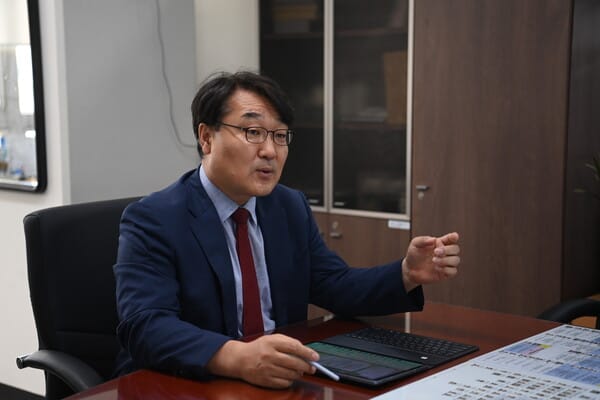
Moon Yang-taek, Director of Power Industry Policy at the Ministry of Climate, Energy and Environment (MCEE), is an energy and power industry expert who previously served as Director of Energy Technology and Director of Renewable Energy Industry and Supply at the Ministry of Trade, Industry and Energy (MOTIE).
He has worked as Director of the Power Industry Policy Division at MCEE and currently serves as Director of Power Industry Policy. We asked Director Moon about the direction and implementation plans for major policies including renewable energy expansion, electricity supply, and the integration of Gencos.
Renewable energy expansion towards 2040
In the short term, we plan for the government, local governments, and public sector to mobilize all resources centred on solar power, which can be completed quickly. In the medium to long term, we will focus on expanding offshore wind power following the implementation of the Special Act on the Promotion of Offshore Wind Power Deployment and the Development of Related Industries.
We will develop large-scale GW-class projects in areas with adequate grid capacity such as the Seoul metropolitan region and create mega-scale renewable energy complexes. We will identify sites for agrivoltaic and floating solar installations and make maximum use of idle spaces including factory roofs, roads, railways, schools, and parking lots.
For wind power, we will support timely completion through end-to-end close management including expedited approval processes, and expand supply infrastructure such as ports and shipyards. We plan to abolish the REC system and spot market, and unify them into competitive auction-based long-term fixed-price contracts to lower generation costs and business risk.
Securing stable electricity supply while expanding renewables
We are establishing a supply system that comprehensively considers power source composition, power grids, and storage devices. We will expand renewable energy as the main power source while harmoniously utilizing carbon-free sources such as nuclear power, and are reviewing balanced power source composition considering economic efficiency and carbon neutrality goals.
To compensate for changes in generation output according to weather and time of day, we will significantly expand flexible resources such as ESS and pumped-storage hydroelectricity and operate existing generation facilities flexibly. We will also strengthen power grids, enhance generation forecasting, and promote load shifting to encourage consumption during periods of high renewable energy generation.
In the 12th Basic Plan on Long-term Electricity Supply and Demand, we will forecast demand from mega-projects and electrification, and present supply measures that reflect regional and national supply-demand conditions and grid circumstances.
Changes citizens will experience in an 'electricity nation'
The energy system will shift from oil and gas to electricity-centred, and electrification will spread across industry, households, and transportation. Beyond simply increasing electricity consumption and facilities, citizens will have new choices and opportunities in how they use electricity.
By adjusting usage times to match time-of-use rates, citizens can reduce their bills. Using rooftop solar and ESS in homes and buildings, and vehicle-to-grid technology in electric vehicles, citizens can produce and store electricity and earn revenue by selling it during peak demand hours, allowing them to participate in energy production and trading.
Roadmap for realizing an electricity nation
We must transform the energy system to simultaneously achieve stable electricity supply, climate crisis response, and strengthened energy security.
We will expand clean power sources and power grids, and spread distributed power systems where electricity produced in regions is consumed in regions. We will enhance technological capabilities in future power industry technologies such as DC power grids, ESS, and virtual power plants, and cultivate competitive companies. We will support domestic technology and experience to lead to new market creation and overseas expansion.
Securing electricity for semiconductor industrial complexes
We will supply necessary electricity in a timely manner while considering overall national supply stability, regional demand and grid conditions, and characteristics of different power sources.
The Honam region has surplus generation capacity, so we will prioritize existing nuclear and renewable energy sources and already-planned generation facilities. For additional demand, we will expand renewable energy and ESS, and are reviewing the establishment of new combined heat and power generation considering the complex's heat and electricity needs.
For Yongin, we will prioritize the 3 GW of planned LNG generation and approximately 1 GW of combined heat and power generation within the complex, and supplement insufficient electricity with regional renewable energy and external power grids. Since the entire nation is connected as one grid, we plan to comprehensively prepare expansion plans for generation facilities and power grids at regional and national levels in the 12th Basic Plan.
Power grid construction plan for the Honam semiconductor complex
Before the complex begins operations, we will proactively construct one supply line connecting to Korea Electric Power Corporation's public grid and one substation within the complex.
The supply line will be built as an underground line passing through Provincial Route 49 in South Jeolla and Gwangju and the Hwangryong River to minimize inconvenience to residents. We will simultaneously pursue procedures that can be conducted in parallel including design and contracting, and shorten the construction period through simultaneous construction via work division and additional work teams during the construction phase.
Supporting domestic renewable energy companies against Chinese products
Strengthening the competitiveness of domestic supply chains is as important as expanding renewable energy distribution. In July, the establishment of a 'domestic production tax credit' in the solar and wind sectors was formalized as part of tax reform. This system reduces taxes in proportion to production volume when companies produce and sell specific items domestically, and is expected to help domestic companies secure price competitiveness.
In long-term fixed-price contract auctions, we will provide incentives such as preferential pricing and bonus points for facilities using domestic equipment, and are also promoting mandatory use of domestic equipment when participating in financing and subsidy support projects. We will also support research and development of next-generation solar cells such as tandem cells and ultra-large wind turbines.
Overall direction of the 12th Basic Plan
The goal is to proactively respond to new demand from AI and industrial electrification while simultaneously achieving carbon neutrality and stable electricity supply. Last month, we re-forecasted 2040 electricity demand reflecting mega-project plans, and presented ambitious renewable energy distribution targets that are achievable when government capabilities are fully mobilized.
Coal power generation will be phased out by 2040 as originally planned, but specific directions will be confirmed after gathering opinions through public forums. For nuclear power, we plan to review its role and appropriate level considering safety, economic efficiency, and supply-demand conditions, and through sufficient public deliberation.
New power sources will be composed primarily of carbon-free sources while preparing a balanced power source mix.
Significance and procedures for integrating five Gencos
The five Gencos each performed similar functions, and the expected competitive effects were limited, with inefficiencies such as redundant investment accumulating. To simultaneously pursue large-scale renewable energy investment and just transition following coal power phase-out, we need to consolidate dispersed capital and workforce.
Through integration, we aim to strengthen the leading role in energy transition and implementation capacity for just transition, and improve management efficiency. We will pursue enactment of special legislation to stably succeed the rights and obligations of the existing five companies and systematically implement integration procedures.
Before legislation is enacted, we plan to establish an integration preparatory committee to proactively determine organization, personnel allocation, operating systems, integration procedures, and overseas business matters.
Addressing employment and regional economy concerns from integration
There will be no artificial restructuring such as workforce reduction during the integration process. We are reviewing a plan to allocate approximately 1,800 of the roughly 2,400 head office personnel from the five companies to the integrated headquarters and approximately 600 to the regional renewable energy division.
Regional thermal power divisions will maintain their current system considering stable operations and on-site safety. During the future coal power phase-out and conversion process, we will reallocate personnel to new businesses according to just transition principles, and are also reviewing plans to establish additional regional renewable energy divisions if necessary.
Industrial electricity rate reform
In April, we reformed time-of-use rates, lowering daytime rates when solar generation is abundant and raising evening rates. This aims to efficiently utilize surplus renewable energy during the day and reduce companies' rate burden.
We are pursuing the introduction of a regional industrial electricity rate system by year-end. We will apply lower rates to non-Seoul metropolitan regions with abundant electricity to disperse demand concentrated in the Seoul metropolitan region. This will reduce electricity rate burdens for basic industries such as petrochemicals and steel located mainly in provincial areas and support mega-projects such as the Honam semiconductor cluster.
Reducing transmission tower construction and resident conflicts
Power grid expansion is unavoidable due to semiconductors, AI, and spreading electrification, but we must shift construction methods to prioritize resident acceptance.
We will minimize new transmission towers through consolidation with existing lines, integration between new lines, and expanded undergrounding. We will also strengthen transparency and democracy in site selection through expanded resident briefings, resident observation, and disclosure of meeting materials.
For villages where national backbone power grids pass through, we will establish 'grid sunshine income villages' to support income generation. We will listen to resident opinions and ensure regions receive tangible benefits while constructing necessary power grids in a timely manner.
Original Korean article: Energy News
English brief by Korea Wind Intelligence, koreawindintel.com



















