

As the government accelerates the rollout of solar and wind power to achieve 100 gigawatts of renewable energy by 2030, long-running domestic offshore wind projects are gradually coming on track. However, the supporting infrastructure such as specialized vessels and backup ports remains in its infancy, prompting warnings that preparations are needed before bottlenecks become a reality.
According to the offshore wind industry on September 28, 2026, Mokpo New Port in the Honam region is the only commercially operating backup port for offshore wind in South Korea. Even Mokpo New Port is a facility that SK Innovation E&S, the project developer of the Jeonnam P1 1st Phase, the first privately led commercial offshore wind complex in the country, has reinforced at its own expense by strengthening the seabed foundation and other elements.
Offshore wind backup ports must have bearing capacity and ample space because turbines and other power generation equipment are heavier and bulkier than general cargo.
Under the Fourth National Port Master Plan Revision (2026-2030), the government plans to coordinate with the MOF to develop offshore wind backup ports at seven locations including Samcheonpo New Port and Saemangeum New Port. However, only a few sites such as Boryeong New Port and Ulsan Port have concrete projects underway.
Mokpo New Port is also the hub for the Sinan Ui project, which recently held a groundbreaking ceremony. The project is expected to enter the turbine installation phase, including tower and blade installation, around mid-2028 after going through substructure installation processes, at which point full-scale use of Mokpo New Port will begin.
SK Innovation E&S, which operates Jeonnam P1 1st Phase at 96 megawatts, is constructing 2nd and 3rd phases on the adjacent site, each at 399 megawatts, aiming to operate a large complex totaling 900 megawatts. After completing the environmental impact assessment in August, the company plans to participate in fixed-price contract bidding in the second half of this year and aims for construction start in 2028, so there is a possibility it will return to Mokpo New Port between 2029 and 2030.
While the individual project schedules are unlikely to overlap directly, the problem lies ahead. Jeonnam Province and Sinan County, including Jeonnam P1 2nd and 3rd phases, aim to develop a total of 8.2 gigawatts of offshore wind capacity by 2035. If projects sequentially enter the construction phase, demand could concentrate on the limited backup port.
While the government is pushing to develop new backup ports and Mokpo New Port plans to expand its scale through third-phase backup facility development, actual implementation takes time. Projects must go through preliminary feasibility studies, budget securing, design and construction, and the backup port construction itself is known to take approximately two years.
Shortage of Specialized Offshore Wind Vessels
There is also a shortage of specialized offshore wind vessels. Currently, domestic wind turbine installation vessels (WTIVs) capable of installing 10-megawatt turbines are limited to Hyundai Steel Industries' Hyundai Frontier, the first domestically built model, and Samhae E&C's Hansan 1 and 2, which changed nationality after acquisition.
Hanwha Ocean, as the second purely domestically built model, is constructing a next-generation WTIV capable of installing 15-megawatt turbines at a cost of approximately 800 billion won, with completion expected in the first half of 2028. After completion, it is expected to be deployed first in the Sinan Ui project in which Hanwha Ocean participates.
Kim Jin-chul, representative of Jeonnam P1 and senior vice president of SK Innovation E&S's renewable energy business division, said regarding WTIV use that "when the next-generation WTIV being built by Hanwha Ocean is completed, demand for it will be high and competition to secure it will be fierce."
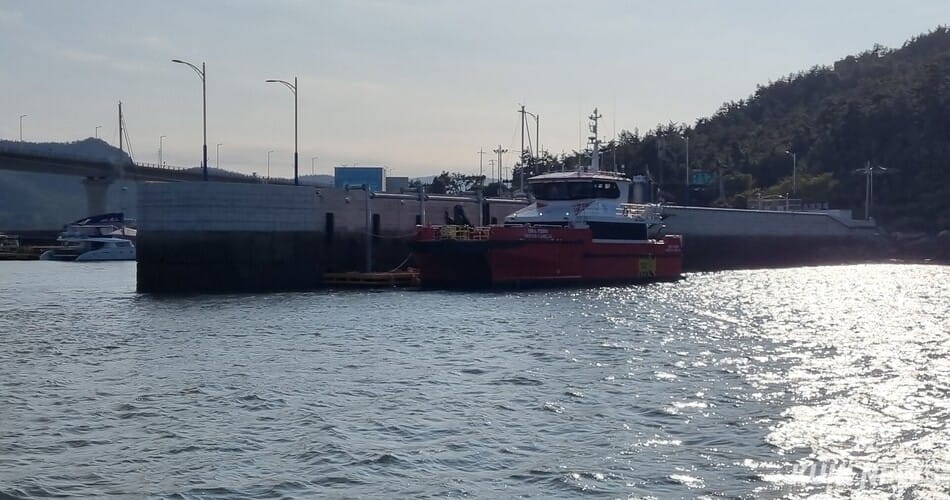
Additionally, demand for crew transfer vessels (CTVs), which are used for offshore wind maintenance, is surging. CTVs are vessels that rapidly transport workers, parts and equipment to offshore wind farms to support maintenance, and are key vessels used throughout the entire lifecycle from offshore wind construction to operation. They are equipped with special design to safely dock at towers and transfer personnel and equipment, as well as precision control systems.
As the government targets supplying 40.7 gigawatts of offshore wind capacity by 2038, the number of CTVs needed domestically is estimated at 50 to 60 vessels, but currently only around 10 vessels are actually in operation. In particular, Korean-type CTVs suited to Korean marine conditions and localization are necessary, and as offshore wind farms expand further offshore, a shift from existing 20-meter-class small CTVs to 25 to 30-meter-class medium vessels is also required.
Jin Song-han, director of the Korea Research Institute for Ships and Ocean Engineering, said at an offshore wind support vessel localization technology development and standardization strategy forum held in April that "to achieve the government's targets, 8 to 10 CTVs must be continuously supplied annually, but if we do not start immediately, we cannot meet this supply."
Supply Chain Must Be Built in Parallel
The offshore wind industry believes that if focus is placed solely on the speed of power plant development, port and vessel shortages could become a new bottleneck in the future. Since backup ports, WTIVs and CTVs are facilities and equipment difficult to secure in the short term, supply chains must be built together ahead of power generation project construction starts.
Democratic Party legislator Oh Se-hee emphasized that "offshore wind expansion extends beyond power generation equipment to related industries including vessels, equipment and operation services, and supply chain construction linked to the shipbuilding and equipment industries must be pursued proactively through localization."
Original Korean article: Kuki News
English brief by Korea Wind Intelligence, koreawindintel.com



















