A bill to integrate five state-owned power generation companies—Korea South-East Power, Korea Southern Power, Korea East-West Power, Korea Western Power, and Korea Midland Power (KOMIPO)—into a single entity is being pursued again.
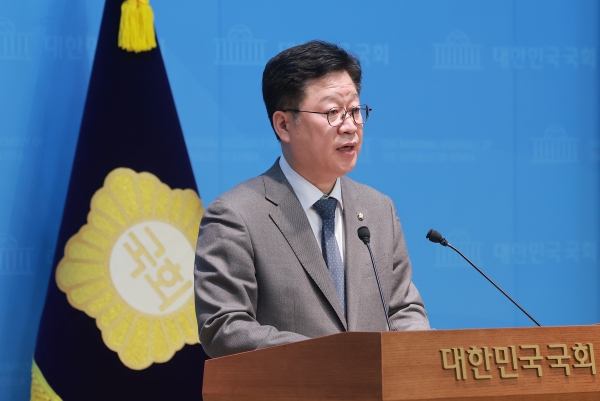
According to the National Assembly and the energy industry on the 23rd, Democratic Party lawmaker Ahn Ho-young plans to jointly introduce the "Korea Power Corporation Act" with fellow lawmakers from the Jeollabuk-do region on the 24th. The bill contains provisions to establish Korea Power Corporation by consolidating the five currently separate power generation public enterprises.
Based on reporting by Green Economy News, the proposed bill sets the capital of the newly established Korea Power Corporation at 32 trillion won, with the government to invest 51 percent or more. The bill designates as major business operations power resource development and power generation projects, as well as expansion and distribution of renewable energy, related research and technology development, overseas business, and investment and contributions. It also provides for the establishment of a "Renewable Energy Transition Headquarters" to oversee renewable energy projects exclusively, and specifies that Korea Power Corporation's main office and the Renewable Energy Transition Headquarters be located in Jeollabuk-do Special Self-Governing Province.
The five power generation companies currently operate as subsidiaries of Korea Electric Power Corporation, each running power plants and renewable energy projects. If the bill passes, it would represent a major reorganization of the state-owned power generation enterprise operating system for the first time since the power generation division of Korea Electric Power was separated during the 2001 restructuring of the power industry.
Earlier Integration Proposals
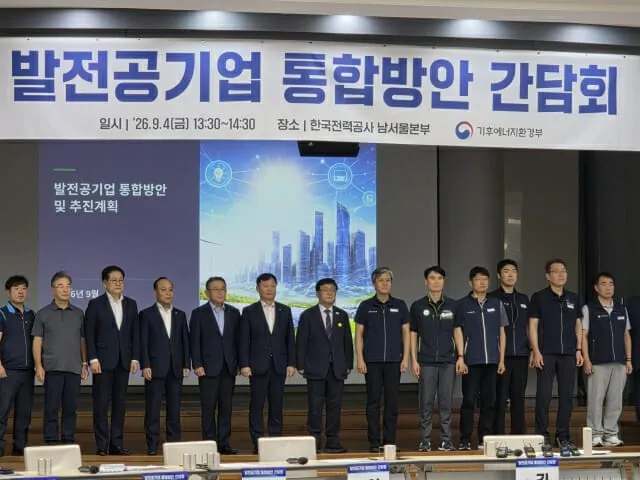
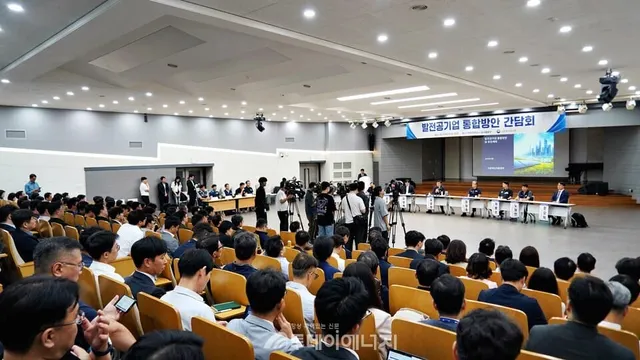
Discussion of integrating power generation public enterprises is not new. Previously, Democratic Party lawmakers Kim Ju-young, Park Hae-chul, and Lee Yong-woo, along with Progressive Party lawmaker Jung Hye-kyung, introduced a similar Korea Power Corporation Act with 32 trillion won in capital in December of last year. However, at that time, the Ministry of Climate and Energy and Environment stated that the scale of funding was excessive and lacked feasibility. The government has also separately reviewed integration plans. A research project on reestablishing the role of power generation public enterprises commissioned by the Ministry of Climate and Energy and Environment to Samil Accounting Corporation recommended in its interim report in June a "single-company integration plan" consolidating the five power generation subsidiaries into one as the optimal alternative. However, the same report also raised concerns that a single large public enterprise could impede fair competition in the power market and lead to inefficient management.
Lawmaker Ahn's office cited the emergence of redundant investment and business competition in the fragmented power generation public enterprise system, and limitations in consistently pursuing national-level energy transition strategy, as the background for pursuing integration. Lawmaker Ahn stated, "To secure stable power supply and demand, a public implementation system is needed to integrate dispersed public power generation capacity and consistently pursue expansion of renewable energy and transition of existing power sources." He added, "If the headquarters of Korea Power Corporation and the Renewable Energy Transition Headquarters are established in Jeollabuk-do, a new energy industry ecosystem can be created by linking Saemangeum renewable energy with Jeollabuk-do's hydrogen and carbon industries."
Path Forward
However, this plan remains at the stage of member-sponsored legislation. For the integration of the five power generation companies and relocation of headquarters to become reality, the bill must go through National Assembly review and discussions among stakeholders including the government, power generation public enterprises, and labor unions.
Original Korean article: Green Economy News