

Generation capacity of 53GW, equivalent to about 38 APR1400 reactors
Korea Power, which is set to launch in October next year, will be a company of what scale?
Looking at the global power market, there are large power generators like France's EDF and India's NTPC, where a single company operates tens of gigawatts of generation capacity. In the United States and Europe, there are also many power companies that operate power plants across multiple states or regions. Korea Power, which consolidates five state-owned Gencos into one, will enter the ranks of large power generators comparable in scale to these companies upon its launch.
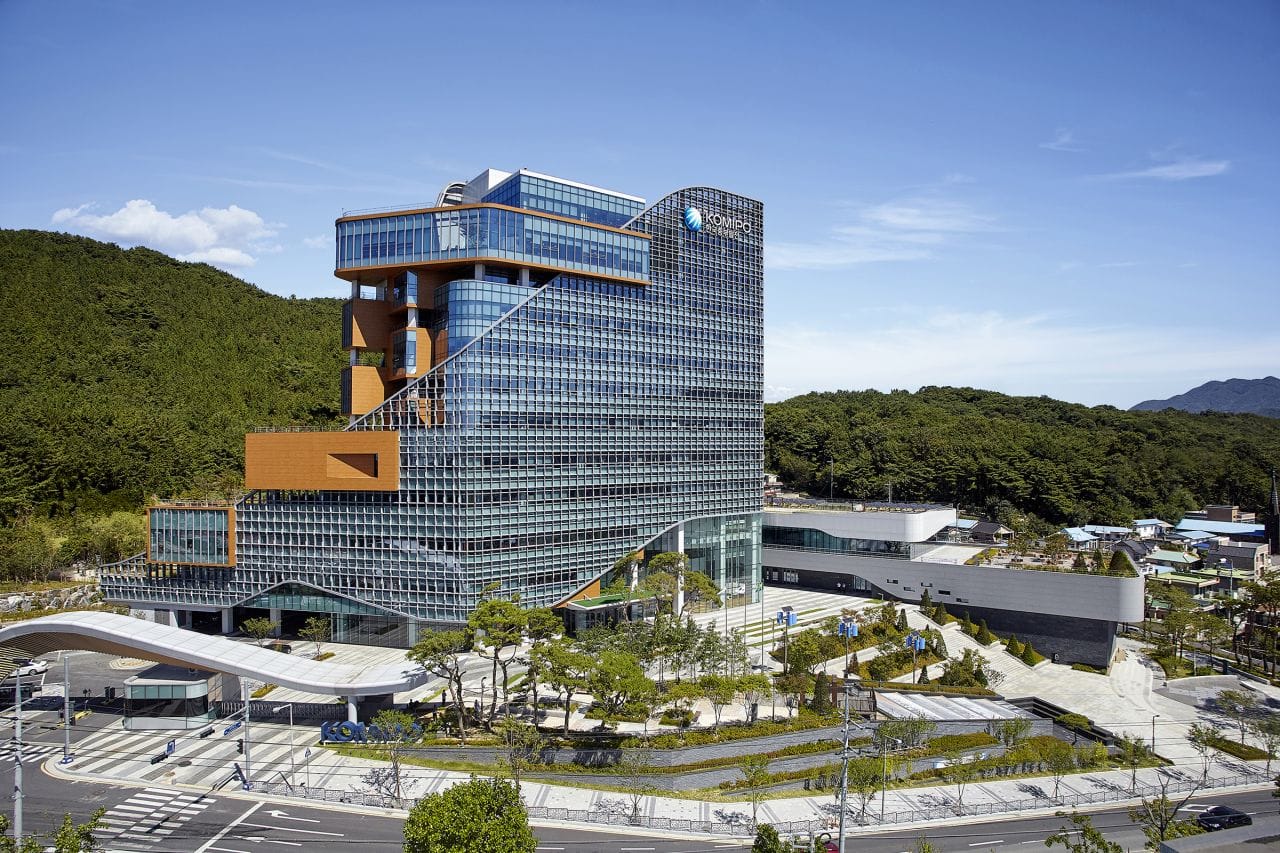
According to MCEE (Ministry of Climate, Energy and Environment) and the power generation industry on September 26, Korea Power, which combines KOEN (Korea South-East Power), KOMIPO (Korea Midland Power), KOWEPO (Korea Western Power), KOSPO (Korea Southern Power), and EWP (Korea East-West Power), will have generation capacity of approximately 53 gigawatts. In simple comparison with the 1.4GW capacity of the APR1400, the domestic mainstay nuclear reactor, this is equivalent to about 38 units. Based on 2025 financial results, the combined assets of the five Gencos will reach approximately 67 trillion won, with over 13,000 employees.
The government expects that when Korea Power launches, it will rank eighth globally in generation capacity, excluding Chinese companies. France's state-owned power company EDF has generation capacity of approximately 126GW, and India's largest state-owned power generator NTPC exceeds 90GW. Spain's Iberdrola stands at around 58GW, with a gap not significantly larger than Korea Power.
It is not merely a matter of similar size. Looking at what generation sources these companies possess reveals challenges that Korea Power will face going forward. EDF is centered on nuclear power, and Iberdrola has a high proportion of renewable energy. By contrast, of Korea Power's 53GW, coal accounts for approximately 32GW and liquefied natural gas for approximately 19GW. For Korea Power, which must simultaneously pursue the phased elimination of coal power and expansion of renewable energy, how to restructure its 53GW capacity will inevitably become a task after launch.
This is why the government has positioned renewable energy expansion as one of the key rationales for the integration of the five Gencos. Until now, the five power companies have each developed renewable energy projects such as solar and wind power, but going forward, the integrated corporation will concentrate capital and personnel to pursue large-scale projects.
Major overseas power companies are pursuing similar changes. Iberdrola has over 46GW of renewable energy among its total generation capacity. NTPC, which grew on the basis of coal power, is also expanding investment in renewable energy such as solar and wind, setting a target to secure 60GW of renewable energy capacity by 2032. For Korea Power as well, how to change its generation source composition becomes important alongside its external appearance as a power generator of global scale.
Fuel procurement by five companies now consolidated
As the company grows larger, an immediate change to expect is economies of scale. Since the five Gencos were separated from KEPCO's generation division in 2001, each has operated power plants and purchased fuel such as coal and LNG. Investment in generation capacity, overseas business, and renewable energy development have also been carried out by individual companies.
When Korea Power launches, these functions will also be consolidated. Fuel for power generation that the five companies previously purchased separately will be procured through unified purchasing, and investment in generation capacity will also be decided by a single company. The government expects that increased purchasing power will lower fuel costs and reduce duplicate investment and competition among companies.
Differences also emerge when pursuing large-scale projects. Instead of dividing renewable energy projects requiring large initial investment, such as offshore wind or large-scale solar, among individual companies, capital and specialized personnel can be concentrated in one place. In overseas power generation business as well, integrated corporate-level investment decisions and business development become possible rather than the five companies competing individually.
Integration more complex than power plants: 575 systems consolidated into one
However, changing the company name to one does not complete the integration work. The five Gencos have operated as separate companies for over 20 years since their separation in 2001. Personnel, accounting, and contracts, as well as information technology systems, have been built separately for each company.
The systems and software currently operated by the five Gencos total 575. Before Korea Power's launch, core systems including enterprise resource planning must be integrated, and standards for organization, personnel, accounting, and contracts must be unified.
This is why the government has set aside approximately one year of preparation period before the corporation's launch. Centered on an integration preparation committee chaired by the second vice minister of the climate ministry, KEPCO and the five Gencos participate in integration work across areas including organization, personnel, finance, and IT.
After integration, the organization will not focus solely on operating existing thermal power plants. The government plans to establish four headquarters at the integrated headquarters: a renewable energy headquarters, a just transition headquarters, a safety technology headquarters, and a planning and management headquarters, with three to four regional renewable energy headquarters to be established nationwide. Korea Power will also handle workforce reallocation and new renewable energy projects that arise during the coal power phase-out process.
Since the five Gencos will be consolidated into a single company for the first time in 26 years following the 2001 separation of the generation sector, how stably different organizations and systems are integrated is expected to be key to Korea Power's smooth transition. Climate Minister Kim Sung-hwan recently said regarding the integration of the five Gencos: "In a situation where 52 coal power plants are phased out sequentially, the integrated corporation of the five Gencos should be viewed as operating as an integrated body for effective transition rather than as a market-dominant developer in the energy industry."
Original Korean article: view.asiae.co.kr
English brief by Korea Wind Intelligence, koreawindintel.com



















