

Combined interest coverage ratio falls from 1.1x to 0.3x
South Korea's five Gencos are projected to be unable to cover even interest payments from operating earnings starting in 2028. Combined operating profit expected at 1.0569 trillion won this year is forecast to swing to a 224.8 billion won deficit by 2030. The government has moved to consolidate the five Gencos to boost their capacity for renewable energy investment, but the financial strength of the power generation companies that would undertake such investment is weakening.
Confirmed alternative investment totals 22.5 trillion won
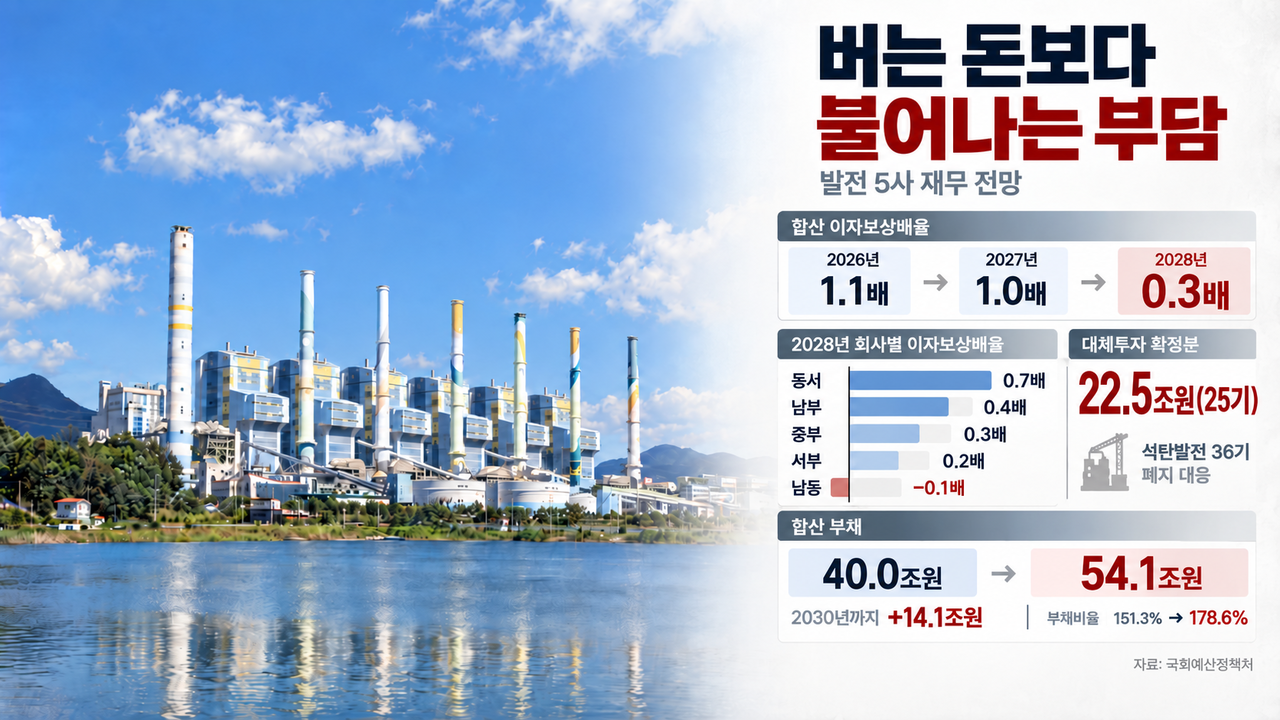
According to a report on public institutions released by the National Assembly Budget Office on September 29, the five Gencos' combined interest coverage ratio will fall from 1.1x this year to 1.0x next year and 0.3x by 2028. The interest coverage ratio is calculated by dividing operating profit by interest expense. A ratio below 1.0x means operating profit alone cannot cover all interest costs. While this year the companies barely cover interest, by 2028 the five Gencos' combined operating profit will cover only about 30 percent of interest expenses.
By company in 2028, the ratios are: KOEN (Korea South-East Power) minus 0.1x, KOWEPO (Korea Western Power) 0.2x, KOMIPO (Korea Midland Power) 0.3x, KOSPO (Korea Southern Power) 0.4x, and EWP (Korea East-West Power) 0.7x. All fall below 1.0x. This condition is expected to continue through 2030, with all five companies recording below 1.0x for three consecutive years.
The financial burden stems from massive replacement investment following the shutdown of 36 coal-fired power plants. The total project cost for 25 units with confirmed replacement equipment budgets reaches 22.481 trillion won. The government has mandated that 27 units shutting down by 2036 be converted to LNG, while 9 units shutting down in 2037 and 2038 be converted to pumped-storage hydroelectric, hydrogen-fired, and other facilities.
Individual replacement projects carry trillion-won price tags. The Gokseong pumped-storage facility replacing Dangjin Unit 7 requires 1.6474 trillion won, while the Bonghwa pumped-storage facility replacing Boryeong Unit 4 requires 1.7243 trillion won. The Hadong combined-cycle plant replacing Hadong Units 2 and 3 costs 1.3803 trillion won, and the Yongin combined-cycle Units 1 and 2 replacing Dangjin Units 3 and 4 cost 1.8811 trillion won. Eleven additional units have unconfirmed replacement equipment or total project costs, so investment burdens could grow further.
Costs also accumulate at plants scheduled for shutdown before closure. Over the past five years, the five Gencos invested 3.71 trillion won in environmental equipment upgrades, performance improvements, planned preventive maintenance, and denitrification and desulfurization equipment maintenance at the 36 units slated for closure. These are unavoidable expenditures to meet environmental and safety standards during operation.
Consolidation eases borrowing burden but full effects remain unclear
Large-scale investment also increases debt burdens. The five Gencos' combined debt is projected to rise from 40.0037 trillion won this year to 54.0777 trillion won by 2030, an increase of 14.074 trillion won or 35.2 percent. Over the same period, the debt-to-equity ratio rises from 151.3 percent to 178.6 percent.
The government plans to ease these financial constraints through consolidation. On September 3, through the "Public Institution Functional Reform Implementation Plan," it announced plans to consolidate the five Gencos into one entity, pool human and material resources, and secure investment capacity for renewable energy. When the Budget Office assumed the five Gencos borrowed 750 billion won for equity investment in a 500 MW offshore wind project and applied this to their financial position at the end of last year, individual Gencos' debt-to-equity ratios rose by 11.9 to 15.2 percentage points, but the combined increase was only 2.7 percentage points. Combining operations reduces the financial impact of the same scale of borrowing.
However, the full financial effects of consolidation have not been calculated. A research project on Genco structural reform released in June concluded that expanding borrowing capacity and increasing capital are necessary for the consolidated entity's large-scale conversion investment. The Budget Office noted that "it is difficult to confirm the financial effects of consolidation because cost savings and costs arising from the consolidation process have not been calculated." It also assessed that "financial impacts from the five Gencos' coal plant shutdowns have not been quantified, so the scale of burden the consolidated entity will assume remains unclear." The Budget Office concluded that consolidation costs and benefits must be weighed together.
Original Korean article: Electric Times
English brief by Korea Wind Intelligence, koreawindintel.com



















