A legal basis has been established to convert the Renewable Energy Portfolio Standard (RPS) into a government competitive bidding contract market and to allow priority grid access for community-participated renewable energy projects. Additionally, systems are being introduced to expand the grid in line with increased generation capacity, including allowing shared connection facilities for renewable energy and private sector participation in constructing the national backbone power grid.
According to relevant industry sources on the 21st, the National Assembly passed seven laws related to renewable energy and the power industry through a plenary session on the 20th, including amendments to the Electricity Business Act, the Special Act on Activation of Distributed Energy, the Act on the Promotion of Development, Use and Supply of Renewable Energy, the Electric Power Source Development Promotion Act, the Special Act on the Expansion of the National Power Grid, the Special Act on Support for Coal-Fired Power Plant Workers and Closed Areas, and the Act on the Transboundary Movement of Waste and Its Treatment. The government assessed that institutional foundations have been established to support renewable energy expansion and timely construction of the power grid through these amendments.
Transition to Contract Market: First Steps with Transitional Measures and Pricing as Follow-up Tasks
The most significant change is the overhaul of the RPS, which was introduced in 2012. Following amendments to the Act on the Promotion of Development, Use and Supply of Renewable Energy, the existing supply obligation-centered RPS will transition to an installed capacity supply obligation and a government competitive bidding contract market system. Issuance of Renewable Energy Certificates (RECs) for new renewable energy facilities will be halted from next year, and operators will be selected through competition in generation source-specific contract markets. Winning facilities will enter into long-term fixed-price power purchase agreements with Korea Electric Power Corporation.
For existing operators, REC issuance will be maintained, and the REC spot market will remain in place for three years after the law takes effect, with abolition scheduled for January 1, 2030. A separate market for small-scale facilities will also operate.
However, the scope of transitional measures for operators who have not yet received RPS facility confirmation has not been finalized. Among business progression stages—from power generation business licensing through development permission, construction plan notification and approval, pre-operation inspection, and commercial operation—the point at which to include existing RPS applicants is expected to emerge as a future point of contention. The Ministry of Climate and Energy plans to review application standards and specify details through subordinate regulations and operational guidelines.
The Korea Solar Energy Association stated in a position paper that "there are positive aspects to the policy direction of improving revenue predictability and financial accessibility through transition to a contract market," while adding that "the transition process must guarantee operators' choice among diverse power trading methods, including stable trading environments for existing REC operators, separate markets for small-scale power generators, and direct PPAs."
The association emphasized that follow-up institutional design is important, as contract market participation conditions and price determination methods—which directly affect business viability—remain to be addressed through subordinate regulations and operational standards.
The wind power industry also agrees with the direction of the contract market transition but views as critical how the new system will reflect the economic viability supplementation function that existing REC weighting factors previously provided.
Wind power requires extended periods for power generation business licensing, wind resource assessment, environmental impact evaluation, community consultation, and grid review. Moreover, a considerable number of projects have been developed on the premise of existing RPS and REC weighting factors.
The Korea Wind Energy Industry Association stated in a welcoming statement that "if a contract market centered on long-term fixed-price contracts becomes stably established, it will reduce uncertainty in wind power projects and positively contribute to long-term investment and industrial ecosystem development," while also noting that "the scope of existing operators and transitional measures must be clarified, and a rational premium (α) system considering the economic viability of existing projects must be established."
The association emphasized that the new pricing system must reflect wind power's characteristic of large cost variation depending on project conditions such as water depth, grid connection distance, substructure and submarine cable conditions, and community participation. It explained that there is a need to present a pricing system and premium adjustment plan reflecting location, grid, and community participation, along with a medium- to long-term roadmap, so that the economic viability supplementation function previously handled by existing REC weighting can continue in the contract market.
Additionally, the reduction rate for rental fees when national property is used in renewable energy projects will be expanded from the existing 50 percent to 80 percent. The plan aims to lower costs of national land use and thereby reduce power generation costs. The Ministry of Climate and Energy explicitly added industrial complexes and installed renewable energy facilities of resident companies to the targets of renewable energy supply projects, establishing legal grounds to expand government support projects targeting factory rooftop solar installations.
Lowering Grid Barriers and Expanding Power Networks: Addressing Connection Solutions
Through amendments to the Electricity Business Act and the Special Act on Activation of Distributed Energy, priority grid access rights are granted to public-interest community-participated renewable energy projects such as sunshine income villages. Accordingly, small-scale public-interest community-participated projects of 1 megawatt or less promoted in areas near the national backbone power grid will be able to connect to power facilities ahead of other electricity businesses. The measure aims to resolve delays in community-participated projects due to grid shortages and to promote increased community income and regional economic activation, taking effect three months after promulgation.
Separate from the intent of expanding community participation and returning generation profits to regions, the equity issue of preferentially allocating limited grid capacity to specific projects remains an unresolved challenge.
The Korea Wind Energy Association argued that "the rights of existing grid connection applicants must not be infringed. In a situation where not a small number of operators are awaiting grid reinforcement after already obtaining power generation business licences and permits, granting priority to new policy projects could further delay connection timing for existing operators," and called for clear transitional measures and protection standards for existing grid connection applicants, as well as objective detailed standards to assess the degree of community participation, profit-sharing structure, and public interest of priority connection targets. The association also stated that information such as available grid capacity, expected connection timing, and future reinforcement plans should be transparently disclosed so that power generation operators can confirm them in advance.
Systems for grid expansion have also been added. Following amendments to the Special Act on the Expansion of the National Power Grid, private sector participation in power grid construction is temporarily permitted. Currently, construction of the national backbone power grid is undertaken by Korea Electric Power Corporation, the transmission operator, but henceforth, following a resolution by the Power Grid Expansion Committee, private operators may also participate in development projects. Upon completion of development, facilities must be immediately transferred to Korea Electric Power Corporation, and the validity period of the private participation clause extends to December 2029. The government expects to respond to surging power grid construction volumes and accelerate timely construction through role-sharing between Korea Electric Power Corporation and the private sector.
The National Assembly, considering concerns about "power grid privatization" from private sector participation in national backbone power grid construction, attached supplementary opinions requiring facilities to be transferred to Korea Electric Power Corporation after project completion, while having the government manage total project costs to prevent excessive profits for private operators and requiring Korea Electric Power Corporation to submit related information to the National Assembly.
Additionally, through amendments to the Electricity Business Act and the Electric Power Source Development Promotion Act, new legal grounds have been established for "shared connection facilities for renewable energy," allowing multiple renewable energy power plants to jointly connect to the grid through a single facility instead of each constructing separate connection equipment. The core element is to shorten facility construction periods by granting shared connection facility construction operators the status of power source development operators and applying permit exemptions. This is expected to reduce construction cost burdens from individual connections and mitigate problems of haphazard land development.
The Korea Wind Energy Association evaluated the institutional improvement positively, emphasizing that "given the limitations of a competitive approach where existing operators and community-participated operators compete over grid connection order with limited grid capacity, renewable energy generation capacity expansion and transmission and distribution network expansion must be pursued at the same pace."
The Electricity Business Act also includes provisions to reorganize the power generation business licensing and permit management system. To integrate licensing and permit management and enhance administrative efficiency and transparency, the plan includes introducing a notification system for electricity business permits, establishing grounds for sanctions on unauthorized stock acquisition, and constructing an electricity business information system.
The five acts that reach offshore wind
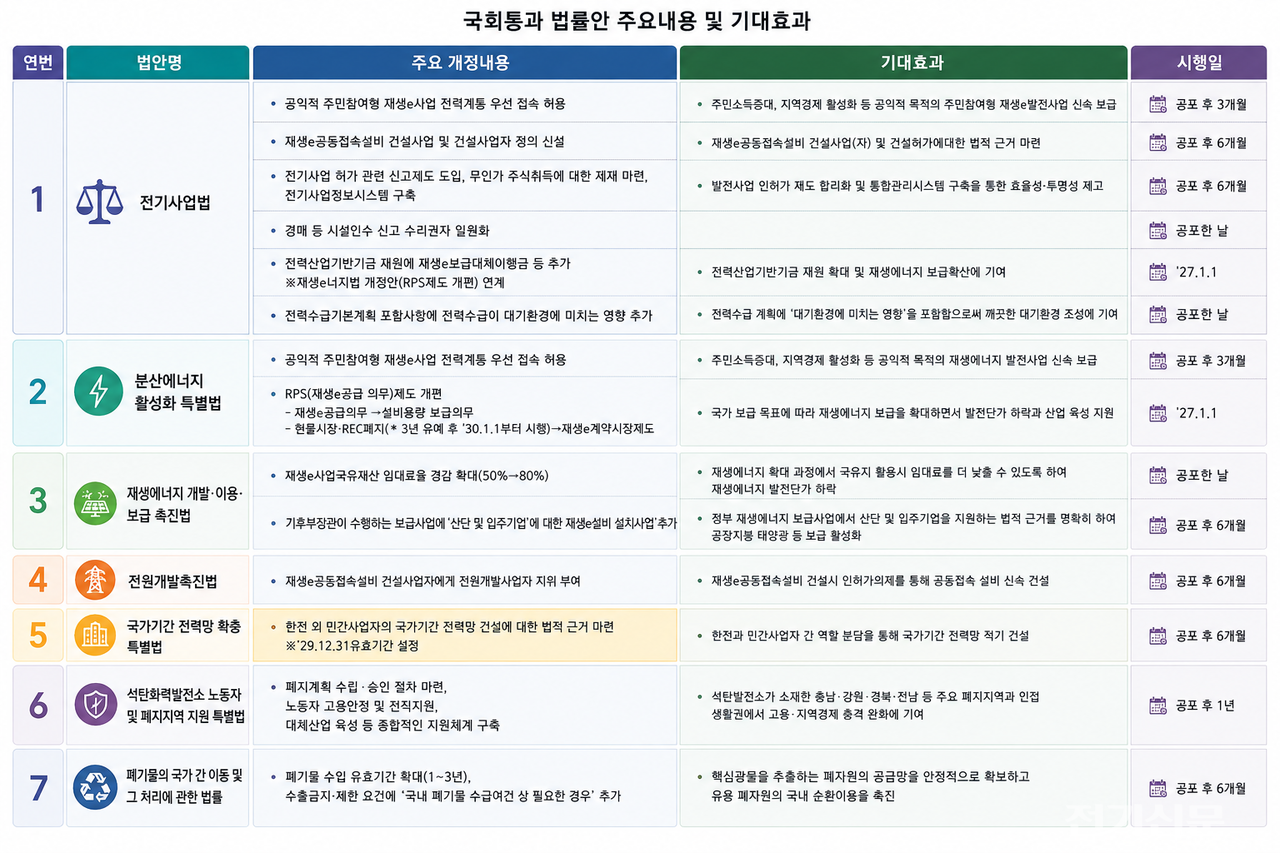
Seven bills cleared the National Assembly on 20 August. Five of them change rules that offshore wind projects work under, and the sections below take each in turn. Two others, covering support for coal plant workers and closure regions and the transboundary movement of waste, do not bear on the sector and are left aside. Effective dates run from promulgation unless a calendar date is given. English titles follow the official translations published by the Korea Legislation Research Institute, and the substance follows the Ministry of Climate, Energy and Environment briefing of the same day.
Electric Utility Act
The broadest of the seven, and the one that matters most here. It creates a statutory definition for shared renewable grid connection facilities and for the companies that build them, giving those assets and their construction permits a legal footing they did not previously have, six months after promulgation. The ministry names offshore wind directly as the reason. As renewable capacity grows, connecting each project to the grid separately drives up connection costs and raises concerns about disorderly land use, so the law is meant to let multiple projects share a connection.
Four further changes come with it. Generation licensing acquires a notification regime, unapproved share acquisitions become sanctionable, and an electricity business information system is to be built, all six months after promulgation. Authority to receive facility transfer notifications, including those arising from auctions, is consolidated under a single body from the date of promulgation. From 1 January 2027, renewable supply substitute payments are added to the revenue of the Electric Power Industry Basis Fund, a change the ministry ties to the RPS overhaul carried in the renewable energy act. The Basic Plan on Long-term Electricity Supply and Demand must now weigh the effect of supply and demand on air quality.
The act also opens priority grid connection to community-participation projects, three months after promulgation. This is narrower than it sounds. The ministry describes it as an exception for small projects of 1 MW or less sited near national grid corridors, which places offshore wind outside its scope. Transmission and distribution licensees currently must give all electricity businesses non-discriminatory access, and the amendment allows public-purpose renewable projects to connect ahead of other business.
Special Act on Activation of Distributed Energy
One provision only. It carries the same priority grid connection rule for community-participation projects, three months after promulgation, subject to the same 1 MW threshold.
Act on the Promotion of the Development, Use and Diffusion of New and Renewable Energy
This is where the RPS is replaced, fifteen years after the standard was introduced in 2012. The ministry's assessment is that the RPS expanded deployment but did little to bring generation costs down or build a domestic industry. The obligation shifts from supplying renewable electricity to deploying installed capacity, and the mechanism moves to a government competitive-bidding contract market of the kind most major markets already run. New capacity bids by generation source, competing within an announced volume and a price ceiling on an installed-capacity basis, and KEPCO signs long-term fixed-price purchase agreements with the winners. The ministry states the aim plainly, which is stable revenue, lower financing costs and improved bankability. The provisions take effect on 1 January 2027.
Renewable energy certificates stop being issued to new facilities from next year. Existing project developers keep receiving them, and the REC spot market is abolished after a three-year grace period from the act taking effect, which the ministry dates to 31 December 2029. Separate market arrangements for small facilities and transitional measures are included to protect existing positions through the changeover. State-owned generators take on a new obligation to install a set volume of renewable capacity themselves.
Two smaller changes sit in the same act. Rent relief on state-owned property used by renewable projects widens from 50 percent to 80 percent, effective on the date of promulgation. Installation of renewable facilities for industrial complexes and their tenant companies is added to the deployment programmes run by the Minister of Climate, Energy and Environment, six months after promulgation.
Electric Power Source Development Promotion Act
A single provision, and the counterpart to the shared connection rules above. Companies constructing shared renewable grid connection facilities are granted the status of electric power development project developer, six months after promulgation. That status carries deemed permits, which is the mechanism the ministry expects to shorten construction of shared connection assets.
Special Act on the Expansion of the National Power Grid
National grid construction is currently reserved to KEPCO as the licensed transmission business, and the ministry's position is that KEPCO alone cannot deliver the present build volume on time. Private companies gain a route in, six months after promulgation, but on conditions. Participation requires a resolution of the Power Grid Expansion Committee. Once a project is complete the builder must transfer the facility to KEPCO immediately. The enabling provision itself is temporary, carrying a sunset at the end of December 2029.
Expected effects described above are the ministry's own, as set out in its briefing of 20 August 2026 and the accompanying summary table, and are reproduced here without endorsement. The briefing is a summary rather than the statutory text, and operative wording should be read from the acts as promulgated.
Original Korean article: Electric Times