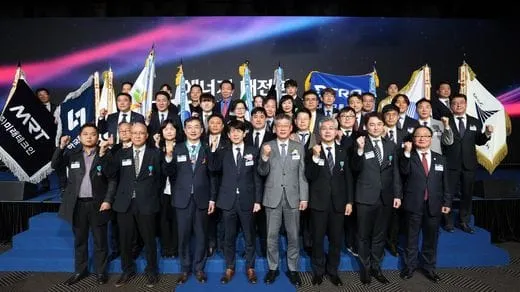
The Korea Wind Energy Industry Association, headed by chairman Kim Gang-hak, has joined hands with the Ministry of National Defense. The goal is to resolve one of the most challenging hurdles in offshore wind projects: the military operational review.
The association announced that on August 27, chairman Kim visited the Ministry of National Defense and held talks with Minister Ahn Kyou-baek to convey industry concerns and proposals for regulatory improvements. Vice chairman for external cooperation Jeong Jong-young and director of external cooperation Choi Deok-hwan also attended.
Offshore wind is a core energy project being pushed by the government. But the gap between plans and reality is large.
According to statistics from the New and Renewable Energy Center of the Korea Energy Agency, the cumulative installed capacity of wind power in South Korea at the end of 2024 was approximately 2.27 GW. This is one-fourteenth the level of solar power, which stands at about 32 GW. New installations also declined from 238 MW in 2022 and 219 MW in 2023 to 113 MW in 2024.
The government's targets are different. The Basic Plan on Long-term Electricity Supply and Demand calls for wind power capacity to increase from 3 GW in 2025 to 18.3 GW in 2030, 35.5 GW in 2036, and 40.7 GW in 2038. Looking at the 2030 target alone, capacity must nearly increase eightfold from current levels.
Multiple hurdles to clear
By the numbers, there is a long way to go. The bigger problem is that building a single wind power plant requires clearing many hurdles.
The process involves site selection, environmental impact assessment, consent from residents and fishermen, power grid connection, and various permits. Offshore wind adds one more step: military operational review. Large-scale wind turbines built at sea can affect military radar and surveillance systems, aircraft operations, and maritime operations. This is why the wind industry is focused on the Ministry of National Defense.
Chairman Kim said on the day, "Offshore wind is a major national policy task and a core pillar of the renewable energy industry that will determine South Korea's future competitiveness. Since security-related consultations, including military operational review, become a major turning point in projects, I hope the Ministry of National Defense will cooperate actively and constructively within the framework of a national strategic industry."
Minister Ahn responded in kind. He said, "I deeply understand the importance of offshore wind for implementing carbon neutrality and securing energy security. We will seek ways to cooperate in building an offshore wind ecosystem within a range that does not interfere with military security and readiness posture."
Experience from Nagwol project
Chairman Kim is a businessman with long experience in wind development and serves as chairman of Myungwoon. After entering the onshore wind business in 2013, he has been pursuing the Nagwol offshore wind project off the coast of Yeonggwang in South Jeolla Province since 2017. The Nagwol offshore wind project is a large-scale undertaking of 364.8 MW with major participation from domestic equipment manufacturers. Based on this experience, Kim was elected as the eighth chairman of the Korea Wind Energy Industry Association this year.
Why the sea is the future
The sea is likely to become the center of wind power expansion. Onshore wind faces high barriers from mountain damage, public acceptance, and lack of suitable sites. By contrast, the sea allows for large-scale complexes. This is why the government is focusing intensively on offshore wind.
But the sea's vastness does not make projects easy. Rather, the interests involved are more complex. There are fishing rights and shipping lanes. There are military operation zones and insufficient power grids. Ports for installing turbines and installation vessels are needed. Offshore wind is not simply about building a power plant but about moving an entire industrial ecosystem.
When a large-scale offshore wind market opens, related industries move together, from turbines and blades to towers, subsea cables, installation vessels, ports, and maintenance. Conversely, if permits and grid connection are blocked, projects remain on paper. Investment from domestic companies becomes difficult to follow.
Ultimately, the key is speed. It is important to establish criteria that developers can predict without compromising military operations and national security. This is why procedures matter: consulting with the Ministry of National Defense on site selection from the project's early stages, filtering out areas with major operational concerns in advance, and quickly finding committee alternatives for adjustable projects.
Original Korean article: Chosun Ilbo