

The government will invest 1,000 trillion won in green transition over the next decade, combining fiscal spending and policy finance, and will launch the Korean-style Green Transformation (K-GX), which will reshape industrial structure across the board from decarbonizing core industries such as steel and petrochemicals to renewable energy, power grids, electric vehicles, batteries, small modular reactors, hydrogen and carbon capture, utilization and storage.
While carbon neutrality policies to date have focused on how much greenhouse gas will be reduced, this strategy is notable for expanding carbon reduction into an industrial and economic strategy that links it to new manufacturing and export industries, regional investment and job creation.
The government is not directly injecting 1,000 trillion won in fiscal spending alone. From 2026 to 2035, it will establish a support system totaling 1,000 trillion won by combining 200 trillion won in fiscal spending and climate finance of 790 trillion won or more through five policy finance institutions: the Industrial Bank of Korea, the Korea Development Bank, the Export-Import Bank of Korea, the Korea Credit Guarantee Fund and the Korea Technology Finance Corporation.
On top of this, the private sector will pursue investment of 220 trillion won centered on K-GX signature projects. The plan is for government fiscal spending and policy finance to share initial risks, draw in private capital and link it to large-scale industrial investment.
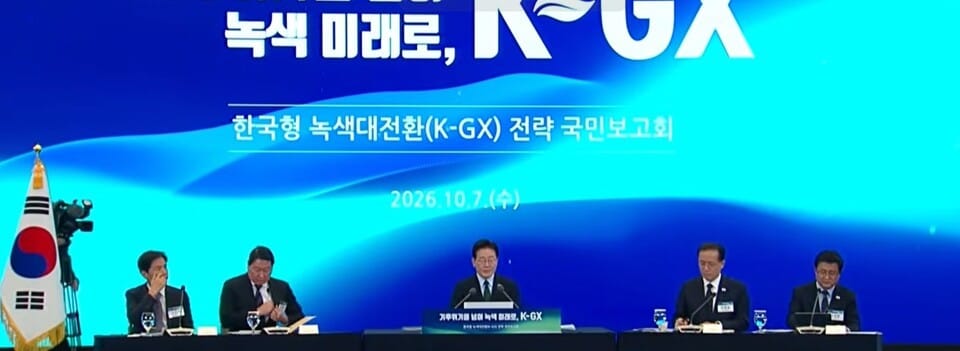
The government held a K-GX Strategy National Report meeting on October 7 at the Korea Chamber of Commerce and Industry International Conference Hall in Seoul and announced the K-GX strategy to be pursued over the 10-year period from 2026 to 2035.
This strategy was prepared based on discussions by a public-private K-GX promotion task force that included the Ministry of Economy and Finance and MCEE (Ministry of Climate, Energy and Environment), along with related ministries covering science and technology, industry, territory, agriculture and food, marine and fisheries, labour and small business, as well as economic organizations such as the Korea Chamber of Commerce and Industry and major industry associations and organizations.
The government has set the direction of K-GX along three axes: K-GX as a new growth engine, K-GX for all and sustainable K-GX.
The biggest shift is that carbon neutrality is no longer confined to the realm of environmental policy but is now bundled into a single strategy encompassing industrial policy, energy policy, finance and taxation, regional balanced development and labour transition.
Industrial Decarbonization and Green Steel
In the industrial sector, production processes in high-emission industries that are core to Korean manufacturing, steel, petrochemicals, cement, semiconductors, displays and refining, will be converted to low-carbon structures.
For steel, the goal is to conduct a demonstration project for 300,000-ton-class hydrogen-reduced iron production by 2030 and to secure a foothold in the global green steel market through mass production of hydrogen-reduced steel in the long term.
Hydrogen-reduced steel is a technology that uses hydrogen as a reducing agent instead of coal used in existing blast furnaces and is regarded as a next-generation process that can significantly reduce carbon emissions in the steel industry.
However, commercialization cannot be achieved through technology development alone. Large-scale clean hydrogen supply, stable electricity and massive capital investment to replace existing blast furnaces are needed simultaneously.
The government has decided to establish clean hydrogen production bases and to prepare measures to stably supply affordable electricity on the premise of corporate investment, because the competitiveness of hydrogen-reduced steel can be significantly affected by the price of hydrogen and electricity.
In petrochemicals and refining, the government will develop technology for naphtha cracking facilities using electricity and expand the use of environmentally friendly fuels. In cement, it will secure low-carbon technologies such as multi-component blended cement. In semiconductors and displays, it will promote technology development to replace high-greenhouse-effect gases used in manufacturing processes with substances with lower global warming potential.
An important shift in this strategy is that industrial decarbonization can be linked from regulatory compliance to product competitiveness.
As the carbon emissions from product manufacturing processes increasingly influence supply chains and purchasing decisions in global markets, companies that first commercialize low-carbon steel, chemical products and semiconductors are more likely to secure new high-value-added markets.
Therefore, if K-GX proceeds as planned, high-emission domestic industries are expected to see expanded industrial innovation investment that goes beyond policies that burden carbon reduction costs to convert production processes themselves into next-generation technology.
Renewable Energy and Power Grid Expansion
In the energy sector, early achievement of 100 gigawatts of renewable energy capacity by 2030 is presented as a core goal.
The government will expand the location and business sites for solar and wind power, lower the cost of electricity generation and expand power grids to accommodate large-scale renewable energy facilities.
By 2030, the government will replace existing transmission lines with high-capacity lines to secure additional transmission capacity and plans to foster direct current transmission and distribution industries to efficiently deliver power from renewable energy generation areas to demand centers.
This means that the focus of renewable energy expansion policy is shifting from simply expanding generation capacity to designing generation, transmission, distribution and demand together.
If only renewable energy facilities are increased without accompanying grid expansion, output control that limits generation may increase and it becomes difficult to supply electricity needed by industrial complexes in a timely manner. This is why power grid investment is presented as foundational infrastructure for K-GX.
Transportation Electrification and Green Industries
In the transport sector, the government will pursue electrification of virtually all modes of transportation beyond conversion centered on passenger electric vehicles.
The government will establish an environmentally friendly fuel subsidy system under the goal of converting 70 percent or more of new vehicles to electric and hydrogen vehicles by 2035 and will reform the electric vehicle subsidy system taking into account regional renewable energy production conditions.
Plans include expanding electrification to public transport such as railways and buses as well as two-wheeled vehicles, construction equipment and ports and ships.
As the scope of electrification expands, it is expected to affect demand expansion in related industries including batteries, chargers, power semiconductors, power equipment, energy storage systems and charging services, in addition to the automotive industry.
To link such industrial transformation to new export industries, the government has selected ten green industries: electric vehicles, batteries, solar, wind, small modular reactors, power equipment, power semiconductors, heat pumps, hydrogen and carbon capture, utilization and storage.
The government will support demonstration and commercialization of next-generation electric vehicle drive motors with reduced rare earth use and next-generation batteries such as solid-state batteries and will promote commercialization and mass production of next-generation solar cells by 2028. It will also work to rebuild domestic supply chains by designating solar core materials as economic security items.
The government will introduce domestic production tax credits for core components and equipment in solar, wind and secondary batteries and will pursue designation of small modular reactors as national strategic technology.
Such policies are expected to shift the focus of green industry development policy from simple expansion of supply to securing domestic manufacturing capacity.
Even if renewable energy and electric vehicle supply increase, if core materials, components and equipment depend on imports, domestic investment and job creation effects will be limited and the country will be vulnerable to supply chain shocks.
However, for policies supporting domestic production to secure long-term competitiveness, they need to have a structure that connects not only subsidies or tax benefits but also production costs, technological capability and overseas market entry.
In particular, power-intensive green industries and hydrogen-reduced steel are likely to be directly affected by electricity prices in investment competitiveness, so establishing a stable zero-carbon and low-carbon power supply system will need to be pursued alongside industrial policy.
Climate Technology and Regional Development
In the climate technology sector, the government will establish a support system tailored to each stage of corporate growth from early startup to growth and expansion.
It will expand innovative research and development and demonstration test beds and will pursue package support of up to 10 billion won for promising climate technology companies. It will also pursue enactment of related legislation to support the industry ecosystem.
Climate technology must be validated in actual industrial facilities and city and energy infrastructure before entering the market, so expanding demonstration projects is expected to help reduce the so-called valley of death in technology commercialization.
K-GX is also combined with regional policy.
The government will discover K-GX models reflecting regional industry and energy conditions centered on five regional hubs and three specialized zones.
In Naju, the government will pursue an energy-specialized city centered on KEPCO (Korea Electric Power Corporation) and Korea Energy Engineering University that connects technology development with investment and startups.
In Jeju, the government will demonstrate a carbon-neutral model combining heat pumps, energy storage systems, distribution networks and virtual power plants with the goal of converting all new vehicles to electric vehicles by 2035.
If the structure of consuming renewable energy produced in regions for regional industry, transport and heating expands, it is expected to ease the burden on power grids while creating new regional industries and jobs.
The government will also pursue green transformation of buildings and living spaces. It will expand carbon-neutral leading cities that combine urban solar, distributed energy and electric mobility and will mandate green remodeling of energy-intensive public buildings.
Existing fossil fuel-based heating support programs will be converted to heat pump distribution programs.
Just Transition and Employment Support
Measures to address employment shocks that may occur during industrial transformation are also included.
The government plans to designate a just transition special zone by the end of 2026 to provide vocational training and incentives to workers in regions affected by industrial structure changes. For workers at coal power plants scheduled for closure, it will prepare a 2040 coal power transition roadmap and related legislation.
This part is expected to be an important factor in ensuring K-GX's sustainability in actual communities. Even if new industries and jobs are created in the carbon neutrality process, regions where existing industry jobs disappear first may face concentrated burdens from the transition.
Finance as the Primary Policy Tool
The largest policy tool presented by the government in this strategy is finance.
From 2026 to 2035, the government will supply a total of 1,000 trillion won in green transition, including 200 trillion won in fiscal spending and 790 trillion won or more in climate finance.
The 790 trillion won in climate finance will be raised through five policy finance institutions: the Industrial Bank of Korea, the Korea Development Bank, the Export-Import Bank of Korea, the Korea Credit Guarantee Fund and the Korea Technology Finance Corporation. The government plans to allocate policy finance supply with 50 percent or more to regions and 70 percent or more to small and medium-sized enterprises.
The government will expand the climate response fund and will prepare institutional frameworks and detailed measures for green bond issuance by the first half of 2027.
Particularly noteworthy is the full-scale operation of transition finance.
The government will provide financial support for low-carbon equipment investment in industries that currently have high carbon emissions but are difficult to classify as green industries in the short term due to their industrial structure, such as steel, petrochemicals and cement.
If transition finance becomes active, it is expected to promote large-scale process conversion in high-emission industries that faced relatively difficult fundraising in existing green finance systems.
However, what matters more than the total amount of 1,000 trillion won is how much actual additional investment it can attract.
Since policy finance consists largely of loans and guarantees, the same funds may be supplied over a long period through maturity and re-lending. Therefore, in the future, it is expected that policy performance can be evaluated more clearly by separately disclosing annual new supply amounts, actual corporate investment amounts and private capital inducement effects.
It is also necessary to minimize the problem of government support concentrating on economically viable projects and simply replacing existing private investment.
In fields with high initial investment costs and technological risks such as hydrogen-reduced steel, carbon capture, utilization and storage and next-generation solar cells, if the government bears the risk of demonstration and early market formation and private finance participates after technology is commercialized, a phased financial structure can be designed to enhance the effectiveness of fiscal investment.
The 220 trillion won private K-GX signature project presented by the government is expected to be the first stage for testing such a public-private investment structure.
The signature project consists of four sectors: self-reliance in clean energy supply chains, decarbonization of national flagship industries, electrification of all modes of transportation and green transformation of national residential spaces.
At the event, Hanwha Q Cells presented localization of core clean power generation materials and perovskite tandem solar cell technology, POSCO Holdings presented building a decarbonized industrial ecosystem based on steel green transformation and LG Electronics and Samsung Electronics each presented projects to expand green transformation in national residential spaces.
Success Factors and Performance Management
The success or failure of K-GX in the future is expected to depend on whether government fiscal and financial support and private projects move individually or are connected as a single investment ecosystem.
Above all, securing policy consistency over the ten-year plan is expected to influence private investment expansion. Steel, petrochemicals, renewable energy and power grids require large investment amounts and long recovery periods, so companies must be able to predict the direction of future carbon pricing, power policy and tax and financial support to make long-term investment decisions.
Power grid and approval issues must also be resolved simultaneously. Even if large-scale investment is made in renewable energy and advanced manufacturing facilities, if grid connection or transmission line construction is delayed, the actual operation timing may be postponed.
Accordingly, it appears necessary to establish a system that manages performance indicators together, including not only renewable energy facility capacity or finance supply amounts but also timely transmission line completion rates, grid connection waiting periods, low-carbon product production by industry, private investment inducement amounts, greenhouse gas reduction amounts and regional jobs.
A mechanism to verify the effectiveness of carbon reduction is also important. If carbon-intensive raw materials or product imports increase in the process of reducing emissions from domestic production processes, national industrial competitiveness and global reduction effects may be limited. If the system for evaluating carbon emissions and supply chains across the entire product lifecycle is strengthened, it is expected to help increase the substantive reduction effect of K-GX investment.
The government plans to establish legal grounds for K-GX support and will continuously supplement the strategy by checking the implementation status of detailed tasks through a public-private K-GX council headed by the deputy prime minister for economy.
Ultimately, K-GX is expected to be a ten-year project that tests whether the cost necessary for carbon neutrality can be converted into next-generation industrial investment, going one step further from how to bear that cost.
If 1,000 trillion won in fiscal and climate finance and 220 trillion won in private projects are connected to domestic industrial ecosystems including power grids, clean energy, low-carbon manufacturing processes and electric vehicles, batteries, power equipment and hydrogen, a foundation for simultaneously pursuing greenhouse gas reduction and strengthening manufacturing competitiveness is expected to be established.
Conversely, if large-scale finance supply does not lead to substantive additional investment and technological innovation or if key foundational conditions such as power grids, approvals and electricity prices are not supported, industrial transformation effects may be limited compared to investment scale.
Accordingly, going forward, performance is expected to be managed focusing on how much additional private investment was attracted beyond the input scale of 1,000 trillion won, how much domestic green industry production and exports increased and how much the carbon intensity of flagship industries decreased, which is expected to contribute to enhancing the effectiveness of K-GX.
Original Korean article: Energy Daily
English brief by Korea Wind Intelligence, koreawindintel.com



















