

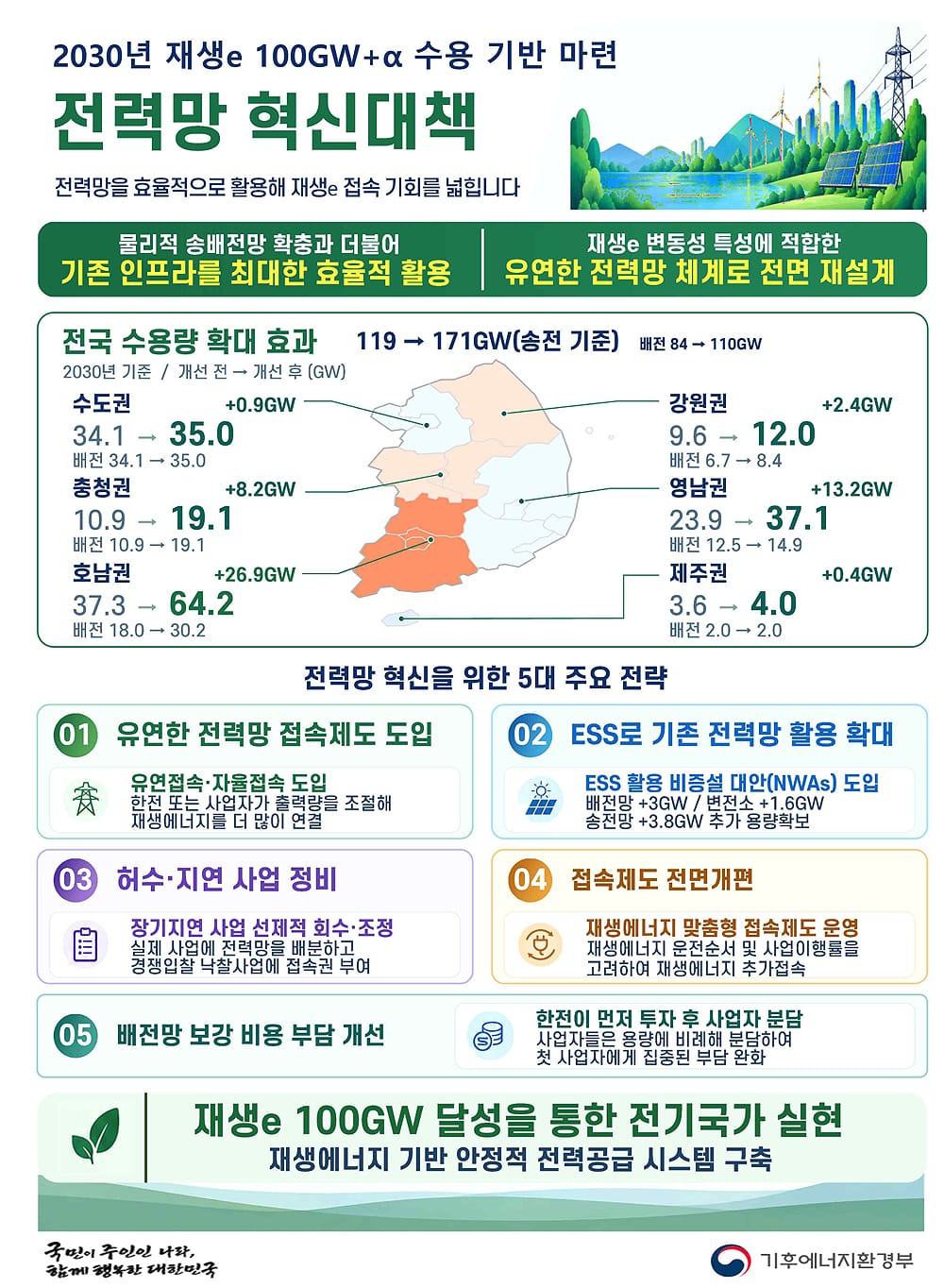
The government will comprehensively overhaul its power grid operating system to accommodate more than 100GW of renewable energy by 2030. The core approach is not to rely solely on building new transmission lines, but to raise the utilization efficiency of existing grids while allocating grid capacity to renewable energy projects with higher feasibility of actual implementation.
The Ministry of Climate, Energy and Environment (MCEE) announced on September 29 at a state council meeting that it had reported a "Power Grid Innovation Plan" that redesigns the power grid system to supply more than 100GW of renewable energy by 2030.
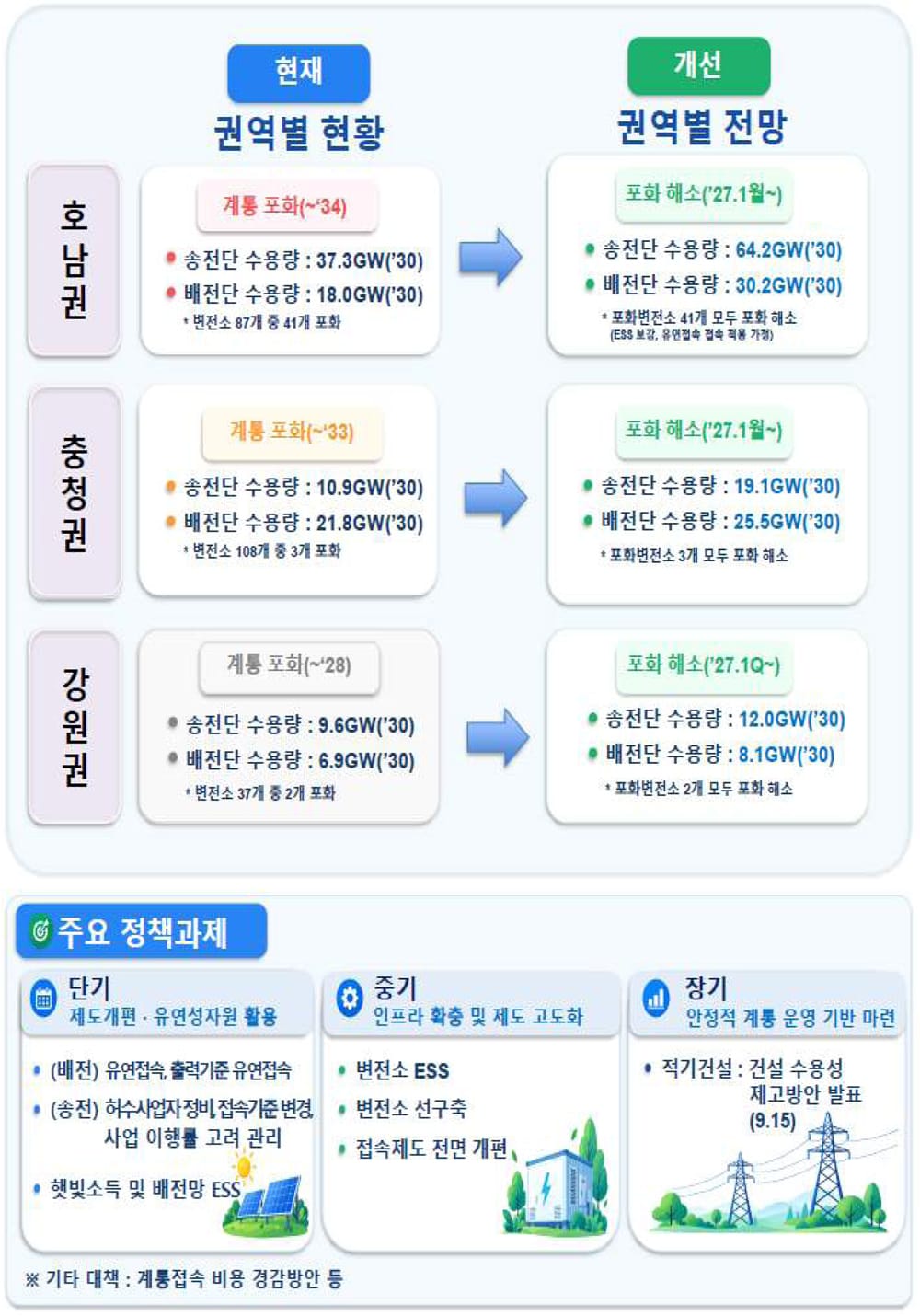
The offshore wind industry is focusing on one key element of this grid plan: the dedesignation of the Honam region grid management substation. The government plans to dedesignate the Honam region grid management substation as of October 1, accept early grid connection applications from existing operators, and resume accepting new project applications from January 2027. The Chungcheong region is also expected to become available for new grid connections, while Gangwon region will have its grid management substation dedesignated in the first half of 2027, when the East Coast to Shin-Gapyeong HVDC Phase 1 is completed.

This measure is significant as a first step toward institutionally resolving the "grid shortage" that has been identified as the biggest obstacle to renewable energy projects, including offshore wind, over recent years. However, dedesignation of the grid management substation does not immediately mean large-scale offshore wind farms will begin commercial operation. The effectiveness of this plan depends on how much of the grid connection rights that existing offshore wind projects have secured can be converted into realistic project volumes, and how quickly transmission lines needed for future new projects are built.
Lowering the barrier to offshore wind grid connection
The Honam region has concentrated renewable energy resources such as wind and solar, but has relatively low power demand, resulting in insufficient transmission lines to send generated power to other regions. According to government data, the Honam region has been pushed back to 2034 or later for new project entry due to transmission and distribution bottlenecks.
Under this plan, the government will expand the renewable energy transmission-side accommodation capacity in 2030 from the existing 119GW to 171GW, and the distribution side from 84GW to 110GW. For the Honam region, the plan is to increase transmission-side accommodation from 37GW to 64GW and distribution side from 18GW to 30GW.
Among these, offshore wind appears as a large-scale power source directly connected to the transmission-side grid, so the policy effect manifests differently. Ultimately, dedesignation of the grid management substation is a starting point for expanding offshore wind developers' grid connection possibilities, but in the end, the transmission line flexibility for the project to connect must be secured.
The new grid connection process presented by the government also deserves attention. After October capacity allocation announcements, early grid connection applications and grid reviews for existing operators will proceed, and after capacity allocation for existing operators is completed, new project applications will begin from January 2027. The government expects that among 87 substations in the Honam region, 46 locations will mostly allow immediate grid connection for new projects. By contrast, the remaining 41 saturated substations are expected to allow phased grid connection between 2028 and 2030 through energy storage systems (ESS) and new substation construction.
Therefore, from the offshore wind industry's perspective, how much spare capacity is actually secured at which connection points becomes a more important variable than the dedesignation of the grid management substation itself.
Actual offshore wind entry prospects of 3GW from 15.8GW connection rights
The biggest message this plan sends to the offshore wind industry is that the government will no longer tolerate a structure where developers monopolize grid capacity and delay projects for extended periods.
The government has diagnosed that while Honam region offshore wind projects have secured 15.8GW of grid connection rights by 2030, actual entry prospects are only about 3GW. As a result, delayed offshore wind volumes have blocked other renewable energy sources from entering the grid.
Going forward, the government will reorganize long-delayed projects based on project progress. Projects that fail to complete environmental impact assessments five years before grid operation start date, or fail to secure fixed-price contracts three years before, will have their grid connection timing adjusted or their grid connection rights revoked. Through this, the government expects to be able to adjust the grid connection timing for about 10GW of the 15.8GW that Honam region offshore wind has monopolized by 2030.
This carries dual meaning for the offshore wind market. For developers whose project schedules are actually progressing, this measure can return grid capacity to them. Conversely, for projects that have secured an Electricity Business Licence but face delays in subsequent procedures such as environmental impact assessment, community acceptance, fixed-price contracts, and financing, the likelihood of their grid connection timing being pushed back increases.
Ultimately, this policy represents a shift toward reallocating grid capacity based on whether a project can actually build a power plant, rather than whether it has obtained an Electricity Business Licence.
From first-come-first-served to competition for grid access from 2027
A more significant change for offshore wind developers is the grid connection system reform to take effect from January 2027.
The government will change its past practice of granting grid connection rights on a first-come-first-served basis in the early stages of power generation projects. Instead, linked with reforms to the Renewable Portfolio Standard system, it will conduct integrated evaluations of renewable energy projects' economic viability, public interest, and grid conditions, then award fixed-price contracts and grid connection rights together to winning bidders in competitive auctions.
This change could alter the sequence of offshore wind development projects. In the past, obtaining an Electricity Business Licence and securing grid connection rights were important early-stage objectives. Going forward, the structure will shift to one where developers must raise permitting and project readiness levels, then win competitive auctions to secure grid connection rights. Therefore, developers must simultaneously secure environmental impact assessments, community acceptance, financing possibilities, and competitive power generation costs.
Particularly noteworthy is the government's announcement that it will calculate new grid connection volumes from 2031 onward by reflecting the actual implementation rate of renewable energy projects at 67.2 percent. This could help reduce uncertainty in the offshore wind market. The government expects this to allow an additional 2.4GW of renewable energy capacity in the Honam region at the permitting stage.
ESS and flexible grid connection: how effective for offshore wind?
Another pillar of this plan is ESS and flexible grid connection. The government will install ESS at grid-saturated substations to increase renewable energy connection capacity without physically expanding substations, and will introduce "non-wires alternatives" that use ESS for transmission line contingencies to utilize transmission capacity that was previously kept empty during normal operations.
The plan involves installing approximately 40MW of ESS at 41 saturated substations in the Honam region to secure about 1.6GW of additional accommodation capacity, and pursuing 2.6GW of transmission line reinforcement ESS in areas like Sinokcheon and Cheongyang where transmission flexibility is insufficient. However, the benefits of such measures will accrue to solar power, which uses distribution networks.
Offshore wind projects often range from hundreds of megawatts to gigawatt scale, making it difficult to solve the entire project's transmission problems simply by installing ESS at substations. In particular, when transmission lines become saturated during periods of concentrated offshore wind generation, flexible grid connection premised on output curtailment is possible, but during financing, stable power generation assurance and output curtailment risk can become important variables.
Ultimately, ESS and flexible grid connection should be viewed realistically not as substitutes for the long-distance transmission lines offshore wind requires, but as complementary measures that buy time until transmission lines are fully expanded.
The government has significantly increased renewable energy accommodation capacity on the power grid by 2030, but simultaneously diagnoses that 345kV transmission line construction can take nine years or more. According to government data, new transmission line expansion equivalent to about 70 percent of current transmission line length is needed by 2038. In other words, the power grid problems supporting the 100GW era cannot be entirely resolved through institutional reform and operational efficiency improvements alone.
Offshore wind in particular, unlike solar, concentrates large-scale power generation complexes in specific sea areas, with submarine cables, onshore substations, and transmission lines moving as one package. Even after a project begins construction, if grid connection facilities are not secured on time, the entire commercial operation schedule can be affected.
Therefore, the effectiveness of this plan is likely to depend not only on "how many connection rights are released" but also on the speed of transmission line construction that can connect connection rights to actual commercial operation.
The key to the 100GW goal: from grid accommodation capacity to actual transmission volume
The biggest change the government presents in this plan is that it has begun viewing the power grid not as a simple physical facility but as an "operable resource."
Flexible grid connection, ESS, non-wires alternatives, reflecting project implementation rates, revoking connection rights, and grid review methods prioritizing renewable energy generation are all mechanisms to utilize existing power grids more efficiently. By changing its grid review method to prioritize renewable energy generation over existing coal and LNG, the government expects about 20GW of additional accommodation nationwide by 2030.
However, from the perspective of expanding offshore wind, operational innovation alone is insufficient. The fact that actual entry prospects for 15.8GW of offshore wind grid connection rights in the Honam region reached only about 3GW was not simply a "grid management" problem but resulted from project development, transmission line construction, and permitting moving at different speeds. This plan focuses substantially on correcting inefficiencies in grid allocation among these factors.
Therefore, the key points to watch for this power grid plan are: how many gigawatts of offshore wind projects actually achieve early grid connection after October's grid management substation dedesignation, by what criteria the roughly 10GW of connection rights being revoked or adjusted are reallocated, and whether offshore wind winning bids in the 2027 new integrated auction actually proceed to commercial operation in sync with actual transmission line completion.
The figure of 100GW of renewable energy by 2030 is not a question of how much generating capacity to install. It becomes 100GW only when generated power can actually flow into the grid and be delivered to consumption areas.
This power grid innovation plan is significant in attempting a transition from an era of "unable to build power plants because the grid is insufficient" to an era of "maximizing the use of existing grids while rapidly building the grids we truly need." However, for large-scale offshore wind expansion, grid management substation dedesignation must not remain merely a starting point but must connect to transmission line expansion, submarine and onshore interconnection construction, and predictability of long-term connection plans.
Ultimately, the offshore wind industry's interest lies not in the policy signal of grid management substation dedesignation but in concrete numbers: when can my project connect, at which connection point, and through how much confirmed transmission capacity can it send power?
Original Korean article: epj.co.kr
English brief by Korea Wind Intelligence, koreawindintel.com



















