

Kolon Global, the construction affiliate of the Kolon Group, is hungry for transformation. The company is making every effort to reduce its dependence on housing business under the 'Haneulchae' brand, whose performance fluctuates with real estate market conditions. A recent example is the company's acquisition of asset management operations and group affiliates that operate hotels, resorts and golf courses. However, Kolon Global has a new business area where it established a foothold long ago: wind power generation.
The construction company holds the title of number one in onshore wind power generation, but it faces a recent challenge. It has been more than 10 years since the company began pursuing offshore wind power generation using wind from the sea, in addition to onshore wind power generation that mainly operates in mountains, yet it has not yet seen results. Recently, due to a shift to losses and increased financial burden, the company is reconsidering the offshore wind power business that it has invested considerable effort in.
Vanished offshore wind pipeline and dividend income
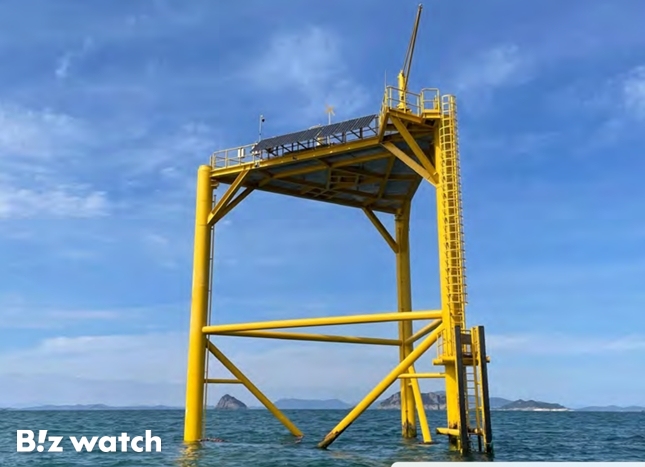
According to Kolon Global on October 6, 2026, the company is reviewing optimization methods for the Wando Jangbogo offshore wind power project it is promoting. This includes reviewing the sale of a 34 percent stake in the special purpose vehicle (SPV) established for the project. The remaining 66 percent stake is held by KOWEPO (Korea Western Power) and JNDC, each holding 33 percent.
First, Kolon Global excluded the related project from its wind power business pipeline in its "2026 second quarter investor relations" materials. In the "2025 fourth quarter investor relations" materials released at the end of last year, the company stated that there were 20 onshore wind power projects in addition to one offshore wind power project, but it quietly removed it from the recent earnings announcement.
The Wando Jangbogo offshore wind power generation project involves building a 400 megawatt-class offshore wind power plant in the shared water area south of Deokwu Island in Saengil-myeon, Wando-gun, Jeollanam-do. The company can expect revenue from selling electricity generated there and from sales of renewable energy certificates (REC).
Until early this year, Kolon Global expected to receive a total of 55 billion won in dividend income from wind power business by 2033. The company projected that the Wando Jangbogo offshore wind power project alone would generate 30 billion won in dividend income. However, at the time of the second quarter earnings announcement, it reduced this to 25 billion won. Kolon Global explained that it took into account the possibility of reviewing the sale of stakes in the offshore wind-related SPV.
However, a Kolon Global official said, "The offshore wind power generation business is being examined from the perspective of reviewing various strategic approaches as part of an overall business portfolio adjustment. Nothing has been specifically decided or confirmed, including the sale of stakes in the offshore wind SPV, and future wind power generation dividend income forecasts may change further."
More than 10 years of waiting
Kolon Global's entry into the Wando Jangbogo offshore wind power generation project dates back more than 10 years. The project began when the company signed a "joint development agreement for green energy self-sufficient island creation project" with Jeollanam-do and Wando-gun in 2013.
At that time, Kolon Global examined wind resources across the entire Wando-gun area and underwent preliminary feasibility studies. Subsequently, in 2018, it signed a joint development agreement (JDA) with KOWEPO and JNDC.
In 2021, Kolon Global announced "Wind Power Business VISION 2030" and aimed for construction start in 2024 through early commercialization of the Wando offshore wind project. However, it was delayed for various reasons.
In August 2022, the company obtained an Electricity Business Licence (EBL), but there was still a long way to go to meet the 2024 construction start target. Only in December 2024 did the cultural heritage survey end, and in January of the following year the company completed environmental impact assessment (EIA) consultation. In the meantime, the construction start target was pushed back to 2029.
Currently, follow-up licensing procedures with relevant government agencies including the Ministry of National Defense (MND) and the Ministry of Oceans and Fisheries (MOF) are underway. The company has not yet reached the stage of detailed design, project cost confirmation, financial structure consultation, and investor and lender consultation. Kolon Global has not confirmed how much it needs to invest.
Instead, Kolon Global is focusing on onshore wind power plants. As of the end of June, the company operates 225.9 megawatts of power generation facilities at six onshore wind power plants, and is currently constructing a total of 179.6 megawatts including Samcheok Dogye (50 megawatts), Yeonggwang Yeongbaek (49 megawatts), Yeongdeok repowering phase 1 (49.6 megawatts) and Uljin Giseong (31 megawatts). According to Kolon Global, in addition to 10 onshore wind power plants that are already operating or whose projects have become concrete, there are 10 more projects.
Financial structure improvement through merger? Not as expected
In early this year, CEO Kim Young-beom expressed his ambition for "the first year of earnings turnaround" with a target operating profit of 120 billion won. Through the first half of this year, operating profit stands at 74.2 billion won and net profit at 43.1 billion won, on track. As profitability has recovered, the company has gained relatively more room to maneuver.
This is the result of Kolon Global's full-scale business restructuring last year aimed at becoming a comprehensive real estate, environment and energy service provider, or "total provider." The company has undertaken disposal of underperforming affiliates, asset sales and reduction of the weight of housing business.
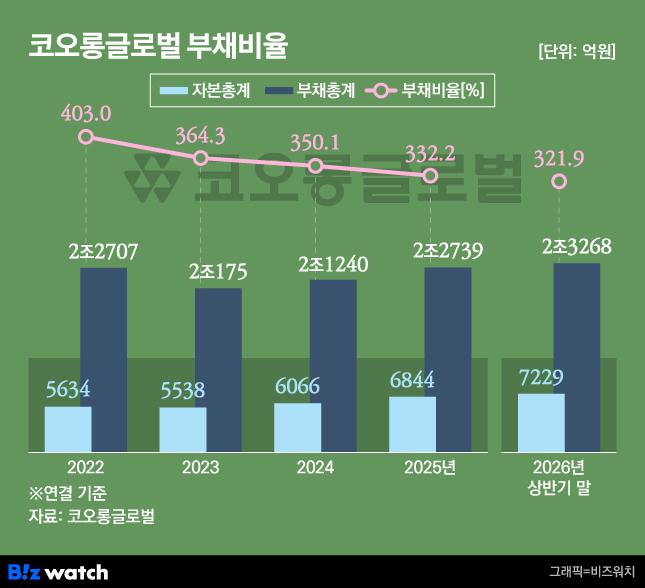
Additionally, by merging MOD, a golf, resort and hotel specialist, and Kolon LSI, an asset management specialist, the company said it would lower its debt-to-equity ratio to below 300 percent.
Kolon Global still has plans to increase its presence in the renewable energy business through wind power operations. However, the arithmetic is complicated for continuing the offshore wind power project, which is not expected to generate dividend income until 2033.
For now, Kolon Global has not lowered its debt-to-equity ratio to the target level. The company's debt-to-equity ratio stood at 333.2 percent as of the end of last year and 321.9 percent as of the end of June this year. While this is lower than the consolidated debt-to-equity ratio of 364.3 percent as of the end of 2023 and 350.1 percent at the end of 2024, it fell short of the effect expected from the merger. This reflects the impact of a large-scale loss, with net loss reaching 200.4 billion won last year.
Relative to its title as number one in onshore wind power, the money Kolon Global currently earns from wind power generation is minimal. According to Kolon Global, last year's wind power generation business annual revenue was only 90.4 billion won. This accounts for 3.4 percent of the company's separate revenue of 2.6912 trillion won. Wind power dividend income, which targets 25 billion won by 2030, stood at 1.7 billion won based on last year's figures.
Kolon Global previously focused on securing liquidity by selling even the Seocho Sporex site, considered a "jewel," to an affiliate in 2024 to ease financial burden. The situation for Kolon Global is now relatively improved compared to then. Will the company make a different choice regarding the offshore wind power business it has invested considerable effort in over more than 10 years?
Original Korean article: news.bizwatch.co.kr
English brief by Korea Wind Intelligence, koreawindintel.com



















