KOEN signs R&D agreement on remote flight control for airborne kite wind power
KOEN (Korea South-East Power) and the Korea Electrotechnology Research Institute signed an R&D agreement on Oct. 7 to develop remote flight control technology for airborne kite wind power systems. The first project covers a 20kW system, with field verification of flight stability at KOEN's site.
Field verification of "airborne wind power technology," which generates electricity by flying kite-shaped aircraft hundreds of meters above ground, is being pursued. Remote flight control technology for a 20kW-class system will be developed, and on that basis, 100kW-class autonomous operation and commercial system deployment will proceed in stages.
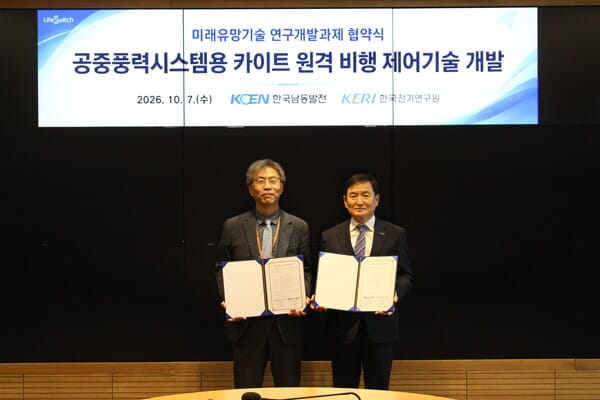
KOEN (Korea South-East Power) and the Korea Electrotechnology Research Institute signed a research and development agreement on October 7, 2026, at KOEN's headquarters in Jinju for developing "kite remote flight control technology for airborne wind power generation systems." The signing ceremony was attended by Lee Young-gi, senior vice president of safety technology at KOEN, Kim Tae-hyun, research director at the Korea Electrotechnology Research Institute, and researchers from both organizations.
This collaboration aims to develop a power generation method that can address the site constraints of tower-type wind power. The research institute develops core control technology while the Genco verifies flight stability in the field.
Harnessing upper-level winds: Remote flight control as the first task
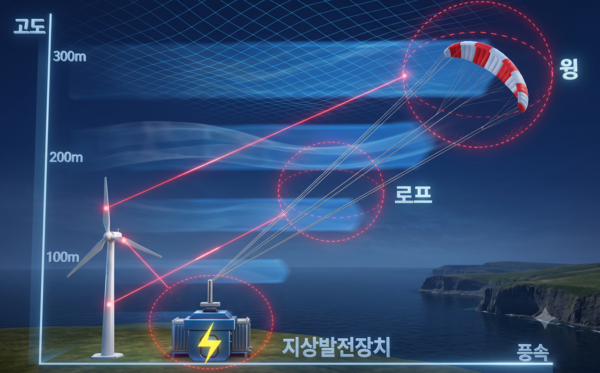
An example of a ground-mounted airborne wind power generation system (AI-generated image). · Photo: Energy News
Airborne wind power is a technology that generates electricity by flying kite-shaped aircraft hundreds of meters above ground instead of using tower structures, then harnessing wind to produce power. It is expected to improve power generation efficiency by utilizing stronger and more consistent upper-level winds compared to ground level, and to address installation area and site constraints.
The two organizations initially focused on securing remote flight control technology to be applied to a 20kW-class airborne wind power generation system and confirming its stability in the field. The research period runs from October 2026 through September 2027, a duration of one year.
The Korea Electrotechnology Research Institute, as the lead organization, will develop core kite remote flight control technology, while KOEN will verify flight stability at power generation sites. The plan is to connect technology development with field verification to establish a foundation for subsequent autonomous operation system development. Whether the flying aircraft utilizing upper-level winds can be controlled stably will serve as the starting point for moving forward to autonomous operation and field demonstration.
Commercial deployment through 100kW autonomous operation
A signing ceremony for the development of kite remote flight control technology for airborne wind energy systems. · Photo: Energy News
The two organizations plan to pursue follow-up development based on the results of this research. In Phase 1, running from the second half of 2027 through 2030, they will develop a 100kW-class autonomous operation system and conduct independent operation demonstration.
In Phase 2, running through 2033, they will build a full-cycle autonomous operation commercial system and remote control infrastructure. The scope of development will expand from remote flight control to autonomous operation, and ultimately establish overall operation and control systems.
This project is viewed as meaningful in that it verifies technology addressing the site limitations of existing wind power at actual power generation sites. The key factors for assessing outcomes are expected to be whether the results of 20kW-class flight stability verification lead to 100kW-class autonomous operation demonstration, and whether actual power generation performance and operational reliability are secured.
EWP (Korea East-West Power) is advancing two renewable energy projects: the 110MW Handong Pyeongdae offshore wind farm in Jeju, which obtained its electricity business license in 2026 and, according to investor materials, targets commercial operation in October 2029, and a 60MWh energy storage…
KOSPO (Korea Southern Power) met with Busan Mayor Jeon Jae-soo on October 14 to request the city's active cooperation for the Dadaepo offshore wind project.
The Chuja offshore wind project is expected to shrink by about 25%, from 2.37GW to 1.79GW, ahead of a fresh tender after the original developer withdrew. A baseline survey by Jeju Energy Corporation reduced the developable area after maritime traffic routes and marine ecosystems were excluded.
Huusteel, a large-diameter steel pipe manufacturer, has completed delivery of approximately 3,000 tonnes of offshore wind-grade large-diameter pipes to an overseas offshore wind project in October 2026.
South Korea's government has decided to consolidate five state-owned power generators (Korea East-West Power, Korea Midwestern Power, Korea Western Power, Korea Southern Power, and Korea Southeastern Power) into a single entity called 'Korea Generation' after 25 years of operating separately.
Korea's five state-owned generators become one in October 2027. They hold 14.0 GW of offshore wind, a third of the national pipeline. What the merger case rests on, and what it leaves unanswered.