

Fishers as participants from the planning stage: co-cultivation potential confirmed in Southwest Offshore Wind demonstration
"It is difficult to achieve true coexistence between offshore wind and the fishing industry if we view fishers merely as targets for damage compensation. They must be transformed into participants in the power generation business and subjects of profit-sharing."
Ko Dong-hwi, principal researcher at the Marine Spatial Development and Energy Research Division of the Korea Institute of Ocean Science and Technology (KIOST), emphasized that coexistence between offshore wind and the fishing industry cannot be understood simply as installing aquaculture facilities between turbines.
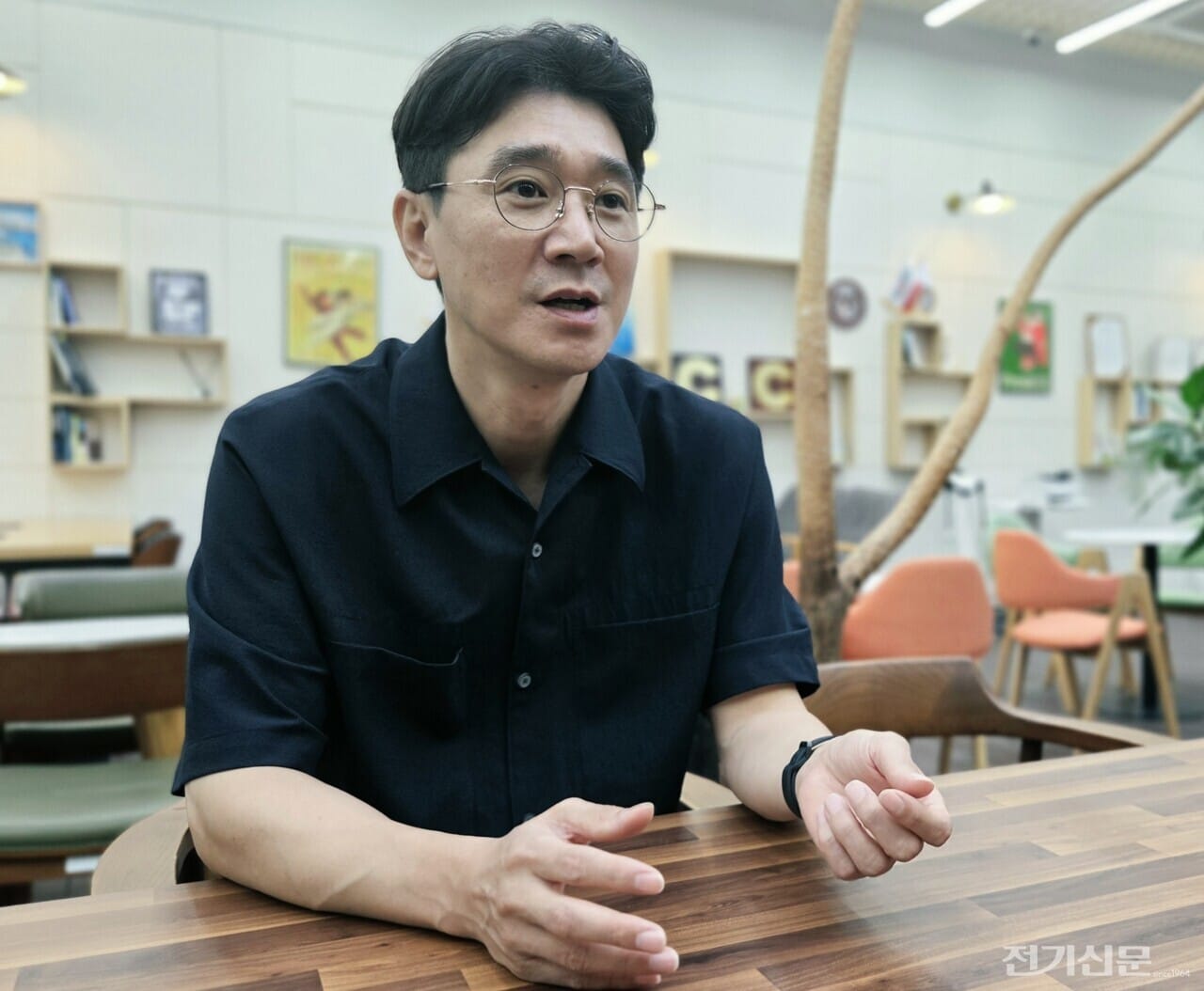
He argued that an operational system is needed in which developers, fishers, and local fishing communities share the same sea while creating joint revenue.
Ko has conducted research in offshore wind and marine energy at KIOST. He participated in developing a health, safety and environment operational support model for the full lifecycle of offshore wind projects, and is currently working on developing technical guidelines for offshore marine warranty surveys, developing offshore seaweed biomass production systems, and establishing submarine infrastructure management frameworks.
Participation from the planning stage rather than post-hoc compensation
The domestic offshore wind industry faces multiple challenges including business uncertainty, weak supply chains, competitiveness gaps with overseas technology, and shortages of large-scale installation and transport equipment and support ports.
Among these, community acceptance is a critical factor determining project success. Without sufficient consultation with local communities, conflicts can become prolonged, leading to project delays and cost increases.
"It is difficult to secure community acceptance by presenting compensation plans only after a project has begun. Fishers and local fishing communities must participate from the planning stage to coordinate coexistence measures."
While existing discussions have focused on loss compensation for fishing restrictions and profit-sharing from power generation, the coexistence model emphasizes sharing economic benefits created in the ocean with local communities by linking them to new industries. This involves utilizing fishery resources in the space between turbines and around structures, expanding from fishing and aquaculture to processing and tourism.
The sea is not a space for any single operator but a shared resource used by diverse stakeholders including fishing, aquaculture, and shipping.
Ko believes that considering this public nature, the benefits generated by offshore wind should also be widely shared with local communities. Offshore wind farms should provide fishers with new production spaces and income sources rather than taking away their fishing grounds, which would also raise community acceptance.
"We must move from damage compensation to profit-sharing, and then to joint revenue creation. Fishing communities should not merely receive a share of power generation profits but directly participate in new industries."
Coexistence potential confirmed in real waters: now must prove business viability
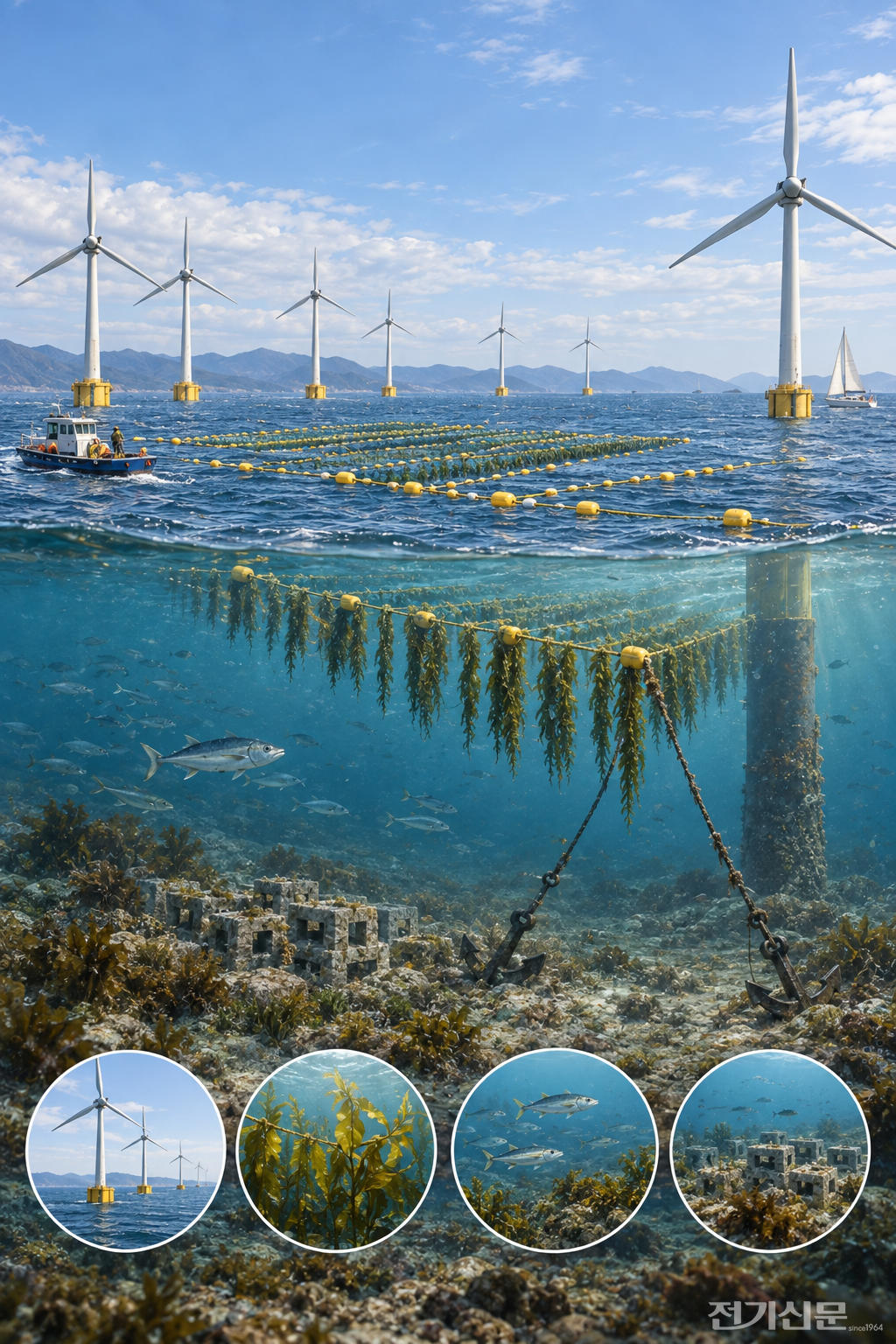
Domestic research on utilizing marine space within offshore wind farms has continued since 2014.
Initially, efforts focused on confirming the fusion potential of offshore wind and marine resources and developing aquaculture technology and related equipment. Later, research expanded to real waters by installing commercial-scale suspended longline aquaculture facilities at the Southwest Offshore Wind demonstration site.
Through multi-species aquaculture demonstration, KIOST confirmed the production potential of scallops and other species. Wind structures appeared to function similarly to artificial fish habitats, suggesting the possibility of creating favorable environments for fish and shellfish.
However, confirming feasibility in real waters is separate from securing business viability. Production effects can vary by sea area and species, and it must be verified whether aquaculture facilities can be operated stably over long periods in rough seas. A process remains to prove that fishers actually receive revenue after deducting installation and maintenance costs.
In particular, for coexistence technology to translate into actual business, operational results must be accumulated over several years. Comprehensive verification of not only the durability and production volume of aquaculture facilities but also maintenance, work safety, and distribution possibilities is necessary before financing, insurance, and private investment can follow.
"Going forward, we must accumulate long-term operational results to prove the technology's reliability and economic viability. It is also important to find species and coexistence technologies suited to environmental conditions and existing fishing structures in each sea area."
This is why European models cannot be directly applied domestically. Our seas are exposed to typhoons, high waves, fast currents, and large tidal ranges. Water depth, seafloor topography, fishing methods, and fishery resource distribution also differ by sea area.
Ko called for developing a "Korean coexistence model" that references European cases but reflects domestic marine environments, fishing structures, and regional conditions.
Aquaculture technology must also change. Applying automatic feeding and remote monitoring, artificial intelligence-based growth management, and independent power supplies using renewable energy can reduce labor and safety issues even in offshore areas. Analyzing sea area environments and fishing ground conditions through satellite observation to select suitable species is also possible.
Rules for coexistence matter more than technology
For wind turbines, submarine cables, aquaculture facilities, and fishing vessels to share the same space, safety and responsibility standards must be in place.
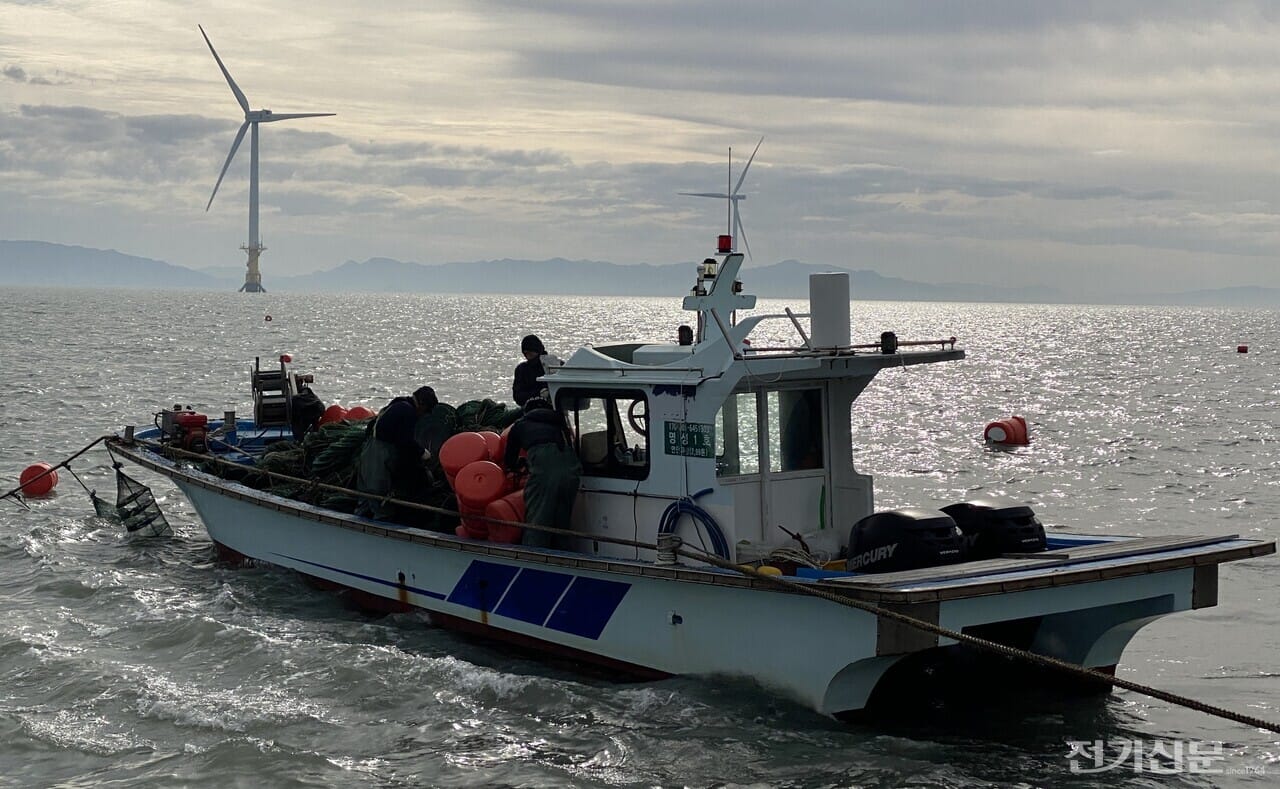
Aquaculture and mooring facilities must be designed to withstand strong winds, high waves, and currents, and must maintain sufficient distance from turbines and submarine cables. Real-time monitoring using automatic identification systems and vessel monitoring systems, radar, and CCTV, as well as operational manuals and emergency response systems, are required.
Ko believes that social and institutional foundations supporting coexistence are as important as technological development. Expert surveys also identified community acceptance, fishing community cooperation, demonstration-based approaches, and institutional support as priority tasks ahead of individual technologies.
"Adding aquaculture facilities to a wind farm cannot be called coexistence. An operational system must be created in which offshore wind, fishing, aquaculture, and local fishing communities share the same space while reducing conflicts and increasing mutual benefits."
To achieve this, specific details must be established regarding which fishing and aquaculture methods are permitted within wind farms, the operators of facilities, vessel passage and work areas, and responsibility and insurance standards in case of accidents. From the site selection stage, existing fishing activities, fishery resources, and aquaculture suitability must be reviewed together, and regional coexistence models must be designed through public-private consultative bodies.
Europe established the concept and policy foundation for multi-purpose marine platforms before pursuing economic feasibility reviews and real-water demonstration projects in stages.
Domestically as well, a roadmap is needed that does not stop at short-term technology development but simultaneously verifies safety, economic viability, and community acceptance.
Expanding use to tourism and leisure must also be approached in stages. A realistic approach is to first establish standards for power facility protection, maintenance, and insurance, then open spaces where operational experience and safety have been secured.
Ko predicted that in ten years, offshore wind farms could develop into complex marine spaces that jointly produce electricity and seafood while incorporating tourism and leisure.
"Offshore wind farms should not be viewed merely as power generation facilities. True coexistence is possible only when they create new value together with other industries, with fishers and local communities at the center."
To him, the sea is an "abundant space" that provides energy, food, rest, and challenge. His most memorable moment was when he confirmed the normal operation of a tidal current power system installed at Uldolmok, where fast currents limit work time.
"When a system I had designed in the laboratory for a long time actually operated in the real sea and the anticipated results appeared as data, I felt great satisfaction. Through that process, I learned that understanding nature and prioritizing safety are as important as technical expertise."
Original Korean article: Electric Times
English brief by Korea Wind Intelligence, koreawindintel.com



















