International Joint Research on DLR and Memorandum of Understanding for Power Industry Application
Korea Electric Power Corporation has partnered with the United States Electric Power Research Institute (EPRI) to develop technologies that complement the variability of renewable energy and increase grid accommodation capacity.
Korea Electric Power Corporation (President Kim Dong-chul) announced on the 25th that it has signed a "Memorandum of Understanding on International Joint Research on Dynamic Line Rating (DLR) and Application in the Power Industry" with the Electric Power Research Institute (EPRI) at the 'CIGRE 2026' event held in Paris, France.
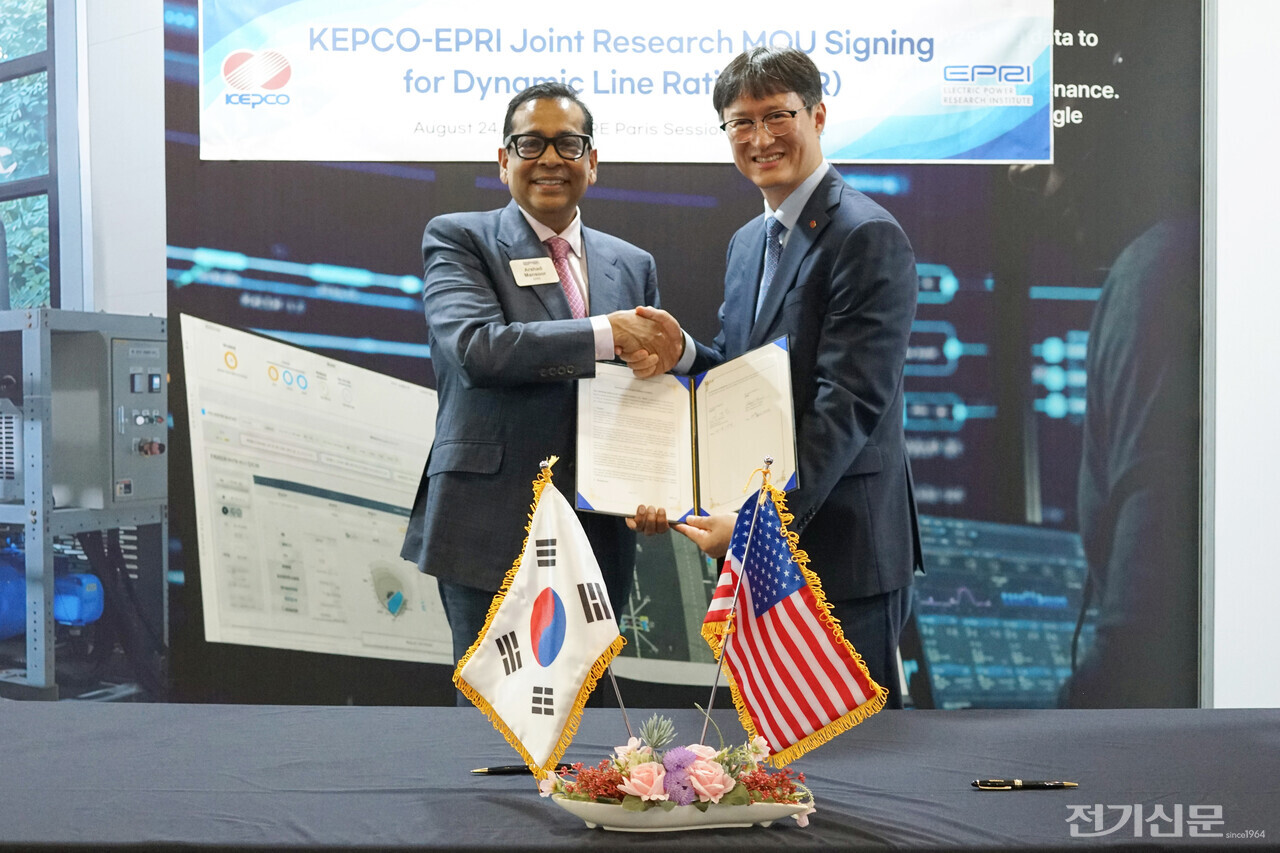
The signing ceremony was attended by Kim Dae-han, head of Korea Electric Power Corporation's Power Research Institute, and Arshad Mansoor, CEO of EPRI, along with key officials from both organizations.
Dynamic Line Rating (DLR) is a technology that departs from the existing method of calculating transmission capacity based on fixed weather conditions and instead calculates in real time the amount of power that a transmission line can safely transmit by reflecting real-time and forecast weather information such as wind speed, wind direction, temperature, and solar radiation.
In particular, when the line cooling effect increases due to higher wind speeds or lower temperatures, more power can be safely transmitted compared to the existing fixed capacity. Accordingly, it is evaluated as a core technology that can increase the utilization of the existing power grid without constructing new transmission lines and expand the grid accommodation capacity for renewable energy with large output variability.
This memorandum of understanding was pursued to share DLR technology and demonstration and operational experience held by both organizations and jointly advance DLR technology optimized for the domestic power system environment in order to improve power grid operational efficiency and enhance the utilization of existing transmission facilities.
Based on this agreement, the two organizations plan to demonstrate DLR sensors and systems developed domestically at EPRI's test facility to advance the technology. They also plan to cooperate in developing operational standards suitable for the domestic power system environment based on North American DLR operational standards and operational experience.
Kim Dae-han, head of Korea Electric Power Corporation's Power Research Institute, stated, "To respond to the expansion of renewable energy and increasing power demand, it is important to have technology that efficiently utilizes existing transmission networks alongside expanding new power grids. Through this cooperation, we will increase the reliability of DLR technology and develop it into an operational technology that can be applied in actual field conditions."
Original Korean article: Electric Times