

A proposal has emerged that creating a Jeju-style wind power operations and maintenance (O&M) support cluster requires consideration not only of ports and maintenance infrastructure to manage offshore wind power facilities, but also of power infrastructure to utilize renewable energy. Opinion has also been offered that the cluster should develop beyond a simple maintenance facility into a hub connecting renewable energy utilization and related industries.
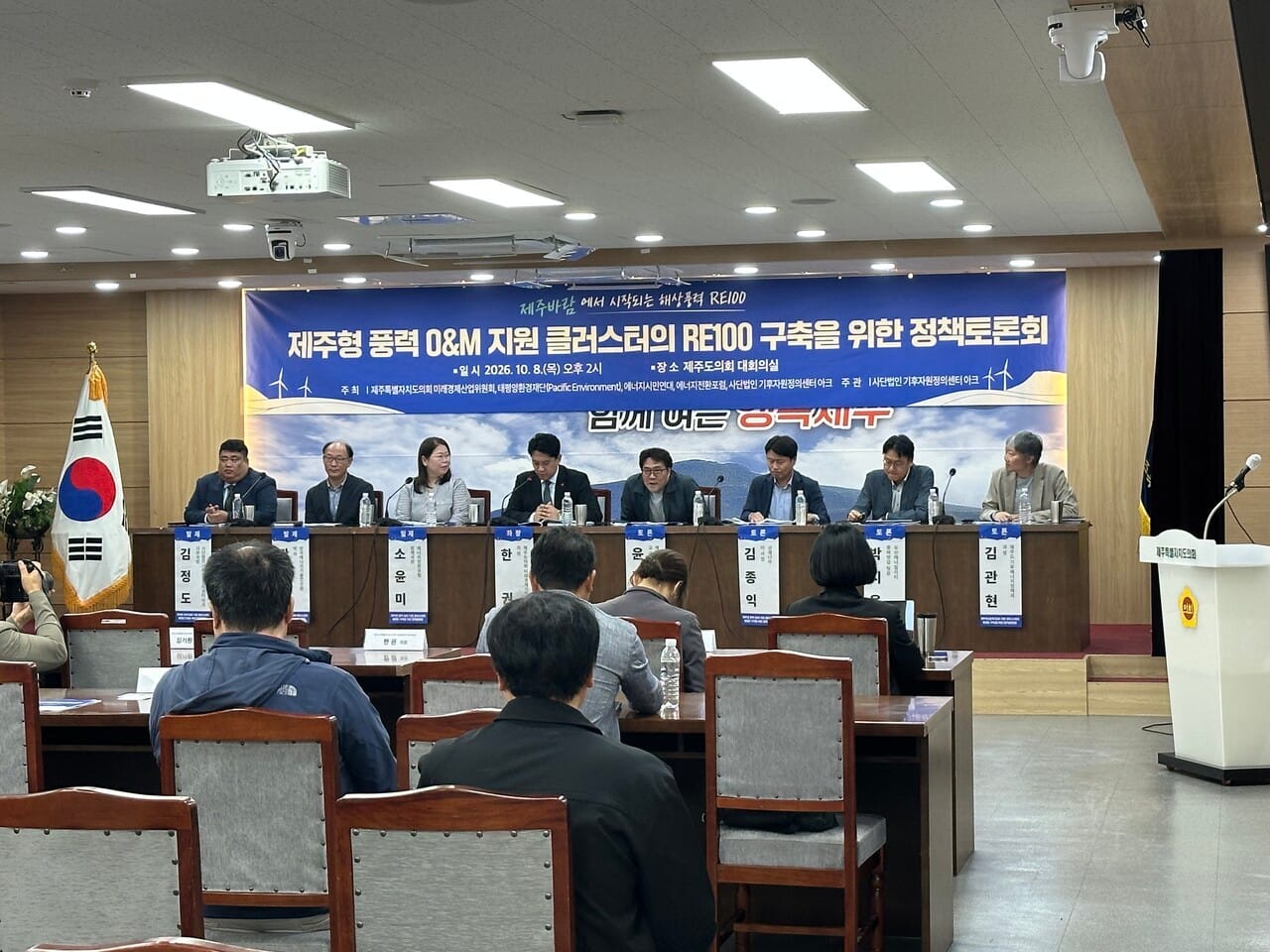
The Future Economy and Industry Committee of the Jeju Special Self-Governing Province Assembly, the Pacific Environment Foundation, the Energy Citizens Coalition, the Energy Transition Forum, and the Arc Center for Climate and Resource Justice held a policy discussion forum titled "Constructing RE100 for Jeju-style Wind Power O&M Support Cluster" on October 8, 2026 at the main conference hall of the Jeju Provincial Assembly.
The discussion forum featured presentations on methods for power utilization at ports, the necessity of offshore wind maintenance support ports, and ways to link wind power O&M clusters with RE100 industrial hubs.
Power demand and port infrastructure
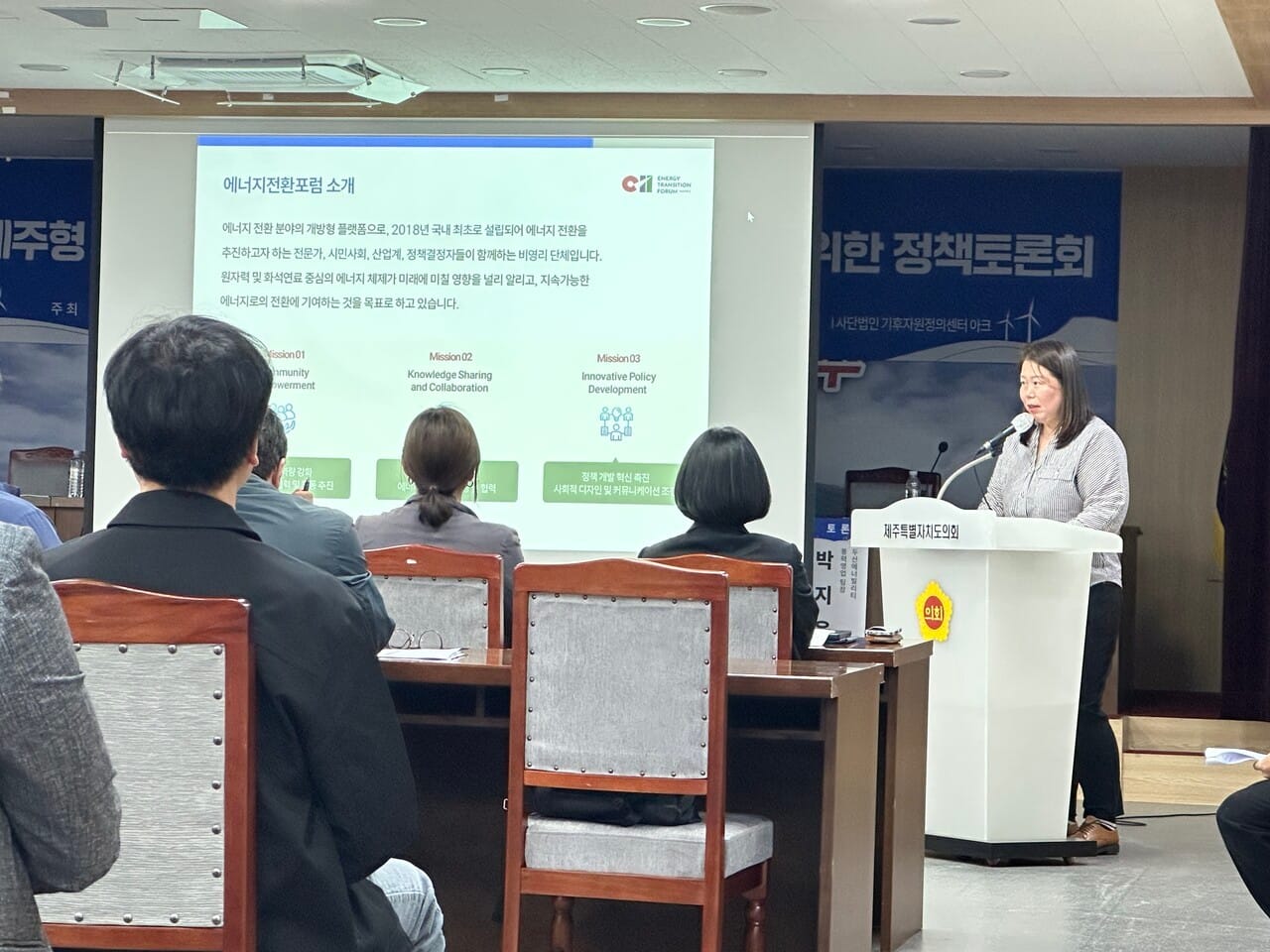
So Yunmi, policy director of the Energy Transition Forum, explained that how to utilize electricity produced in Jeju, where renewable energy generation is increasing, has emerged as an important issue. As renewable energy generation grows, output control that reduces generation capacity is being repeated because not all produced electricity can be utilized. She stressed that beyond expanding renewable energy supply, demand sources capable of storing and consuming electricity must be secured.
So presented ports as new renewable energy demand sources and spaces where power consumption can be managed. She explained that even if equipment supplying shore power to ships and electrified port machinery increase, electrification will struggle to translate into actual carbon emission reductions unless power supply capacity, power grids, and energy storage systems (ESS) are considered together. Accordingly, she emphasized the need to design port systems for power generation, storage, consumption, and management in an integrated manner.
Maintenance infrastructure and port readiness
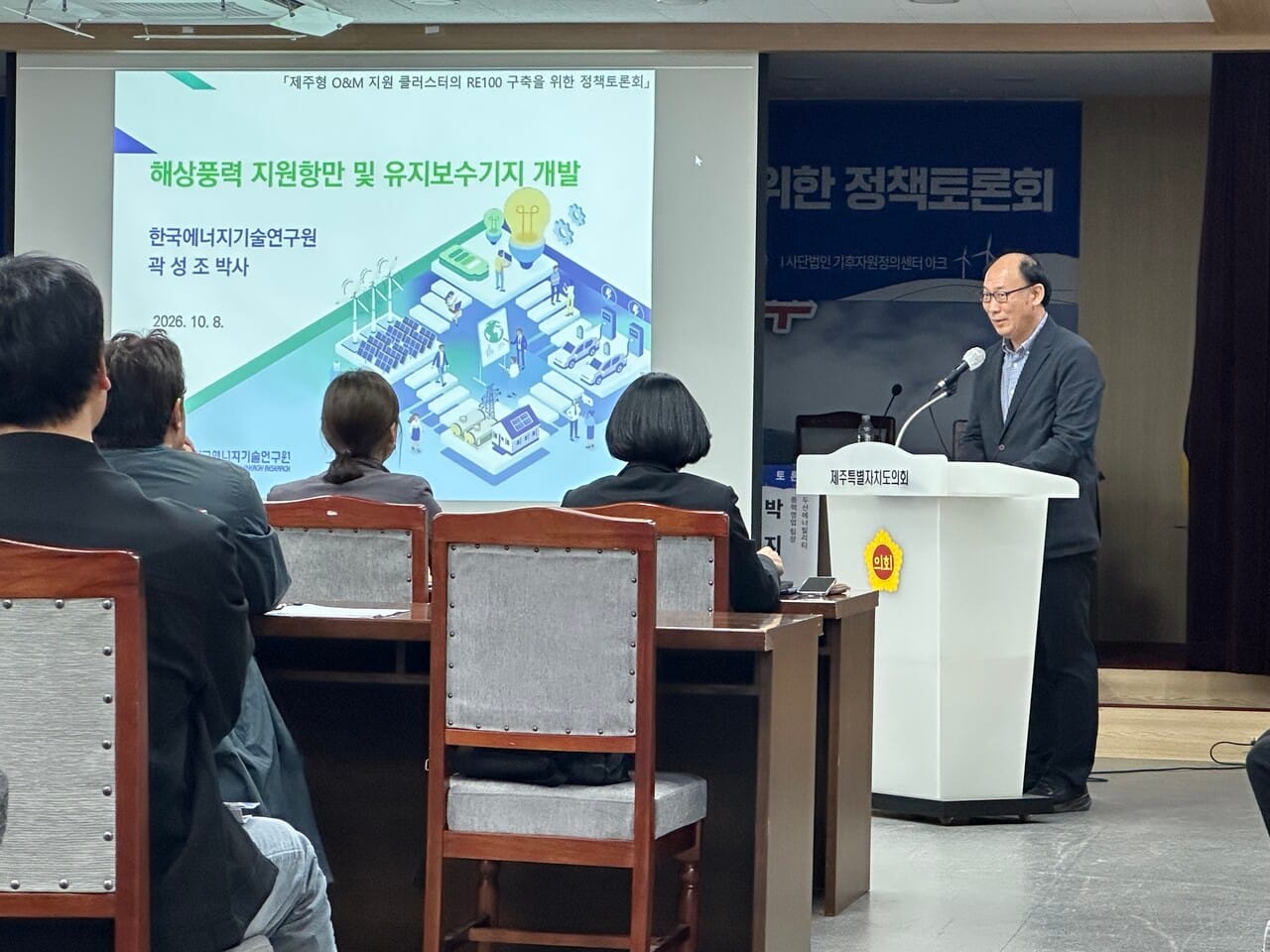
Kwak Sungjo, a researcher at the Korea Energy Technology Research Institute, explained that maintenance support ports and operating systems must be prepared in advance to accommodate expansion of offshore wind power generation facilities. Managing offshore wind facilities requires not only berthing space for ships but also facilities and equipment for storing large components, work vessels, and maintenance personnel.
Kwak noted that whether necessary support infrastructure can be secured in time must be reviewed considering domestic port conditions and offshore wind project schedules. He particularly proposed establishing regional support ports by examining port scale and facility conditions, and building a maintenance system capable of efficiently utilizing ships and equipment.
Linking O&M clusters with RE100 industry
Kim Jeongdo, secretary general of the Arc Center for Climate and Resource Justice, presented the possibility of developing the wind power O&M support cluster into an industrial hub linked with RE100. This means that beyond equipping the cluster with functions such as wind facility diagnosis and inspection, component performance evaluation, maintenance personnel management, and joint developer support platforms, infrastructure for renewable energy utilization must also be prepared together.
Kim explained that wind power O&M cluster policy can be linked with industrial park policy centered on renewable energy utilization. He introduced that Jeju is scheduled to establish a basic plan for the O&M support cluster by 2027, and proposed that RE100-related infrastructure should be considered in the process of preparing the plan.
To specify the direction of creating a Jeju-style wind power O&M support cluster, power infrastructure including power grids and energy storage systems (ESS), as well as methods to secure renewable energy demand sources, must be reviewed together with maintenance facilities and port location and function. Beyond establishing a foundation for maintenance and management of wind power facilities, how to utilize renewable energy produced in Jeju has been presented as a key task in cluster design.
Original Korean article: mediajeju.com
English brief by Korea Wind Intelligence, koreawindintel.com



















