

"Offshore wind power will deliver real benefits to residents through the Suwon-ri model rather than through funds collected like taxes."
"We will pioneer a voluntary carbon market that transcends the limits of mandatory markets and focus on the rationale for relocating public institutions."
"We will attract AI and climate tech companies and innovate with bold customized electricity rate systems."
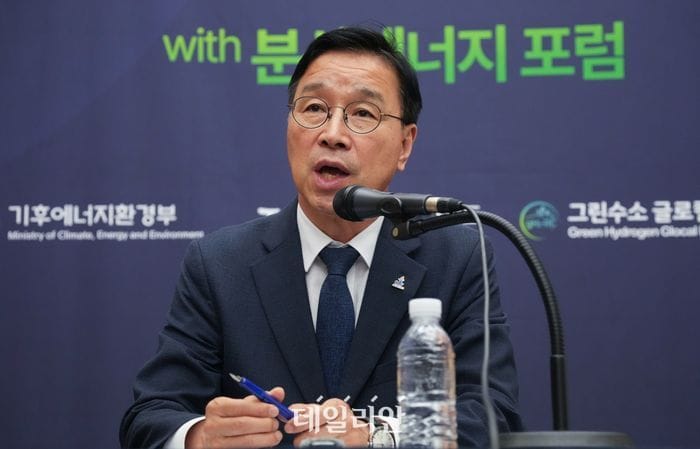
Jeju Special Self-Governing Province Governor Wi Sung-gon declared on September 15, 2026 a strong vision to "substantively implement the 2035 carbon neutrality project and advance the offshore wind power system to establish Jeju as a true climate economy capital."
Governor Wi presented this blueprint at a briefing with reporters from the Ministry of Climate, Energy and Environment (MCEE) held at the Jeju ICC, accepting the direction of the previous administration while maximizing the effectiveness of policy and residents' sense of benefit.
Reshaping Offshore Wind Benefit-Sharing
Governor Wi identified the offshore wind power resident benefit-sharing system as the first policy to address after taking office. Regarding the approach pursued by the previous administration, he pointed out that "it is difficult to persuade actual residents and generate active participation when receiving 17.5 percent of net profits entirely as a fund to be converted into public budget."
The alternative he proposed is the Suwon-ri model of Hanlim offshore wind power. Governor Wi explained that "in the case of Suwon-ri, residents formed a cooperative and directly invested in the project using low-interest loans from the Korea Energy Agency (KEA), achieving a return rate exceeding 13 percent. The village common fund provides childbirth congratulations of 5 million won for the first child and 10 million won for the second and third children, as well as scholarships for university students." His plan is to expand a structure where residents directly participate in fund and cooperative formats and share tangible returns.
He also presented a long-term vision to overcome Jeju's limits in local production and consumption. He stated that "we must install high-voltage direct current (HVDC) transmission to avoid wasting Jeju's excellent wind resources and respond to power demand in the Seoul metropolitan area. Considering the massive electrification demand in the Seoul region 30 years from now, we must envision connecting Jeju offshore wind power to the national grid." He added that "we will boldly convert the slow-to-commercialize hydrogen tram to an electric tram and reorganize the hydrogen sector around consumer management."
Voluntary Carbon Markets and Carbon Neutrality
Governor Wi identified activation of the voluntary carbon market (VCM) as the core of carbon neutrality strategy. He stated that "Jeju has few factories and cannot do much in the mandatory emissions trading market. It is important to focus on the voluntary carbon market, which has high growth potential globally, and create a system where citizens can exchange daily climate actions for credits and trade them." He explained that based on this, he is consulting with the climate ministry on a 2035 carbon neutrality realization project and plans to announce a detailed plan soon.
Public Institution Relocation and Industrial Ecosystem
He also systematically addressed the rationale for relocating three major public institutions currently under way: the Korea Racing Association, Korea Airports Corporation, and Korea Energy Technology Evaluation and Planning (KETEP). Regarding the Racing Association, he said "Jeju, where 50 percent of Korea's horses exist and 90 percent of racing horses are produced, is the optimal location for attracting the Racing Association." On Airports Corporation, he noted that "as the agency managing all airports except Incheon, it is natural for it to come to Jeju, which has connecting flights to all airports nationwide." On KETEP, he emphasized that "Jeju has led demonstration projects in renewable energy and distributed energy over the past decade and must come to solve energy problems."
Regarding concerns about the insularity of regional favoritism culture, he expressed confidence that "migrants from the mainland already exceed 50 percent and the culture has relaxed considerably. We will make Jeju an open space welcoming 15 million tourists annually and a digital sanctuary where anonymity is guaranteed."
Governor Wi also detailed his industrial ecosystem development blueprint. He stated that "to overcome the limitation of having no large-scale industrial complexes outside the advanced industrial park, we will actively pursue industrial complex development and attract companies that need frequency stabilization and AI and climate tech demonstration."
He strongly criticized the uniform electricity rate system led by Korea Electric Power Corporation (KEPCO). He said that "even when trying to use heat pumps, the basic charge becomes higher than for general households, showing a mismatch between policy and reality. Since a difference of 10 or 20 won cannot drive behavior change, we will discover feasible rate systems creating substantial price differences, such as heat pump rates or distributed energy rates, through government studies."
Finally, regarding water shortage concerns from attracting a 40-megawatt artificial intelligence data center, he drew a line by stating that "Jeju is a local government that has invested continuously in water resource management since 1991. If we apply hybrid cooling methods and actively utilize spring water and reservoirs, we can sufficiently accommodate it in a stable manner."
KWI developer profile — KEPCO
4 projects in Korea totalling 1,310 MW. Compiled from the KWI database. Not part of the source article.
Hanlim Offshore Wind — this article
|  |
Southwest Offshore Wind Phase 2
| |
Sinan 1 Offshore Wind
| |
Sinan 2 Offshore Wind
| |
Project data: KWI database — Electricity Business Licence records, EIA filings (ME2021C006), Electricity Regulatory Commission minutes, and pre-EBL permit filings.
Original Korean article: Daily An
English brief by Korea Wind Intelligence, koreawindintel.com



















