

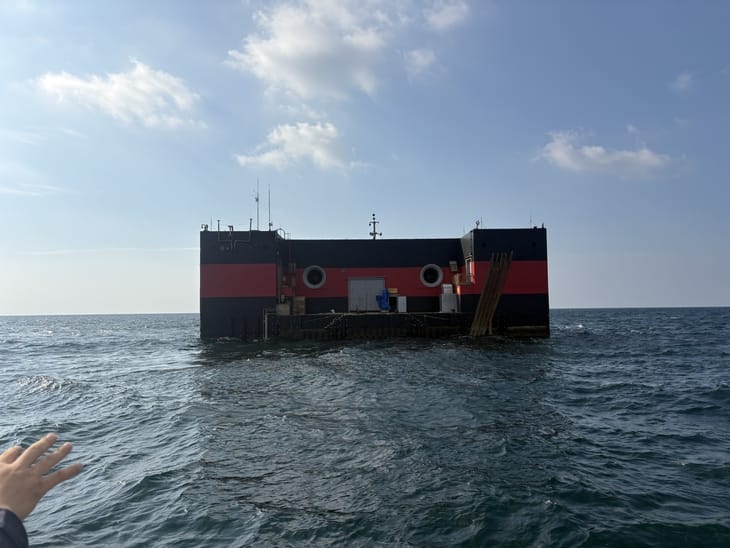
On the 14th, about 20 minutes by sightseeing boat from Yongsu-ri beach in Hangyeong-myeon, Jeju-do, a structure the size of a commercial building stands in the middle of the sea roughly 1.2 kilometers from shore. Following international maritime color standards, it bears a red band across a black background. This offshore substation facility comprises two 250MW units and serves as a link between wave and wind power generation equipment at sea, green hydrogen production facilities, and the onshore power grid. It is part of a wave power generation test site underway in the western waters off Jeju-do.
This wave power test site, led by the Korea Research Institute of Ships and Ocean Engineering, is Asia's first grid connection marine energy real-sea test site at the 5MW scale. Spanning approximately 1.04 million square meters, it consists of five mooring sites, submarine cables, and subsea connectors. At mooring sites located at depths of 15 to 60 meters, demonstrations are underway for wave power generation equipment, fixed-bottom offshore wind turbines, and green hydrogen production linked to wave and wind power generation. The site also includes a wave height meter, weather station, and onshore control center.
Hydrogen production from seawater
The reason for demonstrating wave and wind power generation linked to green hydrogen production is that hydrogen holds great potential as a carbon-free energy source.
Hydrogen has the advantage of abundant resources, and with infrastructure in place, long-term storage and transport become feasible. However, to achieve zero carbon emissions, the electricity fed into water electrolysis equipment for hydrogen production must itself be generated without carbon. In particular, the shipping sector faces limits in adopting vehicle-style electrification, making an energy transition that uses hydrogen as a power source through methanol or ammonia essential.
Europe is already pursuing many projects such as PosHYdon, which involves building fixed and floating plants to directly link electricity generated at sea to hydrogen production.
Kim Gyeong-hwan, senior researcher at the Korea Research Institute of Ships and Ocean Engineering's Eco-friendly Marine Development Research Division, told reporters: "Unlike land, the sea has waves, tidal currents, and wind that enable power generation, but there is no 'fresh water' without salt. We are developing technology to desalinate seawater, produce hydrogen from that water, cool hydrogen production equipment with seawater, and ensure unmanned remote control works without problems at sea."
He added: "We have completed demonstrations producing hydrogen for over 720 hours. We are now developing technology to install hydrogen storage devices and fuel cells to convert the produced hydrogen back into electricity for retail power use. Our goal is to complete the stage of verifying technology for hydrogen production through floating power generation by 2031."
Floating offshore wind and AI management
At Mooring Site 5, the farthest point at 60 meters depth, Doosan Enerbility is set to lead a 3MW floating offshore wind demonstration. Floating offshore wind expansion allows power generation to extend farther and secure greater capacity.
Doosan Enerbility is positioning Jeju-do as an advance base for strengthening offshore wind supply chains and accelerating energy transition. The company operates a Wind Power Center that manages and performs operations and maintenance on 37 wind turbines installed with Doosan Enerbility equipment in Ora-dong, Jeju-si.
The company is also developing equipment technology to raise offshore wind generation efficiency in South Korea, where wind speeds are lower than in Europe and other overseas regions. It plans to soon complete a 10MW wind turbine localization demonstration project and is collaborating with Germany's Siemens to manufacture 15MW turbines at its Changwon factory in Gyeongsangnam-do.
Lee Dong-won, chief of Doosan Enerbility's Wind Business Group, told reporters: "In South Korea, we are pursuing the concept of increasing wind turbine blade diameter to raise generation efficiency. Generally, if a total wind farm capacity exceeds 400MW, we judge that installing 15MW equipment is more advantageous."
Doosan Enerbility's strategy is to strengthen supply chain competitiveness across offshore wind by expanding business from equipment manufacturing capability to engineering, procurement and construction, and operations and maintenance. The company has already delivered wind turbine and equipment supply and EPC results in Jeju-do and southwestern waters, and in the operations and maintenance field, it guarantees quality for 20 years for wind farms using Doosan equipment.
Lee told reporters: "Apart from the 37 units where Doosan directly performs operations and maintenance, Doosan provides technical service for the remaining equipment managed by power generators themselves. There is a sense in the industry that when equipment manufacturers conduct operations, problems during power generation operation will decrease."
The company is also expanding automation in operations and maintenance by incorporating artificial intelligence. Doosan Enerbility developed its own software in 2023, introduced it the following year, and is gradually expanding the proportion of AI monitoring and problem detection.
Choi In-woo, chief of Doosan Enerbility's Wind Business Group, said: "Our goal is to reduce operational inefficiency in wind power generation by 20 percent through AI. We are accumulating data for AI application, and we expect to produce profitability analysis results as early as next year."
Original Korean article: ekn.kr
English brief by Korea Wind Intelligence, koreawindintel.com



















