

Incheon's offshore waters, positioned as a key hub for carbon neutrality and the renewable energy transition, have become a massive testing ground. Large-scale offshore wind power projects with a total installed capacity exceeding 7 gigawatts are underway. However, conflicts and limitations emerging in the implementation process have exceeded dangerous levels, contrary to the momentum on the ground. Incheon Today examines the key issues in Incheon's offshore wind development and seeks alternatives for coexistence between the renewable energy transition and local communities.
The location where offshore wind turbines will be installed off Incheon overlaps with the specific sea area of the West Sea, which produces over 70 percent of domestically farmed blue crabs. The government itself has acknowledged this as a region with high potential for adverse ecological impacts. The problem is that construction does not end in a single phase. Throughout the decades of turbine operation, new environmental pressures such as scour, electromagnetic fields, and cable heat generation can continue beneath the sea. This burden falls entirely on fishing communities and Incheon residents.
Government acknowledges ecosystem damage concerns with conditional approval
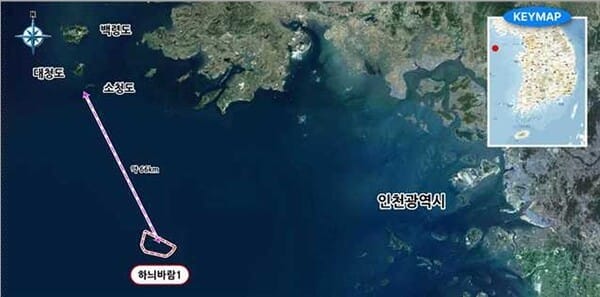
EWP submitted an application for electrical business licence for the Haneulbaram 1, 2, and 3 offshore wind power projects to the Ministry of Climate, Energy and Environment (MCEE) on July 10. The plan is to develop a total capacity of 2.07 gigawatts (660 megawatts, 600 megawatts, and 810 megawatts respectively) by November 2034 in the exclusive economic zone approximately 50 to 60 kilometres south of Sochongdo in Daecheon-myeon, Ongjin County, Incheon.
According to the results of the Ministry of Trade, Industry and Energy (MOTIE) marine site consulting included in the application, all three projects received an opinion of conditional site feasibility. While not violating location restriction regulations under environmental law, the MCEE's assessment was that these are regions with high potential for adverse impacts on the natural environment during project implementation.
The Ministry of Oceans and Fisheries (MOF) also noted that the project area and transmission line sections contain numerous islands, fishing grounds, and aquaculture facilities, making impacts on fish and marine ecosystems inevitable. The ministry stated that impacts on these fishing grounds from suspended solids, noise, and vibration generated during construction and operation must be predicted and mitigation measures established. The Ministry of National Defense (MND) requested relocation of turbine positions citing radar signal shielding.
The Haneulbaram project application itself acknowledges that environmental factors affecting existing marine organisms, seabed, marine physics, and water quality are inevitable due to earthwork on the seafloor. In response, the developer stated it would investigate and predict impacts according to the environmental impact assessment guidelines for offshore wind development projects (Korea Environment Institute and Korea Energy Technology Evaluation Institute, 2024).
The Yellow Sea's unique cold water mass and its effects on blue crab habitat
Woo Seung-beom, director of the Inha University Gyeonggi-Incheon Sea Grant Centre and professor of marine science, explained the oceanographic basis for why Incheon's marine environment is such a sensitive issue at a seminar held on August 20 by the Incheon Offshore Wind Coexistence and Mutual Benefit Civic Committee.
He noted that while the global average ocean depth is 3,000 to 4,000 metres, the Yellow Sea has an average depth of approximately 44 to 45 metres with maximum depths barely exceeding 100 metres, making it a shallow sea like a plate. He highlighted that tidal forces, wind, and river discharge interact in a manner unique to the world in this sea area.
A notable phenomenon is the Yellow Sea cold water mass. This occurs when seawater cooled by winter mixing remains as a cold mass at the bottom even as the surface layer warms in summer. This cold water mass changes shape annually and fluctuates significantly on a four to five year cycle, exerting the greatest influence on blue crab habitat.
Climate change impacts are also evident. Over 57 years from 1968 to 2024, water temperatures around the Five West Sea Islands rose by 1.4C overall. The spread range of freshwater from the Han River and Imjin River varies greatly year to year depending on rainfall. In 2023, when rainfall was heavy, freshwater spread to a much wider range than normal, and this influence can persist for up to ten years.
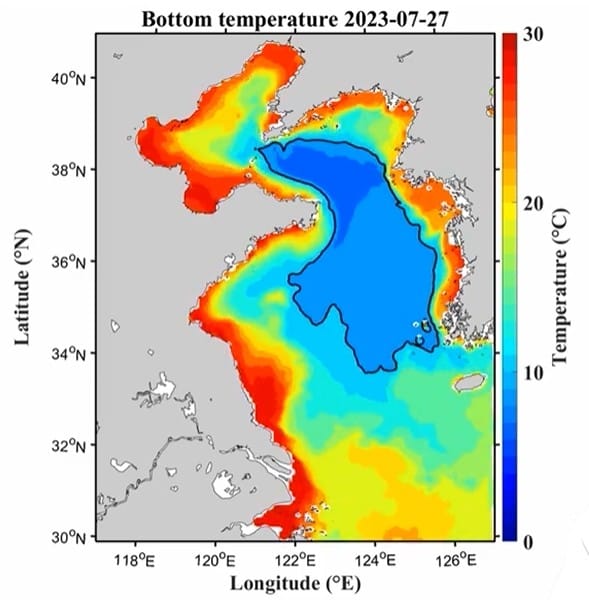
Director Woo emphasized the necessity of long-term observation, stating that because the Yellow Sea is a sea area where multiple factors fluctuate in complex ways, tens of years of data must accumulate to draw the full picture. The characteristics of a sea area cannot be determined from observation in a single year.
From pile-driving noise to scour: environmental pressures from construction and operation
The impacts of offshore wind on marine ecosystems differ in character across construction, operation, and decommissioning phases. During construction, driving piles into the seafloor to install substructures generates large quantities of underwater noise and suspended sediment, while seabed sediment disturbance from power cable installation causes suspended sediment generation and seafloor topography changes.
Unexpected accidents also occur during actual pile-driving work. According to overseas cases in the Offshore Wind Safety Accident Case Collection, unforeseen soil layers such as voids or extremely soft ground have appeared during pile work, causing piles to penetrate rapidly and abnormally. The cause was inadequate site investigation and geophysical survey, resulting in failure to predict soft ground.
Environmental pressures do not disappear once construction ends and turbines begin operating. Scour is a phenomenon where the seafloor is eroded by tidal currents, weakening the ground supporting the turbine foundation structure. This caused a turbine at the Nysted Windfarm operated by Ørsted to topple in January 2022. A turbine 110 metres tall (including blades) standing on a concrete foundation structure 20 metres wide and weighing 2,070 tonnes in waters 6 to 10 metres deep collapsed.
Analysis of satellite imagery of the Southwest Offshore Wind demonstration complex shows scour-induced bands forming around turbines. The affected area is analysed to exceed 4.3 square kilometres. Based on this, Inha University's Sea Grant Centre has proposed that offshore wind developers including Ørsted voluntarily conduct ongoing observation.
Electromagnetic field impacts with no standards; concerns over cables beneath crab grounds
The electromagnetic field issue is more fundamental. At a public hearing for the Incheon 1 project on August 28 of the previous year, a resident asked about underwater electromagnetic field impacts from wind power operation. Ørsted responded that there are no clear domestic or international standards, and that it would conduct additional surveys and simulations of underwater electromagnetic fields and perform impact predictions through expert consultation.
Recent research addressing this issue has also emerged from the domestic academic community. A paper titled "Electromagnetic fields emitted from submarine power cables in offshore wind farms: measurement, attenuation with distance, and potential biological impacts" (by Kwon Eun-mi and six others) published in the Journal of Korean Society for Marine Environmental Energy (Volume 28, Issue 1) of the previous year shows that electromagnetic fields artificially emitted from offshore wind farms disturb the Earth's magnetic field. The analysis indicates this could affect the ecological activities of fish species that use the Earth's magnetic field for direction and food search.
Fishing communities also expressed concern that actual field data measuring cable heat generation is very scarce, making the potential impacts on benthic organisms such as blue crabs substantial. In response, Ørsted stated it would ensure sufficient burial depth to minimise impacts from heat generated by submarine transmission lines.
One-year environmental assessment then a gap until completion
A legal observation gap exists between the environmental impact assessment period for offshore wind developers and the actual construction start date. In Ørsted's case, environmental impact assessment surveys were conducted during 2024 alone. However, the period from construction start to completion is a gap. Legally, Ørsted has no obligation during this time. The limitations of the environmental impact assessment itself, which typically takes only one year, are also raised.
As noted earlier, Incheon's offshore waters experience cold water mass fluctuations on a four to five year cycle, with suspended sediment and freshwater spread ranges varying extremely by season and year. Yet the years between licence approval and construction start, precisely when this sea area's characteristics are most actively changing, remain a blind spot with no oversight.
The Incheon 1 environmental impact assessment report (draft) shows that the local and shipowner council identified deficiencies in the survey methodology itself by item. Marine water quality and marine sediment were surveyed in only two seasons rather than four, and control points outside the power plant area were not clearly established.
Park Ju-hee, executive director of Incheon Green Alliance, pointed out that Ørsted, a global offshore wind company, is known as a model case that carefully considers ecological environment in overseas projects. However, the assessment reports for the 1 and 2 units being pursued in Incheon show the survey scope and frequency were conducted very inadequately.
Hundreds of turbines will be installed, but who monitors cumulative impacts?
A more fundamental problem is that offshore wind development projects in Incheon's waters are not limited to one. With hundreds of offshore wind turbines being installed, individual project environmental impact assessments alone cannot determine cumulative impacts on Incheon's entire offshore waters, making institutional improvements urgent.
Offshore wind development zones are divided, but ocean currents, sediment, marine life, and fishing activities do not follow those boundaries. In particular, it is impossible to hastily judge what burden will fall on fishing communities whose livelihoods depend on this sea.
Park Ju-hee emphasised this point, stating that Gulup Wind Development's offshore wind is proceeding near Gulup-do, KOEN is additionally pursuing offshore wind near Gulup-do, and large-scale projects are planned in the Yongyu, Muui, and Jawol sea areas. She stressed that while project zones are divided, the impacts of overlapping development projects remain unknown. The introduction of cumulative environmental impact assessment that comprehensively considers other development projects is necessary.
Original Korean article: Incheon Today
English brief by Korea Wind Intelligence, koreawindintel.com



















