

The government has drawn up a "power grid innovation plan" to accommodate more than 100 gigawatts of renewable energy by 2030. The core of the plan involves substantially increasing power grid capacity in Honam, Yeongnam, Chungcheong and Gangwon regions. However, observers point out that the plan lacks measures to support offshore wind power generation exceeding 9 gigawatts being pursued off the coast of Incheon.
Connection restrictions lifted in Honam, Chungcheong and Gangwon; minimal expansion for capital region
The Ministry of Climate, Energy and Environment announced on September 29 that it had reported the "power grid innovation plan" to a cabinet meeting to supply more than 100 gigawatts of renewable energy by 2030. The plan centres on building mid to long-term transmission and distribution networks, while in the short term innovating grid systems and operations.
The government lifted the designation of Honam region grid control substations on October 1. These are substations that either do not accept or restrict new applications for connection from new power generation facilities due to grid saturation. As a result, some Chungcheong areas that had previously faced restrictions on new facility entry are expected to be able to connect new capacity.
The East Coast region is scheduled to have restrictions lifted in the first half of 2027, when the first phase of the East Coast to Shin-Gapyeong high-voltage direct current (HVDC) transmission line is completed. A roadmap already exists for lifting connection restrictions in Honam, Chungcheong and Gangwon in that order, but the capital region including Incheon is not on this list.
The government also presented five strategies: implementing flexible grid connection procedures, preparing non-wires alternatives (NWAs) using energy storage systems (ESS), addressing phantom and delayed projects, revising connection procedures, and improving cost-sharing for distribution network reinforcement.
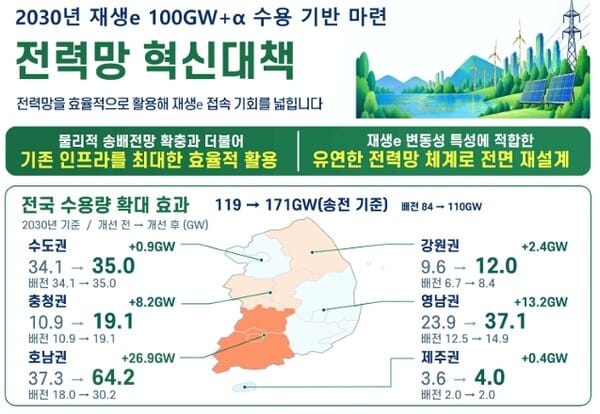
Capital region receives 0.9 gigawatts as national capacity grows by 52 gigawatts; 1.7 percent of total increase
The disparity is stark when looking at the government's regional transmission capacity expansion plans by 2030. Honam region capacity will increase from 37.3 gigawatts to 64.2 gigawatts, a gain of 26.9 gigawatts. Yeongnam region will grow from 23.9 gigawatts to 37.1 gigawatts, an increase of 13.2 gigawatts. Chungcheong region will expand from 10.9 gigawatts to 19.1 gigawatts, a gain of 8.2 gigawatts. Gangwon region will increase from 9.6 gigawatts to 12.0 gigawatts, a rise of 2.4 gigawatts. The government's rationale is that as Honam region renewable energy licences are projected to grow from 13 gigawatts in 2025 to 58.6 gigawatts in 2036, grid capacity must expand accordingly.
However, capital region transmission capacity (Seoul, Incheon and Gyeonggi) will increase only from 34.1 gigawatts to 35.0 gigawatts, a gain of just 0.9 gigawatts. While national transmission capacity grows from 119 gigawatts to 171 gigawatts, a 52-gigawatt increase, the capital region's share represents only 1.7 percent of this expansion.
Off the coast of Incheon, Ørsted (1,470 megawatts), EWP (Korea East-West Power, Hanuibaram, 2,010 megawatts), Gulup Wind Development, KOEN (Korea South-East Power), and Ocean Winds (1,125 megawatts) are pursuing offshore wind projects totalling approximately 9.15 gigawatts. Concerns have been raised that even if the entire capital region increase of 0.9 gigawatts is allocated to Incheon, it will be insufficient.
Phantom capacity recovery and auction winners only get connection rights; competitive variable for Incheon developers
While there are no separate measures to increase Incheon's allocation, some measures warrant attention.
First is the criteria for addressing phantom and delayed projects. If environmental impact assessment (EIA) is not completed five years before the grid usage start date, the connection timing can be adjusted. If a fixed-price contract is not awarded three years before that date, the connection right itself can be revoked. If delays in offshore wind projects being pursued by Ørsted, Gulup Wind Development and KOEN materialise, connection rights could be subject to reallocation under these new criteria.
The government is also changing the grid allocation method that has assumed a 100 percent timely implementation rate for renewable energy projects. From 2031 onwards, newly allocated capacity will reflect the actual implementation rate of 67.2 percent, releasing additional grid capacity to other developers. The aim is to reclaim phantom capacity held by projects that received licences but were never actually built, and redirect it to other developers.
Starting January 2027, in coordination with a revision of the renewable portfolio standard (RPS), connection rights will be granted only to projects that win competitive auctions in the electricity market. Previously, connection rights were granted on a first-come, first-served basis in the early stages of projects, leading to many cases where developers monopolised connection rights while projects stalled or were delayed. This could become a variable in the competitive dynamics among existing Incheon offshore wind developers.
Additionally, the government will improve the structure where the initial connecting developer bears the full cost of shared distribution network reinforcement while later developers use it free of charge. The government is reviewing a British-style model in which Korea Electric Power Corporation invests first and then using developers share costs proportionally to their capacity. If developers bypass Incheon's Shinsongdo substation due to connection saturation, developer burden is expected to ease.
Original Korean article: Incheon Today
English brief by Korea Wind Intelligence, koreawindintel.com
KWI developer profile — Ørsted
2 projects in Korea totalling 1,470 MW. Compiled from the KWI database. Not part of the source article.
Incheon 1 Offshore Wind — this article
|  |
Incheon 2 Offshore Wind — this article
| |
Project data: KWI database — Electricity Business Licence records, EIA filings (ME2025C009, ME2025C010), Electricity Regulatory Commission minutes, and pre-EBL permit filings.



















