

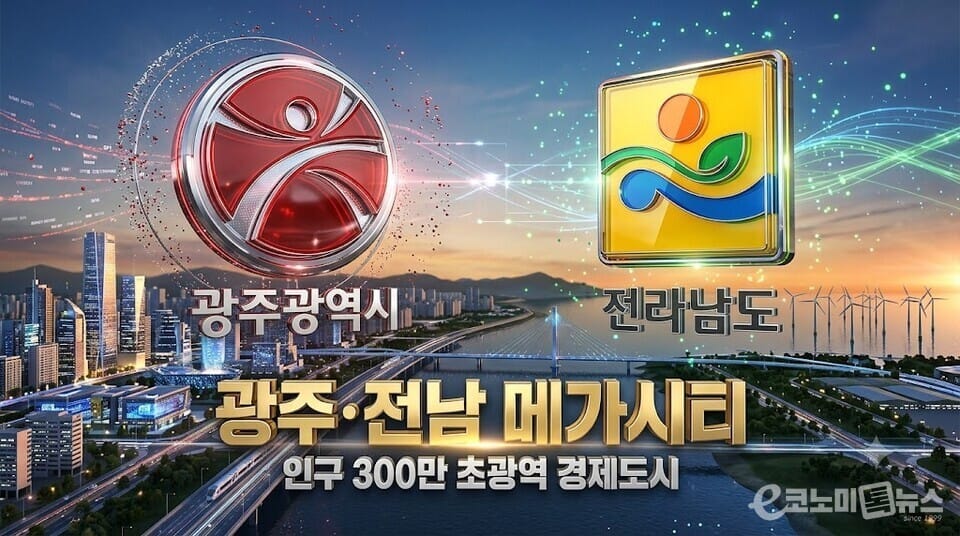
The Gwangju and Jeollanam-do megacity strategy aims to bind the two regions as a single living and economic zone, establishing a metropolitan economic city with a population of 3 million. Reflecting characteristics where administrative boundaries differ but industry, transportation, and living areas are tightly connected, it is being pursued as a super-regional strategy to raise regional competitiveness and realize balanced national development. The core lies in integrating industrial structure and securing new growth axes centered on advanced industries.
Gwangju focuses on AI, mobility, and semiconductor backend; Jeollanam-do on energy and biotech
Gwangju is experiencing rapid growth in technology and innovation-centered industries including AI and data, future mobility, semiconductor backend processes, and advanced materials.
Jeollanam-do, by contrast, has strengths in large-scale manufacturing and energy-based industries: renewable energy including Sinan offshore wind, petrochemicals and carbon materials centered on the Yeosu national industrial complex, biotech industries based on the Hwasun vaccine special zone, and agrifood and marine industries. The two regions have different industrial DNA but possess mutually complementary structures, so high synergy is expected when integrated.
The core of the megacity strategy is combining Gwangju's advanced technology with Jeollanam-do's energy and manufacturing base into a single value chain. Examples include smart energy clusters combining AI and energy, linkages between mobility and battery and materials industries, integration of semiconductor backend processes with materials and power infrastructure, and convergence of biotech and AI healthcare.
Infrastructure projects including expansion of metropolitan rail and transportation networks, creation of national industrial complexes, and construction of power infrastructure based on offshore wind are also key elements supporting industrial integration.
In other words, the Gwangju and Jeollanam-do megacity is a strategy to build a super-regional advanced industrial belt by binding Gwangju's advanced technology and Jeollanam-do's energy and manufacturing into a single value chain.
Gwangju AI Industry Convergence District: "Reshaping city industry with AI" in advanced manufacturing, mobility, and healthcare
The Gwangju AI Industry Convergence District is a regional innovation cluster established as a key hub of national AI strategy and a core project for reshaping Gwangju as an AI-based advanced industrial city. It features a structure combining industry, research, and education centered on AI data centers, supercomputing infrastructure, and AI enterprise clusters, and is positioned as core infrastructure bearing the advanced technology axis in the Gwangju and Jeollanam-do megacity strategy.
In industrial terms, it is expanding into diverse fields including future mobility, autonomous driving, smart manufacturing, and healthcare based on AI. Industrial convergence projects including autonomous driving demonstrations linked with Gwangju Global Motors, manufacturing process optimization, and medical AI analysis are in full swing, promoting digital transformation among local companies. Additionally, AI-based design and verification technologies are being introduced in semiconductor backend and advanced materials fields, strengthening industrial competitiveness.
The Gwangju AI Industry Convergence District is expected to serve as the central axis of the super-regional advanced industrial belt by combining with Jeollanam-do's energy and biotech industries. It functions as a core technology platform promoting Gwangju and Jeollanam-do industrial structure integration through AI-based energy operation systems, digital healthcare transformation of biotech and vaccine industries, and smart management of offshore wind and power infrastructure. Through this, the foundation is being laid for the entire Gwangju and Jeollanam-do region to expand into an AI-centered future industrial zone.
The Gwangju AI Industry Convergence District is a national strategic hub that reshapes regional industry based on AI and forms the technology-centered axis of the Gwangju and Jeollanam-do super-regional advanced industrial belt.
NH Nonghyup Financial launches southwestern region NH financial hub to support Gwangju and Jeollanam-do strategic industries
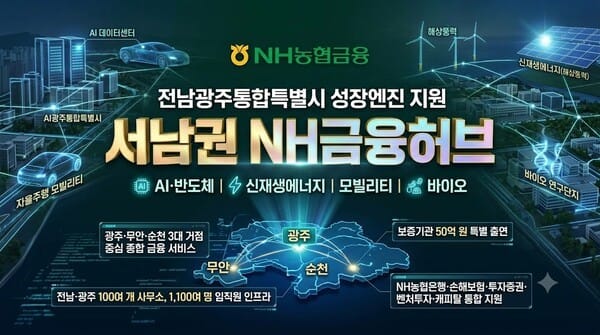
NH Nonghyup Financial Holdings announced that it will launch the southwestern region NH financial hub in the fourth quarter of this year to support core strategic industries of the integrated Jeollanam-do and Gwangju metropolitan area. It will establish a comprehensive financial services system based on regional characteristics of three offices in Gwangju, Muan, and Suncheon, and plans to operate regional financial hubs using the infrastructure of over 100 offices and 1,100 employees across Jeollanam-do and Gwangju.
Target industries for support are AI and semiconductors, renewable energy, mobility, and biotech, identified as future growth axes in the southwestern region. NH Nonghyup Bank will expand corporate finance support through a special contribution of 5 billion won to the Jeollanam-do and Gwangju guarantee agency, and NH Nonghyup Fire and Marine Insurance will strengthen corporate insurance supply. NH Investment and Securities and NH Venture Investment will engage in advanced industry investment and innovative company discovery, while NH Nonghyup Capital will support corporate credit and industrial equipment financing, establishing an integrated financial support system combining expertise across group companies.
NH Nonghyup Financial is also reviewing participation in renewable energy projects including Sinan offshore wind power generation and regional development infrastructure investment. Chairman Lee Chan-woo said, "The southwestern region is a key axis to lead future advanced industries," and added, "Through the NH financial hub, we will gather group capabilities to become a steadfast partner enabling the integrated Jeollanam-do and Gwangju metropolitan area to make a leap forward as a world-class megacity."
Original Korean article: economytalk.kr
English brief by Korea Wind Intelligence, koreawindintel.com



















