

Electricity is produced from solar and offshore wind, delivered to where it is needed through power grids and energy storage systems (ESS). Artificial intelligence (AI) optimizes the operation of power facilities and energy consumption, and resources that have reached the end of their useful life in industrial settings are returned as raw materials.
This is the flow that runs through the exhibition structure of the '2026 Climate Industry International Expo', which opened on September 16, 2026 at BEXCO in Busan.
This year's expo has moved beyond simply introducing individual green technologies to place greater weight on presenting the pathway of industrial transformation that connects energy production, delivery, consumption, and resource recovery. The fact that AI data center power infrastructure, high-voltage direct current (HVDC), high-efficiency heating and cooling systems, and hydrogen-reduced steelmaking are all featured in one place reflects the same direction. A key point of interest for this event is whether decarbonization technology can actually meet real industrial demand and form a market.
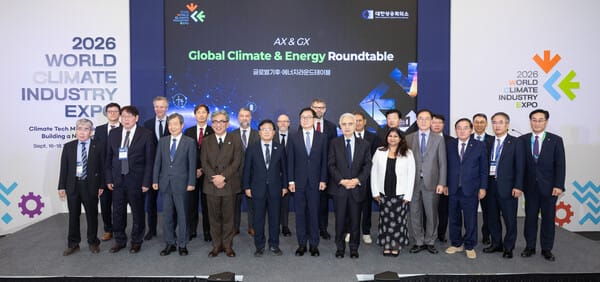
Co-hosted by MCEE (Ministry of Climate, Energy and Environment), the International Energy Agency (IEA), the International Renewable Energy Agency (IRENA), and the World Bank (WB), and organized by KEA (Korea Energy Agency), the expo runs through September 18, 2026. Under the theme 'The Massive Change Created by Climate Tech: A Leap Toward a Decarbonized World', 552 companies have set up 1,455 booths. The event also combines five exhibition halls, including the Future Energy Hall, Clean Power Hall, Environmental Energy Hall, Carbon Neutrality Hall, and Weather and Climate Industry Hall, with international conferences and business consultation sessions.
Generation Equipment and Power Grids: Beyond Clean Power Supply
A distinctive feature of the Clean Power Hall is that generation equipment and power grid technologies are displayed together. It presents both the issue of expanding renewable energy facilities and the challenge of stably delivering the electricity produced as a single industrial task.
Doosan Enerbility introduces large-scale nuclear power, small modular reactors (SMRs), and wind and gas turbine technologies. The exhibition plan includes a demonstration showing the internal structure of a 10 MW wind turbine, a wind integrated remote control center program, and SMR manufacturing technologies such as automated welding, non-destructive inspection, and helical heat exchanger fabrication. The exhibition scope has expanded beyond the generation equipment itself to include manufacturing processes and operational and management capabilities.
Hanwha Q Cells presents solar modules alongside virtual power plants (VPP), AI operating platforms, and direct power purchase agreements (PPAs) for RE100 compliance. Agrivoltaic solar and regional energy solutions are also on display. This reveals a trend where the competitiveness of solar projects is expanding beyond module performance to encompass power resource operation and electricity sales methods.
Denmark's Ørsted introduces offshore wind equipment, maintenance vessel models, and its own low-noise installation technology. The conference also addresses offshore wind development strategies that coexist with marine ecosystems. Installation processes and technologies that reduce environmental impact are being treated as key elements of the business, not just the construction and operation of power plants.
In the power grid sector, Hyosung Heavy Industries showcases HVDC, static synchronous compensators (STATCOM), ESS, and an AI-based power equipment asset management platform. Taihan Cable & Solution presents submarine and HVDC cables, laying capabilities, and bus ducts for AI data centers. LS Cable & System introduces submarine and superconducting cables and integrated power grid solutions.
Connecting these exhibitions reveals a structure running from securing power sources through transmission, grid stabilization, and supply to demand points. The exhibition structure confirms the challenge that investment in generation equipment and power grids must be coordinated to translate the achievements of clean power expansion into actual power supply.
AI Power Demand and Energy Efficiency Technologies in the Same Exhibition
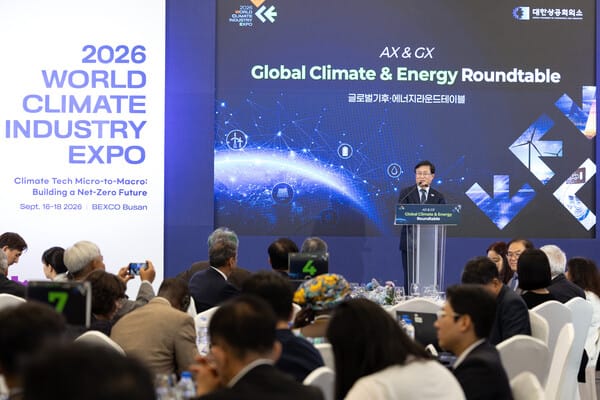
In the Future Energy Hall, power infrastructure supporting AI and technologies using AI to reduce consumption are introduced together. Both supply capacity responding to increased power demand and demand efficiency are highlighted simultaneously.
SK displays energy solutions such as renewable energy and ESS in connection with AI data center power infrastructure construction technology. The company has created an exhibition structure showing what energy sources will power data centers and how they will be operated.
Samsung Electronics introduces energy-saving methods centered on heating and cooling systems, high-efficiency appliances, and integrated energy solutions. A demonstration of heat pump-based heating systems utilizing seasonal operating conditions is also planned. LG Electronics likewise showcases AI high-efficiency appliances for residential spaces and heating and cooling solutions for commercial spaces.
The exhibition also conveys a key message: decarbonization in the industrial sector cannot be completed through power supply technology alone. Korea Zinc introduces renewable energy, green hydrogen, and resource circulation businesses along with eco-friendly smelting technology. POSCO Group presents Korea's hydrogen-reduced steelmaking 'HyREX' and decarbonization steel technology. This carries the meaning that work to change energy sources and work to transform raw materials and production processes must be pursued together.
Can Climate Tech from Small and Medium Enterprises Move from Exhibition to Market?
Amid the large-scale energy infrastructure of major corporations, the concrete problem-solving approaches presented by startups and small and medium-sized enterprises also draw attention. The Climate Tech Special Zone within the Future Energy Hall has gathered related companies and research and development results, while the Innovation Award Special Booth introduces the technologies and products of 12 companies that have won Climate Energy Innovation Awards and CES Innovation Awards.
Croceus combines AI and power semiconductors in next-generation power conversion technology (SST). Poen presents partial repair, replacement, and reuse technology for electric vehicle high-voltage batteries. Vinsen introduces hydrogen fuel cell and battery-based ship electric propulsion systems and ammonia-based ship power systems.
In the resource circulation sector, Nawa's automatic collection and processing system for disposable cups, iCubeLab's solar-based waste collection and management technology, and Terracycle's chemical recycling technology for waste PET and waste clothing are on display. These represent approaches to reduce costs and environmental burdens across different industries such as power equipment, transportation, and waste treatment.
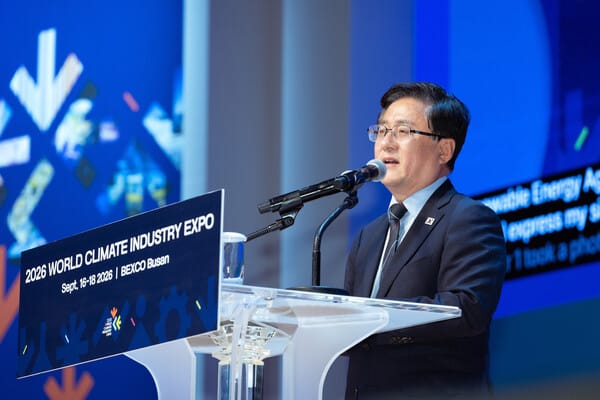
Additionally, export consultation sessions by KOTRA and BEXCO, sales and investment consultation sessions, business consulting for innovative companies, and support for investor presentation pitches are being operated. After the event, how much the consultations lead to demonstration projects, purchase contracts, and follow-up investment will likely become a benchmark for measuring the expo's industrial impact.
International Cooperation Agenda Shifts from Technology to System Transformation
This year, with IRENA newly participating as a co-hosting organization, the scope of international cooperation has also expanded. Following the IEA in 2024 and the World Bank in 2025, an international organization in the renewable energy field has now joined.
Fourteen conferences will discuss energy security and renewable energy expansion, digital transformation, the relationship between AI and energy, and institutional foundations for fostering climate tech companies. Thirty-seven separate exhibition seminars include topics related to field application such as industrial thermal energy decarbonization, demand innovation, green data center certification, and supply chain response technologies.
The messages presented by international organizations have also focused on connections between technology, institutions, and investment. IEA Executive Director Fatih Birol stated that Korea, which has strengths in batteries and power grid equipment, can contribute to supply chain diversification and energy security enhancement. IRENA Director-General Francesco La Camera evaluated Korea's renewable energy expansion and electric nation vision, emphasizing cooperation in energy transition. Sudeshna Ghosh Banerjee, World Bank Regional Vice President for Asia, noted that for climate tech innovation to lead to transformation of the entire energy system, policy and institutional improvements, infrastructure investment, and international cooperation must be pursued together.
This expo is an opportunity to examine in one place the generation, power grid, efficiency, and materials technologies that Korean companies have secured. At the same time, it is a venue for asking what more is needed to connect each of these technologies to actual decarbonization projects. As important as the number of products on display are the demand sources that will adopt them and the investment foundation. When the technology and policy discussions that begin in Busan translate into concrete projects, the industrial potential of climate tech will become clearer.
Original Korean article: Energy News
English brief by Korea Wind Intelligence, koreawindintel.com



















