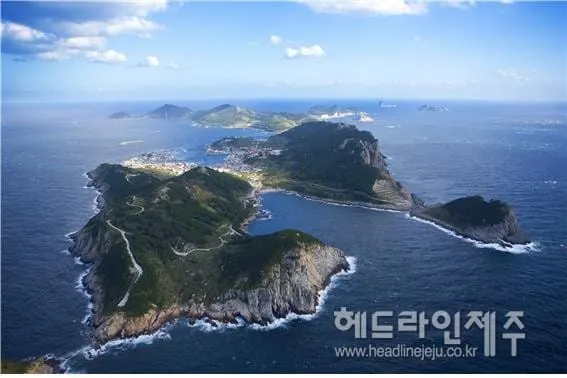
Concerns have been raised that the Phase 2 offshore wind farm project in Gulup Island, Ongjin County, Incheon—where the CJ Group family holds major stakes through Gulup Wind Power Development Co., Ltd.—could infringe on the safe shipping route to the Five Western Islands (Seoha 5-do). As each Incheon offshore wind project raises concerns about threatening the mobility and survival rights of island residents, opposition voices are growing.
According to reporting compiled by Incheon Today on the 21st, the Five Western Islands Residents Association—a nonprofit organization established by residents of Seoha 5-do (Baengnyeong, Daecheong, Socheong, Yeonpyeong, and Soyeonpyeong islands) in Ongjin County—sent an official letter to the Ongjin County Governor on July 13, urging him to deny an extension of the public water surface use and occupancy permit that Gulup Wind Power Development Co., Ltd. had applied for to install wind measurement equipment.
Five Western Islands Residents Association: "Stop Extension Permit for Gulup Wind Power"
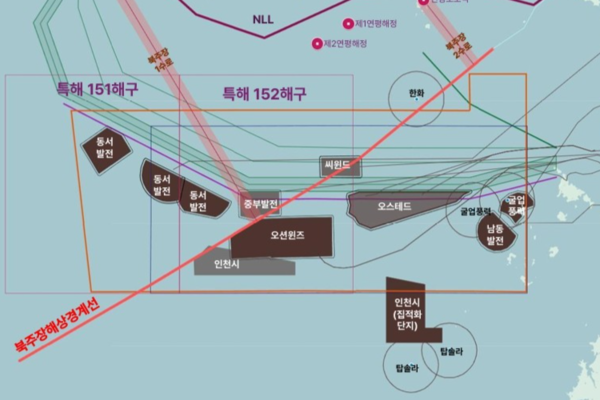
The Five Western Islands Residents Association stated: "We absolutely cannot accept any further promotion of offshore wind farms, including measurement equipment, near the safe shipping route used by Baengnyeong Island residents in the event of North Korean provocation or other emergencies." The maximum effective range of the measurement equipment installed by Gulup Wind Power Development is a 7-kilometer radius (154 square kilometers). If the company receives an offshore wind power generation permit within this zone, it can install turbines within an area of up to 80 square kilometers, which overlaps with the safe shipping route to the Five Western Islands, according to the association's claim.
The written opinion first traces the background of how the safe route was established. From October to mid-December 1973, North Korea illegally crossed the Northern Limit Line (NLL) in the West Sea 43 times, blocking shipping lanes to the Five Western Islands. Following this, the Navy began escorting ships to the Five Western Islands after the 346th Military Armistice Commission meeting in December that year.
The current "Northwestern Islands Ship Navigation Regulations" divide the route created this way into a "basic route" (used during normal times) and a "safe route" (used when tensions rise near the NLL or during localized conflict).
CJ Conglomerate Family-Owned Subsidiary Pursuing Gulup Island Offshore Wind
Gulup Wind Power Development is preparing Phase 1 "Gulup Island Offshore Wind" (250 MW, awarded in the 2026 government wind auction) followed by Phase 2 "Gulup Island Offshore Wind Expansion Zone" (400 MW) in waters near Gulup Island, Ongjin County. The Phase 2 project cost is approximately 2.8 trillion won, and the combined Phase 1 and 2 total project cost is reported to be around 4.6 trillion won. The Phase 2 project is currently in the stage of operating offshore wind measurement equipment and collecting data.
Gulup Wind Power Development is a subsidiary spun off in 2021 from C&I Leisure Industry Co., Ltd. C&I Leisure Industry is a major shareholder with 51% stake held by Lee Seon-ho, management leader of CJ CheilJedang and eldest son of the CJ Group family. C&I Leisure Industry, which owns 98.2% of the Gulup Island land (50% stake), is joined by other shareholders including SK E-trinics (30%) and Daewoo Engineering and Construction (20%).
Following Ørsted, Gulup Wind Also Faces Route Conflicts Repeated in Every Incheon Offshore Wind Project
Gulup Wind Power Development is not the first to have its progress blocked by route issues. "Incheon Offshore Wind 1 and 2," promoted by Danish state-owned company Ørsted, was held three times during the December 2023 Ministry of Trade, Industry and Energy Electricity Committee review due to overlap with the Incheon-Baengnyeong passenger ferry route. It only received approval in November that year after reducing the project area by approximately 30% and revising the zone to maintain a distance of at least 1 nautical mile (1.85 kilometers) from the passenger ferry safe route.
Nevertheless, on September 25, 2024, the Ministry of National Defense expressed concerns about the public water surface use and occupancy permit area that Ørsted had requested for offshore wind foundation surveys, stating that it is an area with restrictions on naval vessel and ship navigation safety. The ministry stated that relocation of the public water surface use and occupancy area by at least 1 nautical mile north and south of the coordinates of the Northwestern Islands ship navigation route is necessary.
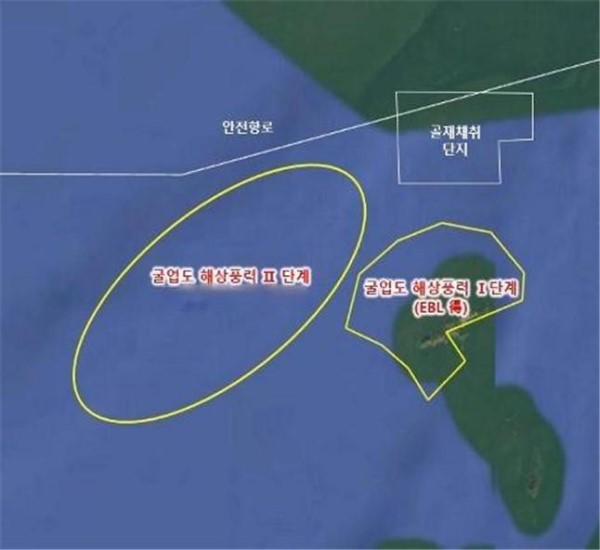
Based on this standard, the Phase 2 project pursued by Gulup Wind Power Development is expected to require area reduction as it must lower its northern boundary to secure the safe route separation distance.
The same applies to "Hanewibaram 1, 2, and 3" projects, which Korea East-West Power Co., Ltd. acquired from German company RWE and is promoting. According to the electric business license application documents, the Ministry of National Defense described the project location as a "core area for defense of the Northwestern Islands and the capital region," and requested adjustment of the northern turbine positions citing radar signal shielding and vessel route overlap as reasons.
The Ministry of Oceans and Fisheries also stated in related agency opinions on the project application: "A shipping flow of vessels 100 meters or longer exists on the south side of the project site," and "the power generation scale, turbine arrangement, and project area may be reduced, changed, or adjusted at the marine traffic safety assessment stage."
The publicly-led "Incheon 2 (IC2)" project promoted by Korea Central Electric Power Co., Ltd. also faced opposition from the Incheon Regional Maritime and Fisheries Administration, which determined that it directly overlaps with the Five Western Islands passenger ferry route.
Following Ørsted, Hanewibaram, and Korea Central Electric Power, Gulup Wind Power Development has also encountered the Five Western Islands route issue—showing that Incheon offshore wind projects, regardless of whether they are foreign-backed, state-owned, or conglomerate-affiliated, are running into the same problem.
Gulup Wind Power Development: "Measurement Equipment and Route Are at a Distance"
A Gulup Wind Power Development official responded: "The actual location where the measurement equipment is installed and the safe route are at a distance from each other. When actually developing the wind farm, it will need to be adjusted so it does not overlap with the route. We explained this to Ongjin County. The measurement equipment permit expires at the end of August, but the extension permit has not yet been issued."
An Ongjin County official also stated: "We have guided the company to comply with safe route separation distances when planning the wind farm in the future. If separation distances overlap, the wind farm itself cannot receive a permit. We understand the company is not trying to receive a permit for the entire area of the measurement equipment's effective range. Therefore, we believe the situation that residents are currently concerned about will not occur."
KWI developer profile — Ørsted
2 projects in Korea totalling 1,470 MW. Compiled from the KWI database. Not part of the source article.
Incheon 2 Offshore Wind — this article
|  |
Incheon 1 Offshore Wind
| |
Project data: KWI database — Electricity Business Licence records, EIA filings (ME2025C009, ME2025C010), Electricity Regulatory Commission minutes, and pre-EBL permit filings.
Original Korean article: Incheon Today