

Boryeong, which experienced coal power plant closures ahead of other regions, has presented to the government a plan to establish offshore wind, hydrogen, and carbon capture and utilization (CCU) as new industrial pillars by 2030, while also attracting the integrated headquarters of state-owned power generation companies and transmission infrastructure to restructure the regional economy after the transition away from coal.
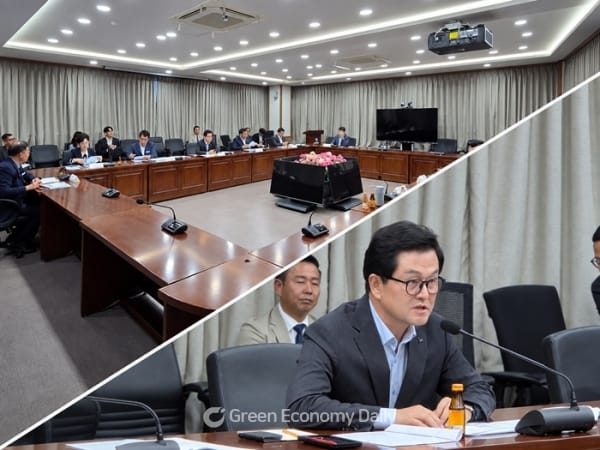
On September 22, 2026, Boryeong Mayor Um Seung-yong presented the city's energy transition plan and raised local issues that the government must address at a "Carbon Neutral Leading City Roundtable" held at the Han River Flood Control Office in Seoul, attended by Ministry of Climate, Energy and Environment (MCEE) Minister Kim Sung-hwan and Dangjin Mayor Kim Ki-jae.
What Boryeong emphasized to the government was not simply greenhouse gas reduction. The more direct issue is what industries and jobs will fill the space left by the power plant.
Boryeong Thermal Power Units 1 and 2 ceased operations at the end of 2020. Shortly after, in January 2021, Boryeong's population fell to 99,964, dropping below the 100,000 mark for the first time since the city's founding. This represented a decrease of 265 people in just one month from 100,229 at the end of 2020.
Over a longer timeframe, the decline is steeper. The population of 100,229 in 2020 fell to 98,142 by January 2022, a loss of 2,087 people. At that time, Boryeong identified job losses from the power plant closure as one factor in the population decline. However, it is difficult to attribute the entire population decrease solely to the plant closure, as multiple factors including aging and youth outmigration work together.
When the plant closed, local concerns centered on jobs and tax revenue. In 2021, Boryeong projected that the closure of Units 1 and 2 could result in a population loss of 342 people and a decrease in local taxes of 4.4 billion won annually. While coal power reduction is a necessary environmental policy, regions dependent on power plants face a structural problem where employment, commercial activity, and tax revenue issues occur simultaneously.
Offshore Wind as the Largest Response
Among the response measures Boryeong presented, offshore wind is the largest in scale.
The city plans to connect new energy industries such as hydrogen and CCU based on 1.3 gigawatt-scale offshore wind development. Rather than eliminating the power plant-centered economy, the focus is on transitioning existing power generation and transmission infrastructure and related workforce to the renewable energy industry. Mayor Um described this as a vision for a "just energy and value transition platform city."
Boryeong has already been selected as a carbon neutral leading city. In the 2024 government competition, the plan presented involved reducing 3.2 million tons of the city's annual greenhouse gas emissions of 36 million tons by 2030. At that time, Boryeong also proposed using profits from energy projects to support residents' electricity bills and vulnerable populations affected by climate crisis.
The difference lies in what citizens will actually experience. The standard for judging policy success becomes whether new energy industries can recreate the jobs and commercial sales lost from the plant closure, and whether profits from offshore wind or hydrogen projects actually return to residents.
Integrated Genco Headquarters and Power Grid
Mayor Um also requested that the government locate the integrated headquarters of the five Gencos in South Chungcheong Province.
The government plan is already concrete. The goal is to merge KOMIPO (Korea Midland Power), KOWEPO (Korea Western Power), KOSPO (Korea Southern Power), KOEN (Korea South-East Power), and EWP (Korea East-West Power) into a single entity and launch "Korea Generation" in October 2027. The current five companies have approximately 2,400 headquarters personnel, with about 1,800 to be assigned to the integrated headquarters and the remaining roughly 600 to be distributed across three to four regional renewable energy divisions.
The location of the integrated headquarters has not yet been decided.
The government stated it will comprehensively consider the regions where power Gencos are currently located, the impact of just transition from coal power plant closures, living and working conditions, and secondary public institution relocation policy before making a final decision. It also noted that the existing buildings of the five power companies in Jinju, Boryeong, Taean, Busan, and Ulsan can each accommodate roughly 500 people, making it difficult to place an 1,800-person integrated headquarters in any single existing facility.
Boryeong currently houses the KOMIPO headquarters. South Chungcheong also has Taean, where KOWEPO is headquartered, so the future decision on the integrated headquarters location is not just a matter for Boryeong alone but is linked to public institution placement across the entire province.
The power grid issue cannot be overlooked.
Boryeong requested that the government incorporate electricity produced by post-coal alternative power sources into the existing transmission system and construct additional transmission infrastructure. Even if the power source shifts from coal to offshore wind and hydrogen, the project cannot proceed without securing a power grid to transmit the generated electricity.
The pursuit of an AI data center in Ungcheon Industrial Complex faces the same issue. Since data centers require stable large-scale power supply, Boryeong requested that the government pursue transmission system modernization as a national power grid reinforcement project. At the roundtable, securing power for the data center emerged as a major local issue alongside offshore wind.
A Four-Year Challenge Ahead
Boryeong's carbon neutrality policy is not a project that ends with a single 2030 greenhouse gas reduction target. The remaining challenge over the next four years is how much the regional economic impact that began with the 2020 coal power plant closure can be offset by offshore wind, hydrogen, CCU, and AI data centers, along with attracting public institutions.
In particular, if the pace of reducing power generation capacity does not match the pace at which replacement industries arrive, residents may experience job losses more directly than carbon neutrality. Conversely, if actual corporate investment, employment, and resident benefit structures from new energy projects materialize, the coal transition policy could become a case study for connecting regional industrial transformation.
Mayor Um stated: "Boryeong's future requires active government support and cooperation. We will do our best to resolve pending issues so that the region can establish new growth foundations during the energy transition process, and we will pursue Boryeong's energy policies without delay."
Original Korean article: Green Economy News
English brief by Korea Wind Intelligence, koreawindintel.com



















