

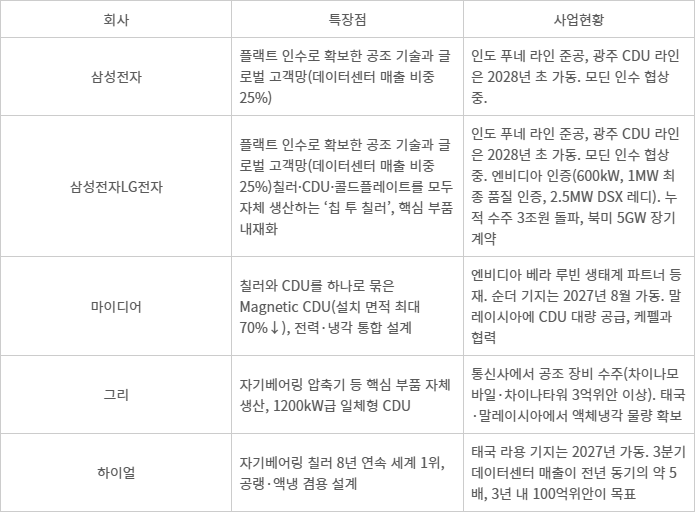
China's three leading white-goods manufacturers have all entered the AI data center cooling market, which Samsung Electronics and LG Electronics have selected as a future growth business beyond home appliances. They are joining Nvidia's ecosystem and using Southeast Asian production bases to rapidly catch up with Korean companies. Following home appliances and televisions, Korean manufacturers now face competition from Chinese companies in AI data center cooling as well. Midea was included in the list of MGX ecosystem partners for Nvidia's next-generation Vera Rubin platform, unveiled at the OCP Global Summit in the United States in October. Its Shunde liquid-cooling production base, involving investment of at least 1 billion yuan, approximately 200 billion won, will begin operating in August 2027. It has supplied large volumes of magnetic-bearing coolant distribution units (CDUs) to data centers operated by major Southeast Asian cloud providers and is targeting the Asia-Pacific market with Singapore's Keppel. In June, it also signed a strategic agreement with Alibaba on AI data center liquid cooling. Gree emphasizes its ability to manufacture key components, including magnetic-bearing compressors, in-house. In June, it introduced an integrated CDU rated at up to 1,200 kW and secured liquid-cooling system orders for data centers in Thailand and Malaysia. In November, it won orders worth at least 300 million yuan, approximately 60 billion won, from China Mobile and China Tower for air-conditioning equipment for data centers and base stations. Haier is investing at least 1 billion yuan in an air-conditioning production base in Rayong, Thailand, targeting operations in 2027 to mass-produce magnetic-bearing cooling equipment and CDUs. It supplied 48 magnetic-bearing chillers to a major Malaysian data center, reducing power usage effectiveness (PUE) from 1.45 to 1.38, and has also supplied data centers in Singapore. Its third-quarter data center revenue rose to nearly five times the year-earlier level. It targets 150% growth this year and 10 billion yuan within three years. All three Chinese companies offer integrated solutions combining chillers and CDUs. Midea introduced a magnetic-bearing CDU that combines the two to reduce installation space by up to 70%. The strategy directly overlaps with LG Electronics' 'chip-to-chiller' approach. They are also competing in the same markets. In Southeast Asia, which Samsung Electronics and LG Electronics are targeting, Chinese manufacturers are stepping up their efforts with local production bases. However, none of the three Chinese companies has yet disclosed liquid-cooling revenue, and all plan large-scale shipments for 2027 to 2028. This would leave Samsung Electronics and LG Electronics one to two years to respond. The two Korean electronics companies are taking different approaches. Samsung Electronics completed its acquisition of Germany's FläktGroup in November 2025 for 1.5 billion euros, approximately 2.34 trillion won. Its largest acquisition since Harman, FläktGroup generates 25% of its revenue from data centers. Samsung combined the organizations by having the head of its HVAC business team also serve as FläktGroup Korea's representative, and completed a production line in Pune, India, in August. It recently recruited Vice President Kim Hyung-wook from Schneider Electric and is reportedly negotiating to acquire US company Modine. Its approach is to make extensive use of external resources. A CDU production line in Gwangju, involving investment of 240 billion won, will begin operating in early 2028. LG Electronics is entering Nvidia's supply chain using its own technology. Led by chillers, its cumulative AI data center cooling orders exceeded 3 trillion won through the third quarter. This was driven by a long-term chiller supply agreement covering 5 GW with US company Air Control Concepts, and discussions are underway on expanding the supplied product range to include CDUs. Its 600 kW and 1 MW CDUs received Nvidia specification approval in July and September, respectively. Its 2.5 MW CDU subsequently met additional requirements and received 'DSX Ready' approval. It plans to extend certification to 4 MW models. 'The business results of direct competition between Korean and Chinese companies in AI data center cooling will begin to become clear in 2027,' an industry representative said. 'Competition between the Korean and Chinese electronics industries, characterized by leaders and followers in home appliances, is expanding into advanced technology sectors.'
Original Korean article: ETNews
English brief by Korea Wind Intelligence, koreawindintel.com

















