Following the Democratic Party's sweeping victory in the US midterm elections, about 80% of data centers under construction or at the planning stage in the United States are now located in states with Democratic governors. With a growing possibility of tighter regulation in major data center hubs, including permitting restrictions and reduced tax incentives, forecasts suggest that construction of new data centers could face delays from 2028.
This image was created using AI technology.
Share of data center capacity in Democratic-led states rises from 35% to 80%; tighter regulation possible
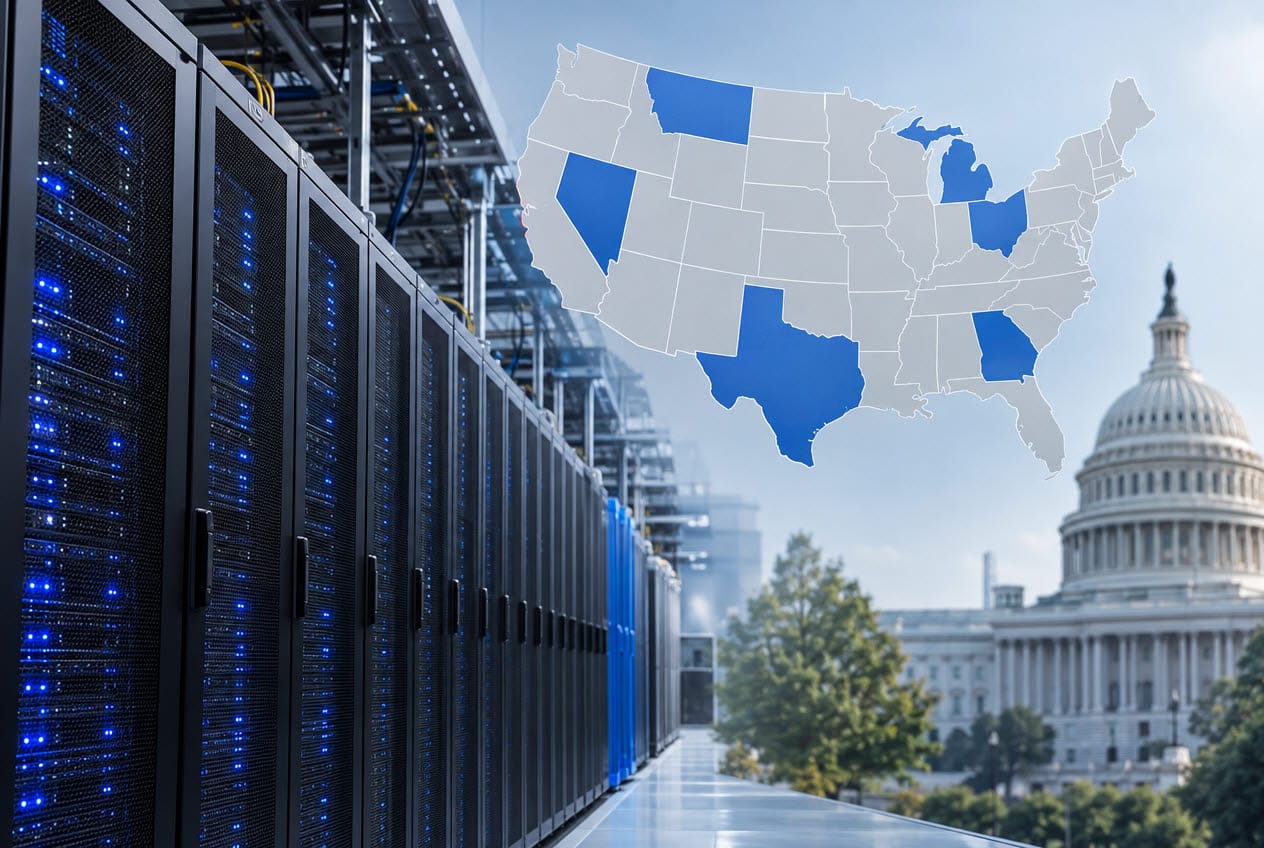
According to the Korea Center for International Finance on November 15, the share of data center power capacity under construction or planned in states with Democratic governors increased from 35% to about 80% following the US midterm elections.
In particular, the 4 states where Democrats regained governorships, Texas, Ohio, Georgia and Nevada, account for about 40% of all planned new US data center capacity additions. This would increase the likelihood that tighter regulation affects major regions that have driven the expansion of AI investment.
Major regions are already pursuing measures including restrictions on permits for new data centers and greater responsibility for grid costs. In Texas, campaign pledges included maintaining a suspension of approvals for new data centers and abolishing tax incentives, while measures discussed in Ohio include requiring developers to bear the full cost of electricity and water.
Local opposition is also growing. Of 45 local referendums related to data centers held on November 3, 44 produced results supporting development restrictions. Rising electricity bills and pressure on water resources associated with data center construction appear to be prompting calls for tighter regulation.
Morgan Stanley cuts 2028 expansion forecast by 20%, shifting capacity to 2029
Overseas investment banks expect the impact on data center expansion through 2027 to be limited, but have highlighted the possibility that construction delays for new projects could become more pronounced from 2028. Many projects scheduled to begin operating in 2027 have already obtained permits or started construction, and most have also secured financing.
Reflecting regulatory uncertainty in Texas, Ohio and other states, Morgan Stanley lowered its forecast for new US data center capacity additions in 2028 by about 20%, from 24.9 gigawatts (GW) to 19.9 GW. It raised its 2029 forecast from 22.7 GW to 27.6 GW. It expects about 5 GW of additions previously scheduled for 2028 to be deferred to the following year.
JPMorgan forecast that the near-term impact would not be substantial because 75% to 80% of data center capacity scheduled to begin operating in 2027 is already under construction, but that the risks of power supply delays and some contract cancellations could increase in 2028 and 2029. Goldman Sachs also assessed that projects without power supply agreements or environmental permits could be affected by construction restrictions.
Higher costs resulting from tighter regulation are another factor. HSBC expected data center regulation to have a greater effect on permitting conditions and the allocation of costs than on the overall scale of capacity additions. Bank of America (BofA) assessed that development periods could lengthen and financing costs could rise, particularly for projects that have not obtained permits. UBS estimated that about 30% of capacity scheduled to be added in 2028 is exposed to regulatory effects.
Some forecasts, however, suggest that tighter regulation would not directly lead to weaker AI investment. Goldman Sachs maintained its forecasts for capacity additions from 2027 to 2029, while suggesting that tighter regulation could extend the investment cycle into 2029 and 2030. Citi assessed that supply expansion would slow in the near term, but that filtering out speculative construction demand could allow AI infrastructure to be developed on a more stable basis over the long term. BofA also raised the possibility that incoming governors could pursue more moderate policies after taking office than their campaign pledges suggested.
The Korea Center for International Finance said, “Constraints on AI data center expansion are extending beyond financing and securing power to include community acceptance and permitting regulation,” adding, “The pace of new capacity additions will moderate over the medium to long term, and differences in companies' competitiveness will widen depending on their ability to bear costs and their financing conditions.”
Original Korean article: Edaily
English brief by Korea Wind Intelligence, koreawindintel.com