

Yeonggwang, an energy city in the Jeollanam-do and Gwangju integrated special city, is moving ahead with a restructuring of future industries, leading with offshore wind and clean hydrogen. The city will build an 11GW-scale 'K-Wind' offshore wind farm in stages off the coast of Yeonggwang and design a 'wind pension' that returns power generation profits to residents. Centered on the Daema Industrial Complex, it will grow clean hydrogen and e-mobility industries, and upgrade agriculture and fisheries such as gulbi and freshwater eel into processing and export industries. The Baeksu coastal sunset, islands, and fishing villages will be linked through stay-type tourism, and regional transport networks will be expanded including the West Coast Railway and extensions of the Dalbit Inland Railway.
The Jeollanam-do Research Institute's 'Yeonggwang County Development Vision' presents the concept of 'a new leap created by sunshine and wind: Yeonggwang, an energy-centered city'. Through eight core tasks including K-Wind offshore wind and clean hydrogen, e-mobility, agricultural and fisheries convergence, gulbi and freshwater eel, stay tourism, care and growth communities, and West Coast transport hub, it focused on connecting energy production to regional industry, resident income, and living conditions.
11GW K-Wind and Clean Hydrogen Energy Axis
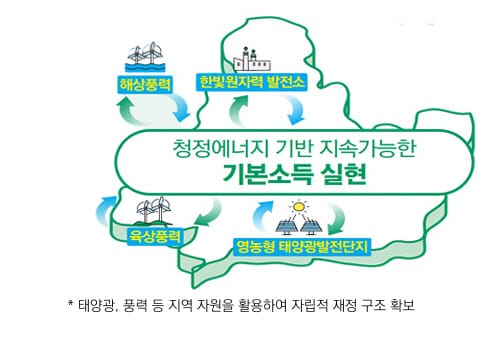
Offshore wind is Yeonggwang's first growth axis. Currently, 182MW of onshore wind and 461MW of solar power are operating, and a 4.1GW-scale project is underway at sea. The report proposes expanding a total of 11GW-scale 'K-Wind' offshore wind power generation complex off the coast of Yeonggwang in stages: 4GW in the short term, 8GW in the medium term, and 11GW in the long term. By 2029, construction start and operation of the Nagwol 365MW and Anma 528MW power generation complexes will also be pursued.
Power generation profits will be connected to resident income. Based on 2037, when 4GW is in operation, annual power generation profits of approximately 200 billion won will be secured and used as a source for 'Yeonggwang-style basic income', with a target of paying residents 1 million won or more per person annually. Various participation methods including resident participation funds, fishery worker equity participation, and local cooperatives will also be introduced to institutionalize profit distribution and damage compensation standards.

















