

On November 4, the day after the US midterm elections, the yield on the 10-year US Treasury note fell to 4.918%. It had risen to 5.34% in early October, its highest level in 24 years. Markets offered two interpretations of the election, in which Democrats won both the Senate and the House of Representatives. One was that divided government would make a large fiscal expansion difficult, reducing the burden of Treasury issuance. The other concerned AI. Aidan Yao of the Amundi Investment Institute assessed the election as closer to a referendum on AI than a verdict on Trump.
In my view, the second interpretation contributed substantially to the decline in yields. Added to the skepticism about AI investment already circulating in the market was a narrative linking a Democratic victory to constraints on AI investment and slower growth. The issue to examine, then, is whether Democrats can actually slow the pace of AI investment. To investigate, I looked at where data centers are located and who represents those areas.
1. More data centers are in Democratic districts
Based on House seats before the election, data centers are concentrated in Democratic districts. In the tally I examined, 214 Democratic districts had 994 data centers, or 58%, while 218 Republican districts had 698, or 40%. The average per district was 4.6 versus 3.2. Virginia's 10th Congressional District, in Northern Virginia, had the most, at 306. Of the top 10 districts, 5 were Democratic, 4 were Republican and 1 had a vacant seat. Most established hubs, including Northern Virginia, Silicon Valley and Oregon, are in Democratic districts. Of the 117 facilities currently under construction, 83, or 71%, are also in Democratic districts.
These figures suggest that equating Democrats with opposition to AI goes too far. Data centers are already tied to tax revenue and jobs in Democratic districts. Those interests became evident in Virginia, where Democrats hold both the governorship and the state legislature. When Governor Abigail Spanberger signed the budget in late June 2026, Spanberger left the sales tax exemption for data center equipment intact. Estimated at $1.9 billion annually, it is the state's largest tax incentive. Instead, the state introduced a tax of $0.011 per kWh of electricity used by data centers and capped annual collections at $600 million. Spanberger maintained that the state should honor its commitments to companies that invested in reliance on the existing tax system. Rather than blocking data centers, the state imposed a charge.
2. But new investment is going to Republican districts
The same tally also contains figures pointing in the opposite direction. Average power capacity per district is higher in Republican districts, at 224 MW, than in Democratic districts, at 124 MW. Investment in projects under construction, including servers and GPUs, is also greater in Republican districts, at $925.5 billion, than in Democratic districts, at $559 billion. That puts approximately 62% of investment under construction in Republican districts.
Facility counts and investment point in different directions because the nature of data centers has changed. Established hubs have many small and medium-sized facilities near cities. New facilities for AI training require large areas of land and substantial power, so they are being built in suburban and rural areas. Markets are concerned not about data centers already built, but about those yet to be built. It is therefore difficult to say, based on the House district map alone, that Democrats will protect AI investment.
3. The key variable is which party holds governorships
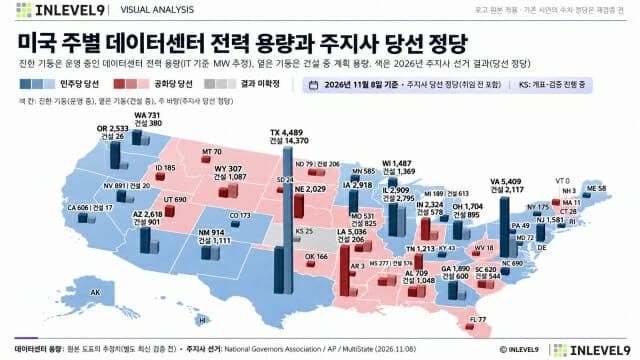
State governments, rather than Congress, actually determine the pace of data center development. Regulators approving grid connections, tax incentives, and water and air permits all fall under state authority. In this election, Democrats took the governorships of 6 states from Republicans: Alaska, Georgia, Iowa, Nevada, Ohio and Texas. There will be 29 Democratic governors in 2027, while the result in Kansas has not yet been finalized.
A substantial shift emerges when governors' party affiliations are compared with state-level data center power capacity estimated from public records by bond and credit research publication Yield & Spread. Of approximately 30,304 MW of data center capacity under construction, the share in states led by Democratic governors rises from about 31% before the election to about 83% afterward. Texas alone accounts for 47% of capacity under construction, while the 6 states where the governor's party changed account for a combined 52%.
Texas Governor-elect Gina Hinojosa pledged a moratorium on approvals for new data centers until the state legislature puts safeguards in place. Hinojosa also pledged to instruct the Public Utility Commission of Texas (PUCT) to freeze residential electricity rates until the law is changed to require large electricity users such as data centers to pay their own electricity costs. The Texas governor appoints all members of the commission. Data center projects seeking connections from Texas grid operator ERCOT exceed 400 GW.
The 83% figure therefore has two implications. It means Democrats cannot disengage from the data center economy, but it also means they will hold most of the permitting authority for new data centers. The bond market reacted to the latter.
4. Republicans imposed restrictions first
Reading these constraints as a Democratic anti-AI policy, however, misses the central point. It was Republican Governor Greg Abbott who first halted new data center grid connections in Texas. On August 3, Abbott suspended new connections and ordered an audit of electricity demand, environmental impacts and tax incentives for developers. ERCOT expects the audit to conclude around December 10. As recently as November 2025, Abbott had called Texas the "epicenter of AI development."
Voter dissatisfaction is not limited to one party, either. In a 2026 Pew Research Center survey, 44% of Democratic supporters and 33% of Republican supporters said data centers were "mostly bad" for household electricity bills. There is a difference, but the shares are substantial on both sides. In an NBC exit poll reported by Reuters, 76% of voters nationwide opposed a new data center being built in their neighborhood.
The conflict is not between Democrats and Republicans, but between residents paying electricity bills and big tech companies consuming large amounts of power. Democrats were more effective at organizing this dissatisfaction during the election.
5. Constraints mean additional charges, not a shutdown
What Democratic state governments have actually done so far is redistribute costs, not eliminate data centers. Virginia taxed data center electricity use, while the Texas governor-elect said approvals would be suspended until data centers paid their own costs. The new Congress will not convene until January 2027, and it has few tools to directly determine data center locations.
I therefore think the market interpretation that a Democratic victory will slow AI investment is directionally right but oversimplifies how it would happen. There are three practical ways this could occur. The cost per 1 MW of new data center capacity rises, construction starts are delayed, and investment moves to states with less regulation. AI demand does not disappear; meeting the same demand takes more time and money.
This distinction also matters when interpreting yields. Construction delays lower growth expectations, but they could also reduce pressure from the issuance of long-term corporate bonds that big tech companies had been selling to finance data centers. Explaining this decline in yields through slower growth alone misses that second mechanism.
6. Dates Korean companies should watch
For Korean companies selling memory, transformers and power equipment to US data centers, this distinction is a practical issue. State-by-state permitting schedules are increasingly likely to determine delivery timing as much as hyperscalers' total annual capital expenditure. There are three immediate items to watch: the ERCOT audit findings expected around December 10, executive orders immediately after Governor Hinojosa takes office in January 2027, and data center legislation during the Texas legislature's regular session that same month. Virginia's data center electricity tax expires at the end of June 2028. The pace of US AI infrastructure development now depends more on the electricity costs state governments impose on data centers than on the majority party in Washington.
The views expressed in this column may differ from the publication's editorial position.
Original Korean article: ZDNet Korea
English brief by Korea Wind Intelligence, koreawindintel.com

















