

With U.S. Democrats gaining control of Congress and key state governments, regulation of AI data centers is moving from discussion to legislation. Once the new Congress convenes, legislative efforts covering electricity bills, safety testing and corporate liability will begin in earnest.
In southern states with concentrations of data centers, governors pledging to halt new approvals have been elected. The veto power of the president, who has opposed mandatory federal regulation, remains the final hurdle.
Capital markets are watching how much regulation could delay actual data center construction and demand for AI semiconductors.
According to Reuters on November 7, Democrats will pursue AI legislation along three tracks when the new Congress convenes in January 2027. The priorities are protecting consumers' electricity bills, independent safety testing for advanced AI, and clarifying corporate liability when harm occurs.
Share prices moved before legislation
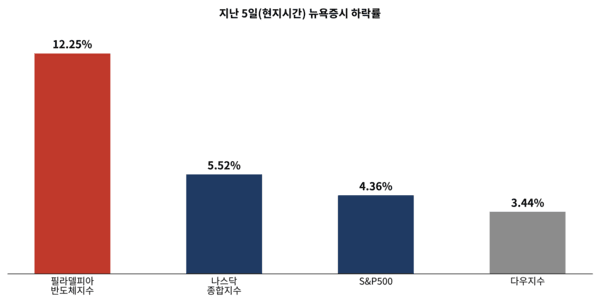
Markets reacted before legislation was introduced. On November 5, local time, the Philadelphia Semiconductor Index fell 12.25% and the Nasdaq Composite declined 5.52%, while the S&P 500 dropped 4.36% and the Dow fell 3.44%.
The Wall Street Journal reported that the market capitalization of Nasdaq-listed stocks fell by $2.5 trillion that day, the largest one-day loss on record. Doubts about returns on AI investment had also been accumulating, with Intel plunging 28.58% on October 30 following a weak fourth-quarter outlook.
State government policies in Texas and Georgia
Democrats also won the governorships of Texas and Georgia, where data centers are concentrated. Texas Governor-elect Gina Hinojosa has pledged a complete halt to data center approvals until the state legislature passes legislation protecting residents.
Georgia Governor-elect Keisha Lance Bottoms also supports a moratorium on new data centers.
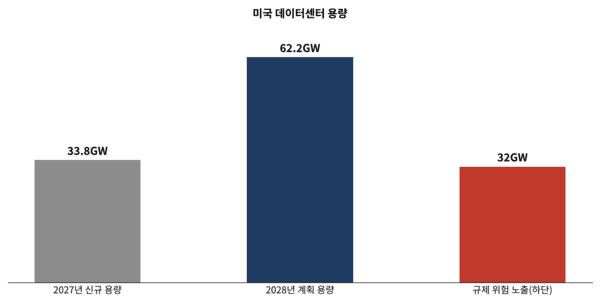
NH Investment & Securities estimated that 32 GW to 33 GW of the 62.2 GW of data center capacity planned in the United States for 2028 faces regulatory risk, with 82% of potentially delayed capacity concentrated in three states: Texas, Ohio and Georgia.
Electricity cost bill failed to clear the Senate threshold
In September 2026, the House passed a data center grid cost bill by 417 votes to 3. It calls on regulators to consider requiring large data centers to bear grid expansion costs.
However, in a Senate procedural vote on September 30, it received only 57 votes in favor, short of the 60-vote threshold. Democrats opposed it, saying that cost allocation remained a recommendation rather than a requirement.
Capital Market News analysis
Capital Market News views the sharp decline as a discount for uncertainty before the details of regulation have been determined. Delays to data center construction and a decline in demand for AI services are separate issues.
Cho Yeon-ju, an analyst at NH Investment & Securities, said: “The stock market's reaction is excessive, given that about 3/4 of the 33.8 GW of new U.S. capacity for 2027 is already under construction, and that capacity not yet under construction for 2028 faces temporary delays rather than outright cancellation.”
This assessment suggests that buildings already under construction are outside the direct scope of new regulation.
The article also assesses that regulation is focused primarily on electricity bills. If data centers are required to bear grid costs, the effect would be higher costs rather than construction stoppages, and semiconductor orders would not necessarily cease immediately.
Investment banking perspective
Securities firms and the investment banking industry view the White House's response as the final determining factor. President Trump has opposed mandatory federal AI regulation, but the legislative framework released by the White House in March 2026 also included preventing sharp electricity bill increases as a principle.
The article assesses that there is considerable room for agreement on electricity bills because both parties intend to address them. Safety testing and corporate liability provisions are more likely to face opposition from the administration, and overriding a presidential veto would require support from more than two-thirds of both the House and the Senate.
The near-term test will be the specific wording of Democratic legislation introduced when the new Congress convenes in January 2027. Whether permitting policies in Texas and Georgia lead to actual approval suspensions is cited as a factor that could determine the direction of AI semiconductor stocks.
Original Korean article: jabon.co.kr
English brief by Korea Wind Intelligence, koreawindintel.com

















