

A proposal has been presented to establish space data centers in stages by 2035 to overcome the power and cooling challenges of terrestrial data centers. The first step would be an orbital demonstration of a small, 100 kg-class space data center using Nuri's seventh launch in 2028.
At the Space Data Center Forum's third discussion at the National Assembly on November 2, Lee Chun-woo, space mission program director of the K-Moonshot task force, said, “Terrestrial data centers face limitations including enormous electricity demand, cooling water shortages, difficulty securing sites, various environmental regulations and data transmission delays.” Lee added, “We need to establish space data centers that use the unlimited solar resources of space and radiative cooling technology.”
South Korean satellite observation data is currently transmitted to ground stations and then stored and analyzed at terrestrial data centers. Lee introduced the K-Moonshot 2035 space mission strategy, which would collect, store, process and analyze space-generated data directly where it is produced, reducing transmission and analysis times and enabling space-based AI services.
The K-Moonshot space mission aims to secure core technologies in power, heat dissipation, AI computing and satellite communications, conduct phased orbital demonstrations, and establish a foundation for private-sector-led commercialization of space AI.
Under the roadmap, a small, 100 kg-class space data center would be established by 2029, followed by a medium-sized, 500 kg-class facility providing space AI services by 2032. The goal for 2035 is a large, tonne-class space data center capable of serving as a platform for commercial AI services.
This would require development of high-capacity solar power systems, radiative-cooling thermal control, radiation-hardened AI computing devices and intersatellite optical communications links. The proposal envisages making active use of domestically competitive technologies, including AI models, neural processing units, or NPUs, high-bandwidth memory, or HBM, and perovskite solar cells.
First demonstration using Nuri's seventh launch in 2028 would require 14 billion won
The immediate task is an orbital demonstration of a small, 100 kg-class space data center. Participants argued that development would need to begin in 2027.
Lim Jeong-heum, head of the Korea Aerospace Research Institute's Space Exploration Research Center, presented a plan to spend a total of 14 billion won over 24 months from 2027 to 2028 to verify the reliability of domestically produced AI semiconductors in the space environment and demonstrate core foundational technologies.
Lim explained that ground tests alone make it difficult to verify large-scale power supply, heat dissipation and stable operation of AI computing devices in space. Actual orbital demonstration results would be needed to determine the scale of subsequent development and investment.
In particular, Lim identified Nuri's seventh launch, scheduled for November 2028, as the first demonstration opportunity. The launch would offer access to a dawn-dusk sun-synchronous orbit, and carrying space data center demonstration equipment as a secondary payload could reduce the cost of a separate launch, Lim explained.
Lim therefore emphasized that the government should ease the burden on private companies of securing individual satellites and provide opportunities for orbital demonstrations. The concern is that delayed development could cause the launch opportunity to be missed, disrupting subsequent technology development and entry into the global market.
Space data center value depends on services; frequency registration and legislation need early attention
Participants also argued that commercializing space data centers would require not only technology development but also business structures and an institutional framework for operating actual services.
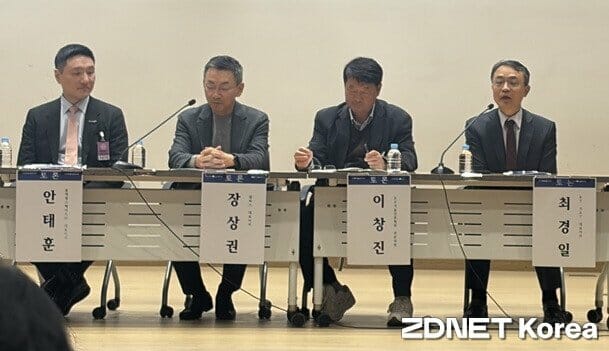
KT SAT chief executive Choi Kyung-il emphasized that the value of space data centers ultimately depends on services. Building and operating space infrastructure requires capabilities different from those needed to provide AI services, Choi explained, so service operators, cost-sharing structures and the division of roles with terrestrial data centers should be defined in advance.
Choi also emphasized the need to expedite satellite frequency registration to ensure stable operation of space AI services. International coordination of satellite frequencies and orbits can take years, requiring preparations ahead of the actual service launch.
KT SAT said it had been working on the internal design of a space data center since 2025 and had been preparing its first orbital registration in the first half of 2026. The company also explained that it could apply its experience operating Mugunghwa satellites and the capabilities of its X Wave One service, which integrates geostationary and low Earth orbit satellite communications, to the space data center business.
The National Assembly and government also agreed on the need to support the development of space data centers.
National Assembly Science, ICT, Broadcasting and Communications Committee member Lee Ju-hee noted that the 2027 budget for space data centers was only 2.1 billion won and said efforts would be made to expand funding to secure the technological foundation and develop an industrial ecosystem.
Korea AeroSpace Administration administrator Oh Tae-seog said space data centers would be included as a core task in the K-Moonshot strategic roadmap to establish a foundation for phased orbital demonstrations and commercialization. Oh also emphasized that support for core technology development and orbital demonstration opportunities would be provided in a timely manner to help domestic companies establish an early position in the space data center components market and global supply chains.
Original Korean article: ZDNet Korea
English brief by Korea Wind Intelligence, koreawindintel.com

















