

Major South Korean artificial intelligence (AI) semiconductor and infrastructure companies are building a K-Composable Cluster that dynamically allocates computing resources. The aim is to improve the efficiency of AI data centers facing enormous power consumption and cost challenges.
At K-Cloud Tech Day 2026, held at Seoul AI Hub on the 27th, HyperAccel CEO Kim Joo-young presented the status and development roadmap of a project to integrate and validate AI semiconductor-based data center training and inference systems.
This large national project runs for a total of 5 years and 9 months, from April 2025 to December 2030. It will receive a total of 45.8 billion won, comprising 34.8 billion won in government support and 11 billion won in contributions from participating institutions. Led by HyperAccel, the project brings together domestic technology companies and institutions including Rebellions, Panmnesia, MangoBoost, Lablup, KAIST and Naver Cloud.
The project's central motivation is the power shortage that has emerged as the biggest obstacle to expanding hyperscale AI data centers. AI semiconductors currently account for 40% of total data center construction costs. Power consumption per server is rising rapidly.
“The key to AI data center development is no longer land or capital, but securing power,” Kim said in the presentation. “In the current situation, where upgrading power infrastructure takes years, this is the biggest bottleneck to expanding the overall system.”
The K-Composable Cluster uses disaggregation technology to physically separate computing resources into pools, including neural processing unit (NPU) pools for inference and training, memory pools, and central processing unit (CPU) pools.
“The K-Composable Cluster we envision is a next-generation architecture that organizes excellent domestically developed AI semiconductors into separate resource pools and dynamically allocates them in fine-grained units to process incoming workloads as efficiently as possible,” Kim said. The plan is to use scheduling software to overcome structural inefficiencies in existing server architectures, where static allocation has left resource utilization at 31%.
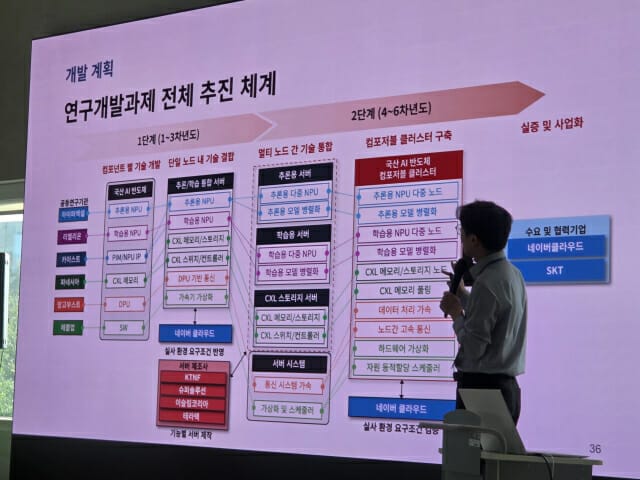
Participating institutions plan to build a domestic full-stack AI infrastructure, each taking responsibility for its area of expertise. HyperAccel, for inference, and Rebellions, for training, will develop NPUs as the core computing devices. Panmnesia will handle CXL memory, while MangoBoost will handle a DPU-based communications system. These will be combined with Lablup's dynamic resource allocation scheduler and KAIST's simulation technology. Finally, Naver Cloud and SKT, as prospective users, will demonstrate and commercialize the integrated system.
The event also highlighted the technical specifications of HyperAccel's proprietary LPU (LLM Processing Unit), Bertha, designed to improve inference system efficiency. Bertha increased memory bandwidth utilization to as much as 90% through a single large-core design, using streamlined dataflow, that eliminates the data movement bottleneck of conventional GPUs. It also uses 192 GB of low-power mobile LPDDR5X memory instead of expensive high-bandwidth memory (HBM), reducing power consumption per card, measured by TDP, to around 250 W and substantially lowering initial infrastructure setup costs.
Related articles
The consortium plans to complete technology integration within a single node in the first phase, covering project years 1 to 3, and finish building the full cluster through integration across multiple nodes in the second phase, covering years 4 to 6. It plans to increase system throughput by up to 3 times through a hybrid architecture in which HyperAccel's LPU handles the compute-intensive prefill stage, while conventional HBM-based GPUs handle the decode stage requiring sequential token generation.
“Our ultimate goal is to develop a highly efficient composable cluster and secure all the systems and components that will form the foundation when AI data center operations expand to multiple racks,” Kim said.
Original Korean article: ZDNet Korea
English brief by Korea Wind Intelligence, koreawindintel.com

















