

SK Telecom continued its earnings recovery with third-quarter operating profit above 500 billion won. As wireless telecommunications revenue returned to normal and the fixed-line business also grew, the AI data center (AIDC) business accelerated infrastructure expansion through newly established companies.
SK Telecom said on November 4 that it recorded consolidated third-quarter revenue of 4.4973 trillion won, operating profit of 552.3 billion won and net profit of 411.8 billion won.
Revenue increased 13.1% year on year, while operating profit rose 1,040.3%. The results reflected a base effect from the customer appreciation package offered following last year's personal information breach.
Compared with the preceding quarter, revenue increased 3.2%, while operating profit declined 2.4%. Operating profit remained above 500 billion won for three consecutive quarters.
On a standalone basis, revenue totaled 3.1563 trillion won and operating profit was 413.5 billion won.
Telecom revenue recovers, with 18,090,000 5G subscribers
Mobile telecommunications revenue rose 21.6% year on year to 2.5697 trillion won. The base effect from the customer appreciation package and a shift toward marketing focused on customer lifetime value (LTV) contributed to the increase.
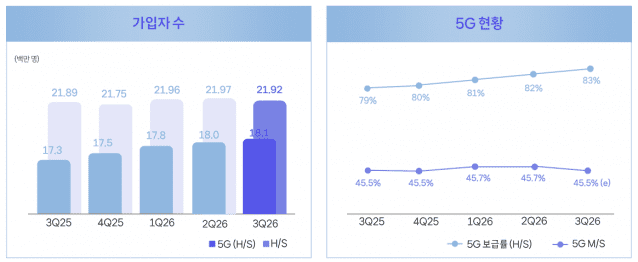
The number of 5G subscribers increased 4.8% year on year to 18,090,000. The 5G penetration rate among all mobile phone subscribers reached 83%.
Average revenue per user (ARPU) rose 0.7% from the previous quarter to 29,297 won.
Fixed-line telecommunications revenue increased 7.4% year on year to 305.5 billion won, supported by growth in high-speed internet subscribers to 7,383,000.
Pay-TV revenue totaled 476.2 billion won, while enterprise business revenue was 278.8 billion won.
SK Broadband also recorded revenue of 1.1728 trillion won and operating profit of 134.7 billion won, supported by fixed-line telecommunications business growth and cost efficiencies. Operating profit increased 51% year on year.
AIDC revenue rises 6.2%, with plans for at least 318 MW from 2030 onward
In the AI business, AIDC and AI services for enterprise and consumer customers continued to grow.
Third-quarter AIDC revenue increased 6.2% year on year to 126.1 billion won, supported by higher data center utilization and increased submarine cable traffic. Revenue declined 7.4% from the previous quarter, partly because of a gap in GPU-as-a-service (GPUaaS) revenue during the transition to new long-term contracts.
Revenue from AI businesses serving enterprise and consumer customers totaled 70 billion won, up 27.3% year on year and 14.2% from the preceding quarter. New cloud business orders drove growth.
The company also established an operating structure to expand its AIDC business. It launched SK Hyper in July and SK Horizon in August, separating business development from infrastructure operations. SK Telecom is responsible for overall business strategy, risk management and global cooperation.
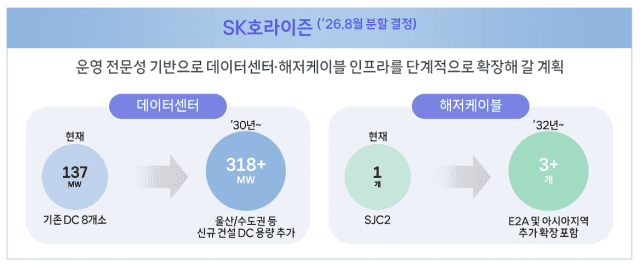
SK Horizon currently operates 137 MW of infrastructure across eight data centers. It plans to add approximately 180 MW of new data centers in locations including Ulsan and the capital region, expanding total capacity to at least 318 MW from 2030 onward.
The submarine cable business is also expected to expand from the current single SJC2 project to at least three projects from 2032 onward, including E2A and additional projects in Asia.
SK Hyper is discussing business terms with potential customers, focusing on Ulsan. Once customers are secured, it intends to begin infrastructure development using sites already obtained.
SK Telecom plans to apply its proprietary AI foundation model to A. and workplace AI services and expand the AI service ecosystem through participation in Moduui AI.
The third-quarter dividend was set at 830 won per share, unchanged from the first and second quarters.
Park Jong-seok, SK Telecom's chief financial officer, said, “With telecommunications and AI as our two main businesses, we were able to achieve both recovery and growth.” Park added, “We will continue working to increase synergies by connecting the telecommunications and AI businesses through a single growth strategy.”
Original Korean article: ZDNet Korea
English brief by Korea Wind Intelligence, koreawindintel.com

















