

Domestic line conversions for ESS production, greater manufacturing capacity and more orders
Competition among the three battery manufacturers has intensified for the third energy storage system (ESS) central contract market tender, which involves 2 trillion won in government funding. Industry attention is focused on whether SK On will make its presence felt again in the third round after recovering from a complete defeat in the first round to secure 50.3% of volumes in the second.
According to industry sources on October 27, behind the order wins are what the report describes as structural shortcomings: a lack of transparency over recognized fire safety certifications representing market standards, and hastily converted production lines rather than a dedicated mass-production plant.
Criticism of reliance on ternary batteries and the transition to LFP and ESS
The report identifies the most serious issue as the company's inability to clearly present certification under global fire safety standards that have become the benchmark for the ESS market. This contrasts with rival Samsung SDI, which has highlighted major standards including UL certification based on its proprietary fire suppression technology, and LG Energy Solution, which has passed the international UL9540A standard and large-scale fire testing (LSFT), raising safety standards for the public grid.
This has prompted criticism that a battery manufacturer's inability to disclose the specific certification standards demonstrating fire safety in a national backbone grid tender may indicate a weak basis for safety verification.
The report attributes SK On's lag in safety certification and technological competitiveness largely to missing the opportunity to restructure its business while remaining focused on ternary batteries for electric vehicles. While competitors established LFP-based ESS product ranges early, emphasizing low costs and safety, SK On concentrated on NCM batteries without the capacity to diversify its portfolio amid overseas expansion spending and accumulated losses, according to the report.
By the time SK On belatedly joined LFP development, competitors had already obtained recognized safety certifications and accumulated more than 10 years of long-life performance data. The report argues that SK On had far too little time to validate its technology.
Concerns over component and cost competitiveness as SK On retains pouch cells
There are also limitations associated with form factor. The global ESS market is showing a clear preference for prismatic batteries, whose rigid outer cases provide durability and make gas venting easier to control during a fire. Their rigid aluminum cases resist external impacts, and venting valves provide strong fire safety performance in large-capacity ESS. However, the metal cases add weight, reducing energy density, while standardized dimensions limit internal space utilization.
SK On, by contrast, continues to use the pouch form factor. Pouch batteries are wrapped in thin film, making them lightweight and space-efficient and facilitating high energy density within the same volume. However, their thin outer walls make them vulnerable to swelling when heat develops, requiring additional safety structures to control it. Their vulnerability to external impacts also makes cost increases from reinforcement frames and additional cooling equipment at the module and pack levels unavoidable, the report argues. It also describes more complex module assembly as a structural disadvantage in price and fire-control competition with Chinese prismatic LFP batteries.
The report interprets SK On's continued use of pouch cells as a way to immediately use the distinctive manufacturing equipment and mass-production expertise it has accumulated since its establishment. With substantial capital expenditure and accumulated losses, converting existing electric vehicle pouch-cell production lines is considered a practical way to respond quickly to the market. The report also suggests that the company intends to defend its cost competitiveness by optimizing packaging design using its proprietary pouch-cell process technology.
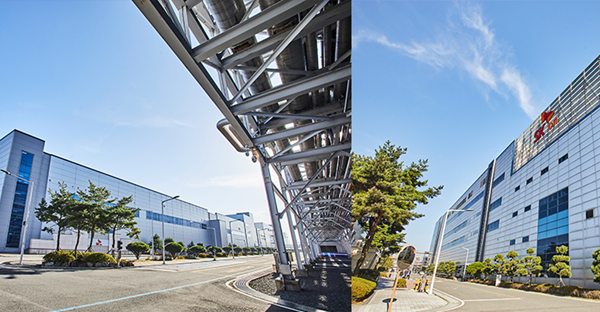
Questions over its track record, meaning actual production and successful delivery and operation of products supplied from a completed dedicated mass-production line, are another issue. While Samsung SDI and LG Energy Solution have spent years validating yields and processes at dedicated lines in South Korea and overseas, SK On has no new dedicated plant and remains in a transitional phase, converting lines at its existing electric vehicle battery plants in Seosan, South Chungcheong Province, and Georgia in the United States. Some industry participants continue to express concern that aggressively expanding orders before mass-production validation is complete could lead to delivery delays or unstable initial yields.
Some industry participants view SK On's second-round order wins as closer to the result of aggressive pricing tailored to tender guidelines and volume allocation than proof of technological strength and superior quality. From the third tender, scoring is being strengthened substantially for both the industrial and economic contribution criterion, which examines domestic sourcing by material, and the fire and facility safety criterion. This has led to expectations that pricing or sales capabilities alone will not be enough to repeat its second-round success without demonstrating its technology.
Competing through domestic sourcing of L&F cathode materials and GridOn
Nevertheless, SK On's strategy is to compete by emphasizing the domestic production and localized core-component supply chain that proved effective in the second tender. It plans to complete the conversion of approximately 3 GWh of its Seosan plant's 7 GWh production lines into dedicated ESS LFP lines by the end of 2026. It also aims to obtain the highest score for industrial and economic contribution by sourcing all core materials from domestic suppliers, including LFP cathode materials from L&F, electrolyte and separators.
On technology, SK On intends to compete directly with rivals through its next-generation ESS brand, GridOn. It plans to address fire concerns by applying advanced safety solutions, including an electrochemical impedance spectroscopy (EIS) state-estimation system that diagnoses internal battery resistance and reaction characteristics in real time, and a dual-valve coolant-based fire suppression system. It also plans to highlight its architecture shared across direct-current (DC) and alternating-current (AC) blocks, alongside the technology of its next-generation GridOn Gen2 model, which increases energy density by 15%, during tender evaluations.
SK On cites large US orders and rejects criticism as unfounded
SK On strongly rejects criticism that its physical products and safety validation are inadequate, calling it unfounded disparagement. It says successive large orders from global customers, including Flatiron in the United States for 1 GWh and NeoVolta Power for up to 18 GWh, as well as South Korea's KPX, demonstrate the quality of its products and technology.
“KPX and global customers would not entrust projects worth hundreds of billions of won to a company without product capabilities or technology,” an SK On representative said. “We also rigorously pass and properly obtain fire safety certifications in line with product delivery requirements.”
Explaining why specific certification standards were not disclosed, the representative said: “Safety standards and certification systems vary considerably by country and product, and company confidentiality rules make it difficult to disclose every certification detail externally.”
Responding to concerns about mass production following factory conversions, the representative said: “It is true that we are converting lines at the Seosan and Georgia plants because our full-scale commercial ESS supply began somewhat later than our competitors', but this is a strategic measure to keep pace with a rapidly changing market. Starting with deliveries to US projects at the end of 2026, we will supply the government's long-duration tender volumes in the first half of 2027 without disruption, demonstrating our product capabilities and earning market confidence.”
Original Korean article: SR Times
English brief by Korea Wind Intelligence, koreawindintel.com

















